Productivity limits and potentials of the principles of conservation agriculture (original) (raw)
Abstract
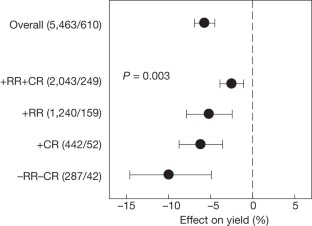
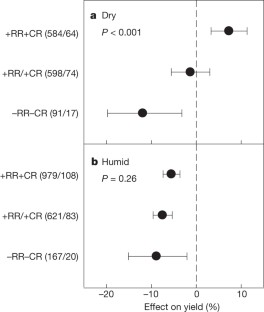
One of the primary challenges of our time is to feed a growing and more demanding world population with reduced external inputs and minimal environmental impacts, all under more variable and extreme climate conditions in the future1,2,3,4. Conservation agriculture represents a set of three crop management principles that has received strong international support to help address this challenge5,6, with recent conservation agriculture efforts focusing on smallholder farming systems in sub-Saharan Africa and South Asia7. However, conservation agriculture is highly debated, with respect to both its effects on crop yields8,9,10 and its applicability in different farming contexts7,11,12,13. Here we conduct a global meta-analysis using 5,463 paired yield observations from 610 studies to compare no-till, the original and central concept of conservation agriculture, with conventional tillage practices across 48 crops and 63 countries. Overall, our results show that no-till reduces yields, yet this response is variable and under certain conditions no-till can produce equivalent or greater yields than conventional tillage. Importantly, when no-till is combined with the other two conservation agriculture principles of residue retention and crop rotation, its negative impacts are minimized. Moreover, no-till in combination with the other two principles significantly increases rainfed crop productivity in dry climates, suggesting that it may become an important climate-change adaptation strategy for ever-drier regions of the world. However, any expansion of conservation agriculture should be done with caution in these areas, as implementation of the other two principles is often challenging in resource-poor and vulnerable smallholder farming systems, thereby increasing the likelihood of yield losses rather than gains. Although farming systems are multifunctional, and environmental and socio-economic factors need to be considered14,15,16, our analysis indicates that the potential contribution of no-till to the sustainable intensification of agriculture is more limited than often assumed.
This is a preview of subscription content, access via your institution
Access options
Subscribe to this journal
Receive 52 print issues and online access
$199.00 per year
only $3.83 per issue
Buy this article
- Purchase on SpringerLink
- Instant access to the full article PDF.
USD 39.95
Prices may be subject to local taxes which are calculated during checkout
Additional access options:
Figure 1: Comparison of yield in no-till versus conventional tillage systems in relation to the other two principles of conservation agriculture.
The alternative text for this image may have been generated using AI.
Figure 2: Comparison of rainfed crop yield in no-till versus conventional tillage systems in relation to the other two principles of conservation agriculture as a function of climate.
The alternative text for this image may have been generated using AI.
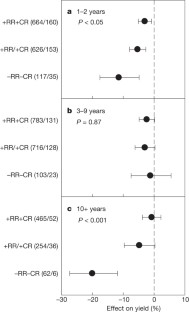
Figure 3: Comparison of yield in no-till versus conventional tillage systems in relation to the other two principles of conservation agriculture over time.
The alternative text for this image may have been generated using AI.
References
- Foley, J. A. et al. Solutions for a cultivated planet. Nature 478, 337–342 (2011)
Article ADS CAS Google Scholar - Lobell, D. B. et al. Prioritizing climate change adaptation needs for food security in 2030. Science 319, 607–610 (2008)
Article CAS Google Scholar - Godfray, H. C. J. & Garnett, T. Food security and sustainable intensification. Phil. Trans. R. Soc. B 369, 20120273 (2014)
Article Google Scholar - Tilman, D., Balzer, C., Hill, J. & Befort, B. L. Global food demand and the sustainable intensification of agriculture. Proc. Natl Acad. Sci. USA 108, 20260–20264 (2011)
Article ADS CAS Google Scholar - FAO. Save and Grow: A Policymaker’s Guide to the Sustainable Intensification of Smallholder Crop Production 1–37 (FAO, 2011)
- Hobbs, P. R., Sayre, K. & Gupta, R. The role of conservation agriculture in sustainable agriculture. Phil. Trans. R. Soc. B 363, 543–555 (2008)
Article Google Scholar - Stevenson, J. R., Serraj, R. & Cassman, K. G. Evaluating conservation agriculture for small-scale farmers in sub-Saharan Africa and South Asia. Agric. Ecosyst. Environ. 187, 1–10 (2014)
Article Google Scholar - Giller, K. E., Witter, E., Corbeels, M. & Tittonell, P. Conservation agriculture and smallholder farming in Africa: the heretics’ view. Field Crops Res. 114, 23–34 (2009)
Article Google Scholar - Rusinamhodzi, L. et al. A meta-analysis of long-term effects of conservation agriculture on maize grain yield under rain-fed conditions. Agron. Sust. Dev. 31, 657–673 (2011)
Article Google Scholar - Brouder, S. M. & Gomez-Macpherson, H. The impact of conservation agriculture on smallholder agricultural yields: a scoping review of the evidence. Agric. Ecosyst. Environ. 187, 11–32 (2014)
Article Google Scholar - Andersson, J. A. & Giller, K. E. in Contested Agronomy: Agricultural Research in a Changing World (eds Sumberg, J. & Thompson, J. ) Ch. 2 22–46 (Earthscan, 2012)
Google Scholar - Giller, K. E. et al. A research agenda to explore the role of conservation agriculture in African smallholder farming systems. Field Crops Res. 124, 468–472 (2011)
Article Google Scholar - Friedrich, T., Derpsch, R. & Kassam, A. Overview of the global spread of conservation agriculture. Field Actions Sci. Rep. 6, 1941 (2012)
Google Scholar - Godfray, H. C. et al. Food security: the challenge of feeding 9 billion people. Science 327, 812–818 (2010)
Article ADS CAS Google Scholar - Sachs, J. et al. Monitoring the world’s agriculture. Nature 466, 558–560 (2010)
Article ADS CAS Google Scholar - Palm, C., Blanco-Canqui, H., DeClerck, F., Gatere, L. & Grace, P. Conservation agriculture and ecosystem services: An overview. Agric. Ecosyst. Environ. 187, 87–105 (2014)
Article Google Scholar - Erenstein, O., Sayre, K., Wall, P., Hellin, J. & Dixon, J. Conservation agriculture in maize- and wheat- based systems in the (sub)tropics: lessons from adaptation initiatives in South Asia, Mexico, and Southern Africa. J. Sustain. Agric. 36, 180–206 (2012)
Article Google Scholar - Grassini, P. & Cassman, K. G. High-yield maize with large net energy yield and small global warming intensity. Proc. Natl Acad. Sci. USA 109, 1074–1079 (2012)
Article ADS CAS Google Scholar - Corbeels, M. et al. Understanding the impact and adoption of conservation agriculture in Africa: a multi-scale analysis. Agric. Ecosyst. Environ. 187, 155–170 (2014)
Article Google Scholar - Serraj, R. & Siddique, K. H. M. Conservation agriculture in dry areas. Field Crops Res. 132, 1–6 (2012)
Article Google Scholar - International Center for Research in the Dry Areas (ICARDA) Geoinformatics Unit. http://gu.icarda.org/en/ (2014)
- Cook, B. I., Smerdon, J. E., Seager, R. & Coats, S. Global warming and 21st century drying. Clim. Dyn (in the press)
- Dai, A. Increasing drought under global warming in observations and models. Nature Clim. Change 3, 52–58 (2013)
Article ADS Google Scholar - Farooq, M., Flower, K. C., Jabran, K., Wahid, A. & Siddique, K. H. M. Crop yield and weed management in conservation agriculture. Field Crops Res. 117, 172–183 (2011)
Google Scholar - Govaerts, B. et al. Conservation agriculture and soil carbon sequestration: between myth and farmer reality. Crit. Rev. Plant Sci. 8, 97–122 (2009)
Article Google Scholar - Erenstein, O. Crop residue mulching in tropical and semi-tropical countries: an evaluation of residue availability and other technological implications. Soil Tillage Res. 67, 115–133 (2002)
Article ADS Google Scholar - Hijmans, R. J., Cameron, S. E., Parra, J. L., Jones, P. G. & Jarvis, A. Very high resolution interpolated climate surfaces for global land areas. Int. J. Climatol. 25, 1965–1978 (2005)
Article Google Scholar - UNEP. World Atlas of Desertification, 2nd edn (eds Middleton, N. & Thomas, D. ) (Edward Arnold, 1997)
- Hedges, L. V., Gurevitch, J. & Curtis, P. S. The meta-analysis of response ratios in experimental ecology. Ecology 80, 1150–1156 (1999)
Article Google Scholar - Adams, D. C., Gurevitch, J. & Rosenberg, M. S. Resampling tests for meta-analysis of ecological data. Ecology 78, 1277–1283 (1997)
Article Google Scholar - R Core Team. R: A Language and Environment for Statistical Computing. http://www.R-project.org (R Foundation for Statistical Computing, 2013)
- Canty, A. & Ripley, B. boot: Bootstrap R (S-Plus) Functions. R package v.1.3-11. (2014)
Acknowledgements
We are grateful to the National Key Science and Technology Project of China for supporting X.Q.L. with grant number 2014ZX07101-012.
Author information
Author notes
- Cameron M. Pittelkow
Present address: Present address: Department of Crop Sciences, University of Illinois, Urbana, Illinois 61801, USA., - Cameron M. Pittelkow and Xinqiang Liang: These authors contributed equally to this work.
Authors and Affiliations
- Department of Plant Sciences, University of California, Davis, 95616, California, USA
Cameron M. Pittelkow, Bruce A. Linquist, Mark E. Lundy & Chris van Kessel - College of Environmental and Resource Sciences, Zhejiang University, Hangzhou, 310058, China
Xinqiang Liang - Center for Ecosystem Science and Society, Northern Arizona University, Flagstaff, 86011, Arizona, USA
Kees Jan van Groenigen & Natasja van Gestel - Department of Environmental Systems Science, Swiss Federal Institute of Technology, ETH-Zurich, Zurich 8092, Switzerland,
Juhwan Lee & Johan Six - United States Department of Agriculture, Agricultural Research Service, Soil and Water Management Unit, St Paul, Minnesota 55108, USA,
Rodney T. Venterea - Department of Soil, Water, and Climate, University of Minnesota, St Paul, 55108, Minnesota, USA
Rodney T. Venterea
Authors
- Cameron M. Pittelkow
- Xinqiang Liang
- Bruce A. Linquist
- Kees Jan van Groenigen
- Juhwan Lee
- Mark E. Lundy
- Natasja van Gestel
- Johan Six
- Rodney T. Venterea
- Chris van Kessel
Contributions
C.v.K., B.A.L., and X.Q.L. conceived the project. All authors contributed to the literature search, except N.v.G. and R.T.V. C.M.P., X.Q.L., J.L., K.J.v.G., B.A.L., and M.E.L. extracted data from publications and contributed to construction of the database. C.M.P., X.Q.L., K.J.v.G., and N.v.G. conducted analyses. C.M.P. and X.Q.L. wrote the manuscript draft and all authors contributed to interpretation of the results and writing of the final paper.
Corresponding author
Correspondence toCameron M. Pittelkow.
Ethics declarations
Competing interests
The authors declare no competing financial interests.
Extended data figures and tables
Supplementary information
PowerPoint slides
Rights and permissions
About this article
Cite this article
Pittelkow, C., Liang, X., Linquist, B. et al. Productivity limits and potentials of the principles of conservation agriculture.Nature 517, 365–368 (2015). https://doi.org/10.1038/nature13809
- Received: 20 May 2014
- Accepted: 29 August 2014
- Published: 22 October 2014
- Issue date: 15 January 2015
- DOI: https://doi.org/10.1038/nature13809
This article is cited by
Comments
Commenting on this article is now closed.
- Hwat-Bing So 15 January 2015, 08:30
We (Cons Agric researchers and practitioners from 3 continents) wish to express our concern over the misleading message that the Letter by Pittekow et al., is sending to the readers, specifically to the non-specialists and policy makers. This message promotes a perception that Conservation Agriculture (CA) has failed as a tool to improve crop yields. This misleading message was clearly taken up by some of the press releases listed in the ?article metrics? of this letter and in the accompanying Editors summary.
In fact, no-till practice initially was not intended as a tool to improve productivity (yield), but rather to combat soil degradation from mechanical cultivation associated with the loss of surface soil (erosion)(1,2), organic matter(2) (oxidation associated with increased aeration) and compaction (from tractor weight and implement action) which results in yield declines (associated with reduced fertility and water infiltration). Therefore the adoption of no-till (which include residue retention) should arrest this yield decline and when (later) combined with crop diversification, became conservation agriculture to promote the sustainability of farming operation. It has been widely adopted globally for these reasons. It is expected that soil organic matter and fertility will be returned and yield improved over time(2), but how long this process will take and whether it will return productivity is a complex, not well understood process and will depend on the amount of surface residue left (related to yield and crop rotation), soil properties and state of degradation, and the prevailing climatic conditions (rainfall, evaporation and temperature). This is quite different from claiming that CA is intended as a tool for improving productivity. However, CA is an essential tool to arrest soil degradation, improve soil quality and, ensure that cropping can remain sustainable into the foreseeable future (3). Long term yield stability and increases; and improved ecosystem services would be a bonus.
Despite our critique, the authors should be commended on conducting such a large study (610 studies with 5000+ paired observations across 48 crops and 63 countries, with a bias of approximately 50% US data). Unfortunately the meta-analysis is largely limited to a statistical analysis of yield data with very little mechanistic explanations of cause and effect, necessary to make sense of the data collected across such a wide range of conditions. (4) The letter failed to take account of the effect of soil and crop types and we can only assume that the study considered that there is no effect of soil and crop types which is incorrect and unacceptable.
In the accompanying dataset we noticed that not only was the amount of observations different than that stated in the paper(differences were not clarified, hence it would be difficult to replicate the analysis) but there were also observations with zero values for both conventional and no-till yields. Further, we noticed extreme values were left in the dataset where the authors of the cited papers admitted to crop failures. Retention of these values would favour the statistical significance observed by the authors. Furthermore, results could be biased towards US conditions.
We believe there were missed opportunities for a more comprehensive analysis using an explicit scientific framework. A simple conceptual framework would have predicted some of the results from their analysis and the database could have been used to confirm some of the theoretical and empirical aspects of CA.
Experimentally, no-till can be isolated from residue retention, but in realistic farm practice no-till is automatically accompanied by residue retention except when there are competing uses for residues such as animal feed in some developing countries (5). Erosion losses can be reduced by 70-90% of that from bare ground by retaining a 40% ground/residue cover (6) and this is particularly relevant on sloping lands which are increasingly used in developing countries. This was not made clear and the use of no-till with no residue cover (as used in this article) is inappropriate except for experimental purposes.
References cited:
1.	Gonzalez-Sanchez, E.J., Veroz-Gonzalez, O., Blanco-Roldan, G.L., Marquez-Garcia, F. and Carbonell-Bojolo, R. A renewed view of conservation agriculture and its evolution over the last decade in Spain. Soil and Tillage Research 146: 204- 212.(2014)
2.	Corsi, Sandra, Friedrich, T., Kassam, A.H., Pisante, Michele and Moraes S�, Jo�o de. Soil Organic Carbon Accumulation and Greenhouse Gas Emission Reductions from Conservation Agriculture: a literature review. Integrated Crop Management Vol.16. FAO, Rome, Italy (2012)
3.	Jat, R.A., Sahrawat, K.L. and Kassam, A.H. (Eds). Conservation Agriculture: Global Challenges and Prospects. CABI, UK. 324 pp. (2013).
4.	Brouder, S.M. and Gomez-Macpherson, H. The impact of conservation agriculture on smallholder agricultural yields: A scoping review of the evidence. Agriculture, Ecosystems & Environment 187:11?32 (2014)
5.	Richards, Meryl, Sapkota, T., Stirling, Clare, Thierfelder, C., Verhulst, Nele, Friedrich, T. and Kienzle, J. Overview of Conservation Agriculture. FAO Practice Brief September 201 (2014).
6.	USDA: Revised Universal Soil Loss Equation. efotg.sc.egov.usda.gov/refe...
Contributing authors:
Hwat-Bing So (corresponding author), Adjunct Professor (Soil Physics and Management), Environmental Futures Centre, Griffith University, Nathan, Q 4111, Australia – h.so@griffith.edu.au; Ph : +61423333750
Don C Reicosky, Soil Scientist, Emeritus, Morris, MN USA 56267- don.reicosky@gmail.com; Ph: 1-320-287-2314
Rolf Derpsch, International Consultant for Conservation Agriculture/No-till, C.C. 13223 Shopping del Sol, Asunci�n, Paraguay- rolf.derpsch@gmail.com, Ph: +59521609717
Amir Kassam, Moderator, Conservation Agriculture Community of Practice (CA-CoP), Food and Agriculture Organization (FAO) of the United Nations, Rome, Italy – amirkassam786@googlemail.com ; Ph: +44(0)7768011313
Tom Goddard, Senior Policy Advisor, Alberta Agriculture and Rural Development #206, 7000 – 113 St., Edmonton, Alberta, Canada T6H 5T6 – tom.goddard@gov.ab.ca; Ph : 780-427-3067
Howard Buffett, CA Farmer, Howard G. Buffett Foundation, Decatur, Illinois, USA. hgb@hgbfoundation.org ; Ph : 1-217-429-3715
2. Chandrika Tilakarathna 20 January 2015, 22:16
Apply microbes to fix yield issues in no-till farming
Conservation agriculture has been accepted internationally as a sustainable production system with increased profits and food security while preserving and enhancing the resources and the environment for future global food security challenges. It is based on three crop management practices; no-till farming, permanent soil cover by crop residues or cover crops, and crop rotation. However, uncertainty of crop yields in no-till farming has made it to much debate on its suitability for future crop production. Importantly, when no-till is combined with the other two conservation agriculture principles of residue retention and crop rotation, its negative impacts are minimized (see Nature 517, 365-368; 2015). It is important to note here that the residue retention and the crop rotation contribute to improved crop production through reinstating microbial diversity in degraded soils. Then, the question arises here is that, why do not we apply directly beneficial microbes to the soil, rather than manipulating relatively less efficient plant components to reinstate sustainability, which takes a prolong period?
Direct application of microbes or microbial communities in biofilm mode has been shown to start restoring depleted tropical cropland soils, soon after their application, within 1?2 months, with better yields (see for e.g. Soil Biol. Biochem. 43, 1059?1062; 2011; Buddhika, U. V. A. et al. in Microbial Bioresources (eds Gupta, V. K., Thangdurai, D. & Sharma, G. D.), CABI Publications (in press). Interestingly, such practices have shown that they can produce equal or even relatively high, consistent yields with only 50% of recommended chemical fertilisers in several crops, in comparison to 100% of the fertilisers, from the first year of their application. In addition, they contribute to increased soil carbon sequestration and reduced greenhouse gas emission, which lead to mitigate global warming. In fact, if microbial application would be adopted in no-till farming, that would allow farmers to harvest a better crop, even from the onset of restoration of the deteriorated lands, without letting them to wait till the soil gets improved.
Gamini Seneviratne* & Chandrika Tilakarathna
National Institute of Fundamental Studies, Kandy, Sri Lanka. * gaminis@ifs.ac.lk
3. Howard Buffett 2 February 2015, 11:32
We (Theodor Friedrich, Michele Pisante, Wolfgang G. Sturny, Sandra Corsi and Howard Buffet), a group of international scientists with considerable experience in Conservation Agriculture research and practice, would like to express our concern on the results and conclusions made by the authors of the above paper. First of all it calls our attention to the use of the term Conservation Agriculture (CA) in the title while their analysis is based mainly on the no-tillage technology, which is only a part of CA. In this respect our main concern is the lack of an internationally accepted definition of no-tillage which makes the results of such a meta-analysis on this topic questionable. In this context the Pittelkow paper is ignoring at least two publications which had been published prior to its finalization, addressing methodological flaws which are repeated in the paper.
The transition phase from tillage-based agriculture (TA) to CA is crucial and delicate (Knowler and Bradshaw, 2007). Usually the full benefits of CA and the rehabilitation of soil-related ecosystem functions can take time (three to seven years (Sturny et al., 2007) may be needed for all the benefits to take hold) and, the initial transition years may pose issues which can influence farmers to leave the CA practices (Stagnari et al., 2014).
If in this communication we are referring especially to one publication (Derpsch et al., 2014), it is because the theme about the lack of standards in tillage terminology has not been addressed in this way by other authors.
The reality: ?Worldwide literature on yield and environmental performance of no-tillage systems is inconsistent and even contradictory. In many cases, inconsistencies can be explained by a lack of common standards in how experiments in tillage systems were performed. Sometimes mulch tillage, reduced tillage, minimum tillage or other methods involving various degrees of soil tillage disturbance are coined no-tillage. This lack of common understanding of what no-tillage systems are plagues research scientists as well as practitioners worldwide? (Derpsch et al., 2014).
?For example, some researchers have found that no-tillage sequesters carbon in the soil (Rasmussen et al., 1980; Kern and Johnson, 1993; West and Post, 2002; Sá and Lal, 2009; González-Sánchez et al., 2012), while others contend no effect or contradictory results (Baker et al., 2007; Blanco-Canqui and Lal, R. 2008), leading to major confusion in the research community as to the true effect of tillage systems on a key environmental response? (Derpsch et al., 2014).
It is important to consider that ?depending on how no-tillage research is conducted, different results will be obtained in terms of soil carbon sequestration, soil moisture retention, seed germination / plant establishment, weed infestation, soil fertility, soil biological activity, and crop yields. It is imperative to profoundly understand the no-tillage system before implementing it or attempting to research the system? (Derpsch et al., 2014).
?Unfortunately it has become a common practice of using laconic, non-des criptive statements in the materials and methods section of publications (e.g. ?the experiment included three tillage treatments, conventional, minimum and no-tillage?) or not describing in detail how the experiment and no-tillage system were carried out? (Derpsch et al., 2014) making it impossible to understand how the research was implemented. It is not enough to define no-tillage just briefly like it is often seen in literature ?the soil was left undisturbed from harvest to planting?.
It has become evident that different research results in no-tillage have frequently not been system specific but rather a consequence of different definitions, technologies and methodologies of no-tillage systems that have been applied (Derpsch et al., 2014).
If a random number of the papers analysed in the Pittelkow et al. meta-analysis would be examined considering the above arguments, it would become evident that:
?	Materials and methods of a great number of papers are not des criptive enough to be able to understand how no-tillage research was conducted and what degree of soil disturbance was involved while seeding, making it impossible to be able to thoroughly understand or replicate the experiments.
?	As long as the deficiencies mentioned above remain, the scientific literature will continue to be filled with inconsistent, controversial and confusing research results about the no-tillage system.
?	It is concluded that the inconsistent and loose use of the word no-tillage in the past by many researchers all over the world and the lack of detailed des criptions in the materials and methods section of publications on no-tillage, will necessarily lead to flawed results when analyzing data of the preceding four decades, especially in the case of meta-analysis, e.g. the Pittelkow et al paper.
The inconsistency in such meta-analyses and the confusion created by such papers have already been discussed and published in a review of meta-analyses on carbon sequestration (Corsi et al., 2012). Considering this publication and the one on the need of better defining no-tillage systems for research purposes (Derpsch et al., 2014), it is surprising that such confusing research work as the paper by Pittelkow et al. is still being undertaken.
References:
Baker, J.M., Ochsner, T.E., Venterea, R.T., Griffis, T.J., 2007. Tillage and soil carbon sequestration – What do we really know? Agric. Ecosyst. Environ. 118, 1-5.
Blanco-Canqui, H., Lal, R., 2008. No-tillage and soil-profile carbon sequestration: An on-farm assessment. Soil Sci. Soc. Am. J. 72, 693-701.
Corsi, S., Friedrich, T., Kassam, A., Pisante, M., de Moraes Sà, J.C., 2012. Soil Organic Carbon Accumulation and Greenhouse Gas Emission Reductions from Conservation Agriculture: A literature review, Integrated Crop Management Vol.16-2012, AGP/FAO, Rome, 101 pp.
Derpsch, R., Franzluebbers, A.J., Duiker, S.W., Reicosky, D.C., Koeller, K., Friedrich, T., Sturny, W.G., Sá, J.C.M, Weiss, K. Why do we Need to Standardize No-tillage Research? Soil & Tillage Research 137, (2014) 16-22
González-Sánchez, E.J., Ordóñez-Fernández, R., Carbonell-Bojollo, R., Veroz-González, O., Gil-Ribes, J.A., 2012. Meta-analysis on atmospheric carbon capture in Spain through the use of conservation agriculture. Soil Tillage Res. 122, 52-60.
Kern, J.S., Johnson, M.G., 1993. Conservation tillage impacts on national soil and atmospheric carbon levels. Soil Sci. Soc. Am. J. 57, 200-210.
Knowler, D., Bradshaw, B., 2007. Farmers? adoption of conservation agriculture: areview and synthesis of recent research. Food Policy 32, 25?48.
Rasmussen, P.E., Allmaras, R.R., Rohde, C.R., Roager, N.C., 1980. Crop residue influences on soil carbon and nitrogen in a wheat-fallow system. Soil Sci. Soc. Am. J. 44, 596-600.
Sá, J.C.M., Lal, R., 2009. Stratification ratio of soil organic matter pools as an indicator of carbon sequestration in a tillage chrono sequence on a Brazilian Oxisol. Soil Tillage Res. 103, 46-56.
Stagnari F., Galieni A., Speca S., Cafiero G., Pisante M. (2014). Effects of straw mulch on growth and yield of durum wheat during transition to Conservation Agriculture in Mediterranean environment. Field Crops Research, 167: 51?63.
Sturny, W.G., Chervet, A., Maurer-Troxler, C., Ramseier, L., Müller, M., Schafflützel, R., Richner. W., Streit, B., Weisskopf, P., Zihlmann, U., 2007. Comparison of no-tillage and conventional plough tillage ? a synthesis. AGRARForschung 14 (8): 350-357.
West, T.O., Post, W.M., 2002. Soil organic carbon sequestration rates by tillage and crop rotation: A global data analysis. Soil Sci. Soc. Am. J. 66, 1930-1946.
Contributing authors:
Dr. Theodor Friedrich, FAO Representative Cuba, theodor.friedrich@fao.org
Prof. Michele Pisante, Professor, Chair, Agronomy and crop sciences research and education center, University of Teramo, mpisante@unite.it
Dr. Wolfgang G. Sturny, Swiss-No-till, sturny@no-till.ch
Dr. Sandra Corsi, FAO Rome, sandra.corsi@gmail.com
Howard Buffett, CA Farmer, Howard G. Buffett Foundation, Decatur, Illinois, USA. hgb@hgbfoundation.org
4. Yaxian Hu 27 May 2015, 05:28
We, Nikolaus J. Kuhn and Yaxian Hu, from the University of Basel, Switzerland, would like to express further serious doubt about the results of Pittelkow et al. 2014, because the global averaging of data generated by plot and field scale experiments ignores several relevant spatial and temporal factors. First, unless weighed by the geographic area an individual study applies to, the effects of conservation agriculture on global crop yield cannot be assessed properly. For instance, 42% of Pittelkow et al. 2014 study sites are located in drylands, over-representing global drylands which include only approximately 30% of global croplands (FAO, 2008). Furthermore, global averages just account for average food production, but devalue the annually varying benefits of conservation agriculture in drylands. Increased yields in drylands with conservation tillage have been acknowledged by Pittelkow et al. 2014, but not fully appreciated with regards to food security. The benefits of conservation agriculture on crop yields is of particular significance during dry years when famine in drylands is not caused by lack of global (average) production, but regional access to affordable food after poor harvests (Cavatassi et al., 2011). Reducing the number of years with crop yields below a critical threshold of regional food supply is therefore equally relevant for food security in drylands than average global yields (Kuhn et al., 2015). Finally, conservation agriculture protects soils, e.g. by reducing soil erosion (e.g., Wang et al. (2008). Therefore, even if conservation tillage currently just maintains crop yields, the practice represents a significant contribution to sustainable food production through protecting the producing land itself (e.g., Shi and Shao, 2000; Schiettecatte et al., 2005). Overall, in the light of the actual spatial and temporal dimensions of conservation tillage impacts on crop yields, conclusions drawn from oversimplifying meta-studies like the one of Pittelkow et al. 2014, based on one global average, carry the serious risk of contributing to poorly-researched policy development and agricultural practice.
Literature cited:
Cavatassi, R., Lipper, L. and Narloch, U.: Modern variety adoption and risk management in drought prone areas: insights from the sorghum farmers of eastern Ethiopia, Agric. Econ., 42(3), 279?292, doi:10.1111/j.1574-0862.2010.00514.x, 2011.
FAO, C. D. R., Natural Resources Management and Environment Department: Chapter 1. Drylands, People and Land use, in Water and Cereals in Drylands, pp. 5?15, Rome., 2008.
Kuhn, N. J., Hu, Y., Bloemertz, L., Xiao, L., He, J., Li, H. and Greenwood, P.: Conservation Tillage: Food Security, Yes; Carbon Sequestration, No? --- 20 years observations on the Chinese Loess Plateau, European Geosciences Union General Assembly, Vienna., 2015.
Schiettecatte, W., Ke Jin, Yao, Y., Cornelis, W. M., Junjie Lu, Huijun Wu, Verbist, K., Dianxiong Cai, Gabriels, D. and Hartmann, R.: Influence of simulated rainfall on physical properties of a conventionally tilled loess soil, Catena, 64(2-3), 209?221, doi:10.1016/j.catena.2005.08.017, 2005.
Shi, H. and Shao, M.: Soil and water loss from the Loess Plateau in China, J. Arid Environ., 45(1), 9?20, doi:10.1006/jare.1999.0618, 2000.
Wang, X., Gao, H., Tullberg, J. N., Li, H., Kuhn, N. J., Mchugh, A. and Li, Y.: Traffic and tillage effects on runoff and soil loss on the Loess Plateau of northern China, Soil Res., 46(8), 667?675, 2008.