Small particles dominate Saturn’s Phoebe ring to surprisingly large distances (original) (raw)
- Letter
- Published: 10 June 2015
Nature volume 522, pages 185–187 (2015)Cite this article
- 3644 Accesses
- 20 Citations
- 261 Altmetric
- Metrics details
Subjects
Abstract
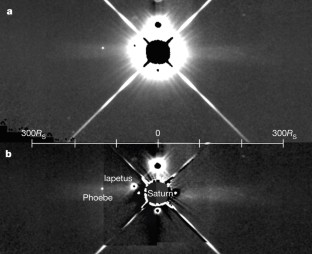
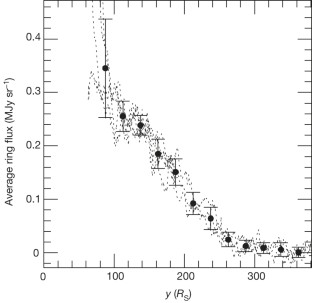
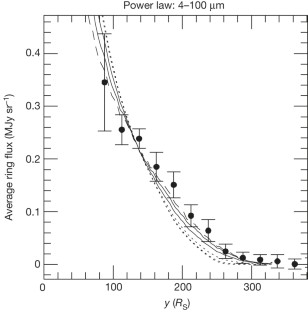
Saturn’s faint outermost ring, discovered in 2009 (ref. 1), is probably formed by particles ejected from the distant moon Phoebe2,3. The ring was detected1 between distances of 128 and 207 Saturn radii (_R_S = 60,330 kilometres) from the planet, with a full vertical extent of 40_R_S, making it well over ten times larger than Saturn’s hitherto largest known ring, the E ring. The total radial extent of the Phoebe ring could not, however, be determined at that time, nor could particle sizes be significantly constrained. Here we report infrared imaging of the entire ring, which extends from 100_R_S out to a surprisingly distant 270_R_S. We model the orbital dynamics of ring particles launched from Phoebe, and construct theoretical power-law profiles of the particle size distribution. We find that very steep profiles fit the data best, and that elevated grain temperatures, arising because of the radiative inefficiency of the smallest grains, probably contribute to the steepness. By converting our constraint on particle sizes into a form that is independent of the uncertain size distribution, we determine that particles with radii greater than ten centimetres, whose orbits do not decay appreciably inward over 4.5 billion years, contribute at most about ten per cent to the cross-sectional area of the ring’s dusty component.
This is a preview of subscription content, access via your institution
Access options
Subscribe to this journal
Receive 51 print issues and online access
$199.00 per year
only $3.90 per issue
Buy this article
- Purchase on SpringerLink
- Instant access to the full article PDF.
USD 39.95
Prices may be subject to local taxes which are calculated during checkout
Additional access options:
Figure 1: WISE Band 4 mosaic of the Phoebe ring.
The alternative text for this image may have been generated using AI.
Figure 2: Measured radial profiles.
The alternative text for this image may have been generated using AI.
Figure 3: Theoretical radial profiles for 4–100 µm size distributions.
The alternative text for this image may have been generated using AI.
Figure 4: Theoretical radial profiles for 4 µm–30 cm size distributions.

The alternative text for this image may have been generated using AI.
References
- Verbiscer, A. J., Skrutskie, M. F. & Hamilton, D. P. Saturn’s largest ring. Nature 461, 1098–1100 (2009).
Article ADS CAS Google Scholar - Burns, J. A., Hamilton, D. P., Mignard, F. & Soter, S. in Physics, Chemistry and Dynamics of Interplanetary Dust (eds Gustafson, B. A. & Hanner, M. S. ) 179–182 (ASP Conference Series, Kluwer, 1996).
Google Scholar - Tamayo, D., Burns, J. A., Hamilton, D. P. & Hedman, M. M. Finding the trigger to Iapetus’ odd global albedo pattern: dynamics of dust from Saturn’s irregular satellites. Icarus 215, 260–278 (2011).
Article ADS Google Scholar - Wright, E. L. et al. The Wide-field Infrared Survey Explorer (WISE): mission description and initial on-orbit performance. Astrophys. J. 140, 1868–1881 (2010).
Google Scholar - Tamayo, D., Hedman, M. M. & Burns, J. A. First observations of the Phoebe ring in optical light. Icarus 233, 1–8 (2014).
Article ADS Google Scholar - Burns, J. A., Lamy, P. L. & Soter, S. Radiation forces on small particles in the solar system. Icarus 40, 1–48 (1979).
Article ADS Google Scholar - Hamilton, D. P. Motion of dust in a planetary magnetosphere: orbit-averaged equations for oblateness, electromagnetic, and radiation forces with application to Saturn’s E ring. Icarus 101, 244–264 (1993).
Article ADS Google Scholar - Hamilton, D. P. Erratum: Motion of dust in a planetary magnetosphere: orbit-averaged equations for oblateness, electromagnetic, and radiation forces with application to Saturn’s E-ring. Icarus 103, 161 (1993).
Article ADS Google Scholar - Hamilton, D. P. & Kruger, H. The sculpting of Jupiter’s gossamer rings by its shadow. Nature 453, 72–75 (2008).
Article ADS CAS Google Scholar - Jontof-Hutter, D. & Hamilton, D. P. The fate of sub-micron circumplanetary dust grains I: Aligned dipolar magnetic fields. Icarus 218, 420–432 (2012).
Article ADS Google Scholar - Jontof-Hutter, D. & Hamilton, D. P. The fate of sub-micron circumplanetary dust grains II: Multipolar fields. Icarus 220, 487–502 (2012).
Article ADS Google Scholar - Gladman, B. et al. Discovery of 12 satellites of Saturn exhibiting orbital clustering. Nature 412, 163–166 (2001).
Article ADS CAS Google Scholar - Hamilton, D. P. Planetary science: Saturn saturated with satellites. Nature 412, 132–133 (2001).
Article ADS CAS Google Scholar - Brooks, S. M., Esposito, L. W., Showalter, M. R. & Throop, H. B. The size distribution of Jupiter’s main ring from Galileo imaging and spectroscopy. Icarus 170, 35–57 (2004).
Article ADS Google Scholar - Brown, M. J. I., Jarrett, T. H. & Cluver, M. E. Recalibrating the Wide-field Infrared Survey Explorer (WISE) W4 filter. Publ. Astron. Soc. Austral. 31, e049 (2014).
Article ADS Google Scholar - Showalter, M. R., de Pater, I., Verbanac, G., Hamilton, D. P. & Burns, J. A. Properties and dynamics of Jupiter’s gossamer rings from Galileo, Voyager, Hubble and Keck images. Icarus 195, 361–377 (2008).
Article ADS Google Scholar - Hedman, M. M., Burns, J. A., Hamilton, D. P. & Showalter, M. R. The three-dimensional structure of Saturn’s E ring. Icarus 217, 322–338 (2012).
Article ADS Google Scholar
Acknowledgements
This publication makes use of data products from the Wide-field Infrared Survey Explorer, which is a joint project of the University of California, Los Angeles, and the Jet Propulsion Laboratory/California Institute of Technology, funded by the National Aeronautics and Space Administration. This research was supported by grants from NASA Outer Planets and Origins (D.P.H.).
Author information
Authors and Affiliations
- Department of Astronomy, University of Maryland, College Park, 20742-2421, Maryland, USA
Douglas P. Hamilton - Department of Astronomy, University of Virginia, Charlottesville, 22904-4325, Virginia, USA
Michael F. Skrutskie & Anne J. Verbiscer - Infrared Processing and Analysis Center, Caltech, Pasadena, 91125, California, USA
Frank J. Masci
Authors
- Douglas P. Hamilton
- Michael F. Skrutskie
- Anne J. Verbiscer
- Frank J. Masci
Contributions
F.J.M. led the development of the WISE Image Atlas products and provided optimally background-matched custom mosaics to support this analysis. M.F.S. and A.J.V. did the image processing and data analysis associated with Figs 1 and 2. D.P.H. performed the analytic calculations, ran the numerical models, and produced the theoretical curves of Figs 3 and 4.
Corresponding author
Correspondence toDouglas P. Hamilton.
Ethics declarations
Competing interests
The authors declare no competing financial interests.
Extended data figures and tables
Extended Data Figure 1 Ring flux in a subset of single (Level 1B) WISE Band 4 (22 μm) exposures.
We organize these nine independent images so that each row contains three images centred at approximately the same ecliptic latitude (vertical direction). For each row, spacecraft orbital precession shifts Saturn in the ecliptic longitude direction so that the planet moves from left to right. The vertical ring extent is about 50 pixels and the horizontal extent exceeds 200 pixels, so even the single exposures can be binned to yield modest signal to noise ratio on the ring.
Extended Data Figure 2 A portion of the WISE Image Atlas frame containing ring emission.
The image is rotated so that ecliptic north is up and east is to the left. In this Atlas Image, the bright emission from Saturn is outside the WISE field of view, but one of its diffraction spikes is visible at top right; processing artefacts to the bottom left and right should be ignored. The ring flux (horizontal stripe) is uncontaminated by Saturn’s scattered light, although the orbital motion of Saturn smears the embedded image of Phoebe into a bright oval. The faint point sources are distant stars and galaxies.
Extended Data Figure 3 A custom WISE Band 4 mosaic produced from selected Level 1B frames.
Each selected Level 1B image was free from significant artefacts from Saturn’s scattered light. The frames have been shifted, offset to a common background level and stacked with trimmed average pixel filtering in Saturn’s frame of reference (so that Phoebe, the point source on the east/left side of the ring, appears unsmeared). Ecliptic north is up and east is to the left. Green lines highlight the regions used for flux extraction.
Extended Data Figure 4 WISE Band 4 images of the star Alpha Tau.
a, Direct image of the star. b, The same image rotated by 90° and subtracted from itself mitigating scattered light. The large blob-shaped artefacts up, down, left and right from the central star are due to the reflection of starlight from the telescope’s internal structure. Significant artefacts from azimuthally asymmetric scattered flux near the star, by contrast, are not evident in the subtracted image b. Residuals after subtraction arise largely from frame offset mismatch and are typically of order 0.2 DN in the image in b (compared with 3 DN for the ring flux at 160_R_S).
Extended Data Figure 5 Examination of background structure.
a, A WISE Band 3 (12 μm) optimally frame-matched mosaic oriented in ecliptic coordinates with north up and east to the left. b, Band 4 (22 μm) optimally frame-matched mosaic. The ring is evident in the middle of the Band 4 image, extending left and right horizontally from the central white over-exposed image of Saturn. The backgrounds are largely uniform, especially in Band 4, with the exception of a north–south gradient characteristic of zodiacal dust emission. Ring flux is not obviously evident in the 12 μm Band 3 exposure.
Extended Data Figure 6 Quantitative analysis of Band 4 background gradient in units of DN.
This figure plots the average background level in DN (vertical axis) row-by-row (horizontal axis) in the Band 4 image shown in Extended Data Fig. 5. The analysis region slightly overlaps the ring flux, which appears as the small bump around line 3300 and establishes the ring plane. The sense of the rotation used in the 90° subtraction carries flux from line numbers 3500–4000 into the ring midplane. Because the DN values are so similar, the bias introduced by the rotation is no greater than 0.1 DN while the inner ring flux is of order 6 DN.
Extended Data Figure 7 Colour composite of the Phoebe ring.
Mosaics of images in WISE Bands 2, 3 and 4 (4.6, 12 and 22 μm) comprise the composite image in ecliptic coordinates. North is up and east is to the left. Scattered light from Saturn forms the bright white circle at the centre of the image and the ring is the faint horizontal bar that cuts across Saturn.
PowerPoint slides
Rights and permissions
About this article
Cite this article
Hamilton, D., Skrutskie, M., Verbiscer, A. et al. Small particles dominate Saturn’s Phoebe ring to surprisingly large distances.Nature 522, 185–187 (2015). https://doi.org/10.1038/nature14476
- Received: 31 October 2014
- Accepted: 02 April 2015
- Published: 10 June 2015
- Issue date: 11 June 2015
- DOI: https://doi.org/10.1038/nature14476
This article is cited by
Spitzer’s Solar System studies of asteroids, planets and the zodiacal cloud
- David E. Trilling
- Carey Lisse
- Anne Verbiscer
Nature Astronomy (2020)
Circumplanetary Dust Populations
- Frank Spahn
- Manuel Sachse
- Mihály Horányi
Space Science Reviews (2019)
Dust Phenomena Relating to Airless Bodies
- J. R. Szalay
- A. R. Poppe
- F. Spahn
Space Science Reviews (2018)
Editorial Summary
A closer look at Saturn's Phoebe ring
Discovered in 2009 by the Spitzer Space Telescope, Saturn's outermost ring is thought to consist mainly of particles from the distant moon Phoebe. New observations from NASA's WISE (Wide-field Infrared Survey Explorer) mission have now provided an infrared image of the entire Phoebe ring. Douglas Hamilton et al. show that the ring spans a region between about 100 and 270 Saturn radii from the planet, well beyond Phoebe's orbit. Small particles dominate the ring, and grain temperatures are elevated because of the radiative inefficiency of the smallest grains.