Large historical growth in global terrestrial gross primary production (original) (raw)
- Letter
- Published: 06 April 2017
- J. A. Berry2,
- U. Seibt3,
- S. J. Smith4,
- S. A. Montzka5,
- T. Launois6 nAff8,
- S. Belviso6,
- L. Bopp6 nAff8 &
- …
- M. Laine7
Nature volume 544, pages 84–87 (2017) Cite this article
- 15k Accesses
- 306 Citations
- 462 Altmetric
- Metrics details
Subjects
Abstract
Growth in terrestrial gross primary production (GPP)—the amount of carbon dioxide that is ‘fixed’ into organic material through the photosynthesis of land plants—may provide a negative feedback for climate change1,2. It remains uncertain, however, to what extent biogeochemical processes can suppress global GPP growth3. As a consequence, modelling estimates of terrestrial carbon storage, and of feedbacks between the carbon cycle and climate, remain poorly constrained4. Here we present a global, measurement-based estimate of GPP growth during the twentieth century that is based on long-term atmospheric carbonyl sulfide (COS) records, derived from ice-core, firn and ambient air samples5. We interpret these records using a model that simulates changes in COS concentration according to changes in its sources and sinks—including a large sink that is related to GPP. We find that the observation-based COS record is most consistent with simulations of climate and the carbon cycle that assume large GPP growth during the twentieth century (31% ± 5% growth; mean ± 95% confidence interval). Although this COS analysis does not directly constrain models of future GPP growth, it does provide a global-scale benchmark for historical carbon-cycle simulations.
This is a preview of subscription content, access via your institution
Access options
Access Nature and 54 other Nature Portfolio journals
Get Nature+, our best-value online-access subscription
$32.99 / 30 days
cancel any time
Subscribe to this journal
Receive 52 print issues and online access
$199.00 per year
only $3.83 per issue
Buy this article
- Purchase on SpringerLink
- Instant access to the full article PDF.
USD 39.95
Prices may be subject to local taxes which are calculated during checkout
Additional access options:
Figure 1: Measurement-based histories of atmospheric COS at South Pole and global sites.
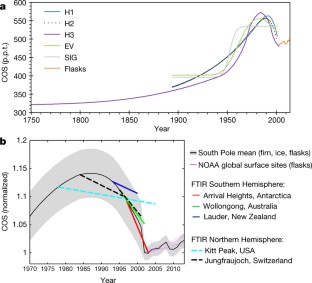
The alternative text for this image may have been generated using AI.
Figure 2: A priori distribution of present-day magnitudes and alternative time trends for components of the global COS budget.
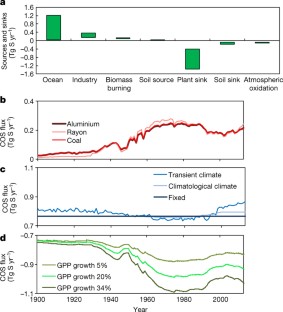
The alternative text for this image may have been generated using AI.
Figure 3: Long-term trends in global atmospheric COS concentrations.
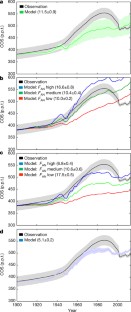
The alternative text for this image may have been generated using AI.
Figure 4: Comparison of carbon/climate models.
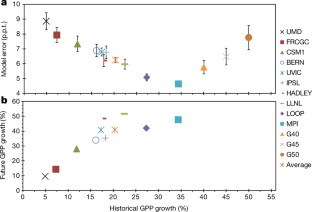
The alternative text for this image may have been generated using AI.
References
- Norby, R. J., Warren, J. M., Iversen, C. M., Medlyn, B. E. & McMurtrie, R. E. CO2 enhancement of forest productivity constrained by limited nitrogen availability. Proc. Natl Acad. Sci. USA 107, 19368–19373 (2010)
Article ADS CAS Google Scholar - Schimel, D., Stephens, B. B. & Fisher, J. B. Effect of increasing CO2 on the terrestrial carbon cycle. Proc. Natl Acad. Sci. USA 112, 436–441 (2015)
Article ADS CAS Google Scholar - Friedlingstein, P. et al. Uncertainties in CMIP5 climate projections due to carbon cycle feedbacks. J. Clim. 27, 511–526 (2014)
Article ADS Google Scholar - Arneth, A. et al. Terrestrial biogeochemical feedbacks in the climate system. Nat. Geosci. 3, 525–532 (2010)
Article ADS CAS Google Scholar - Montzka, S. A. et al. A 350-year atmospheric history for carbonyl sulfide inferred from Antarctic firn air and air trapped in ice. J. Geophys. Res. 109, D22302 (2004)
Article ADS Google Scholar - Field, C. B., Lobell, D. B., Peters, H. A. & Chiariello, N. R. Feedbacks of terrestrial ecosystems to climate change. Annu. Rev. Environ. Resour. 32, 1–29 (2007)
Article Google Scholar - Ehlers, I . et al. Detecting long-term metabolic shifts using isotopomers: CO2-driven suppression of photorespiration in C3 plants over the 20th century. Proc. Natl Acad. Sci. USA 112, 15585–15590 (2015)
ADS CAS PubMed Google Scholar - Sandoval-Soto, L. et al. Global uptake of carbonyl sulfide (COS) by terrestrial vegetation: estimates corrected by deposition velocities normalized to the uptake of carbon dioxide (CO2). Biogeosciences 2, 125–132 (2005)
Article ADS CAS Google Scholar - Stimler, K., Montzka, S. A., Berry, J. A., Rudich, Y. & Yakir, D. Relationships between carbonyl sulfide (COS) and CO2 during leaf gas exchange. New Phytol. 186, 869–878 (2010)
Article CAS Google Scholar - Wohlfahrt, G. et al. Carbonyl sulfide (COS) as a tracer for canopy photosynthesis, transpiration and stomatal conductance: potential and limitations. Plant Cell Environ. 35, 657–667 (2012)
Article Google Scholar - Hilton, T. W. et al. Large variability in ecosystem models explains uncertainty in a critical parameter for quantifying GPP with carbonyl sulphide. Tellus B Chem. Phys. Meterol. http://dx.doi.org/10.3402/tellusb.v67.26329 (2015)
- Commane, R . et al. Seasonal fluxes of carbonyl sulfide in a midlatitude forest. Proc. Natl Acad. Sci. USA 112, 14162–14167 (2015)
Article ADS CAS Google Scholar - Maseyk, K . et al. Sources and sinks of carbonyl sulfide in an agricultural field in the Southern Great Plains. Proc. Natl Acad. Sci. USA 111, 9064–9069 (2014)
Article ADS CAS Google Scholar - Whelan, M. E. et al. Carbonyl sulfide exchange in soils for better estimates of ecosystem carbon uptake. Atmos. Chem. Phys. 16, 3711–3726 (2016)
Article ADS CAS Google Scholar - Campbell, J. E. et al. Photosynthetic control of atmospheric carbonyl sulfide during the growing season. Science 322, 1085–1088 (2008)
Article ADS CAS Google Scholar - Montzka, S. A. et al. On the global distribution, seasonality, and budget of atmospheric carbonyl sulfide (COS) and some similarities to CO2 . J. Geophys. Res. 112, D09302 (2007)
Article ADS Google Scholar - Berry, J. et al. A coupled model of the global cycles of carbonyl sulfide and CO2: a possible new window on the carbon cycle. J. Geophys. Res. Biogeosci. 118, 842–852 (2013)
Article CAS Google Scholar - Campbell, J. E. et al. Atmospheric carbonyl sulfide sources from anthropogenic activity: implications for carbon cycle constraints. Geophys. Res. Lett. 42, 3004–3010 (2015)
Article ADS CAS Google Scholar - Andreae, M. O. & Barnard, W. R. The marine chemistry of dimethylsulfide. Mar. Chem. 14, 267–279 (1984)
Article CAS Google Scholar - Andreae, M. O. & Ferek, R. J. Photochemical production of carbonyl sulfide in seawater and its emission to the atmosphere. Glob. Biogeochem. Cycles 6, 175–183 (1992)
Article ADS CAS Google Scholar - Launois, T., Belviso, S., Bopp, L., Fichot, C. & Peylin, P. A new model for the global biogeochemical cycle of carbonyl sulfide–Part 1: assessment of direct marine emissions with an oceanic general circulation and biogeochemistry model. Atmos. Chem. Phys. 15, 2295–2312 (2015)
Article ADS CAS Google Scholar - Aydin, M. et al. Changes in atmospheric carbonyl sulfide over the last 54,000 years inferred from measurements in Antarctic ice cores. J. Geophys. Res. Atmos. 121, 1943–1954 (2016)
Article ADS CAS Google Scholar - Mahieu, E. et al. Observed trends in total vertical column abundances of atmospheric gases from IR solar spectra recorded at the Jungfraujoch. J. Atmos. Chem. 28, 227–243 (1997)
Article CAS Google Scholar - Rinsland, C. P. et al. Measurements of long-term changes in atmospheric OCS (carbonyl sulfide) from infrared solar observations. J. Quant. Spectrosc. Radiat. Transf. 109, 2679–2686 (2008)
Article ADS CAS Google Scholar - Lejeune, B. et al. Optimized approach to retrieve information on atmospheric carbonyl sulfide (OCS) above the Jungfraujoch station and change in its abundance since 1995. J. Quant. Spectrosc. Radiat. Transf. 186, 81–95 (2017)
Article ADS CAS Google Scholar - Welp, L. R. et al. Interannual variability in the oxygen isotopes of atmospheric CO2 driven by El Nino. Nature 477, 579–582 (2011)
Article ADS CAS Google Scholar - Beer, C. et al. Terrestrial gross carbon dioxide uptake: global distribution and covariation with climate. Science 329, 834–838 (2010)
Article ADS CAS Google Scholar - Zhu, Z. et al. Greening of the Earth and its drivers. Nat. Clim. Chang. 6, 791–795 (2016)
Article ADS CAS Google Scholar - Kolby Smith, W. et al. Large divergence of satellite and Earth system model estimates of global terrestrial CO2 fertilization. Nat. Clim. Chang. 6, 306–310 (2016)
Article ADS CAS Google Scholar - Hansen, J., Kharecha, P. & Sato, M. Climate forcing growth rates: doubling down on our Faustian bargain. Environ. Res. Lett. 8, 011006 (2013)
Article ADS Google Scholar - Drake, J. E. et al. Increases in the flux of carbon belowground stimulate nitrogen uptake and sustain the long-term enhancement of forest productivity under elevated CO2 . Ecol. Lett. 14, 349–357 (2011)
Article Google Scholar - Wenzel, S., Cox, P. M., Eyring, V. & Friedlingstein, P. Projected land photosynthesis constrained by changes in the seasonal cycle of atmospheric CO2 . Nature 539, 499–501 (2016)
Article ADS Google Scholar - Li, W . et al. Reducing uncertainties in decadal variability of the global carbon budget with multiple datasets. Proc. Natl Acad. Sci. USA 113, 13104–13108 (2016)
Article ADS CAS Google Scholar
Acknowledgements
We thank P. Friedlingstein for climate-model data; D. Streets for inventory suggestions; and P. Koch, C. Tebaldi, D. Lobell, P. Peylin, N. Petra, A. Wolf, J. Schnoor and C. Field for comments on our study. This work was supported by the US Department of Energy, Office of Science, Office of Terrestrial Ecosystem Sciences (grant no. DE-SC0011999). S.A.M. acknowledges support in part from the National Oceanic and Atmospheric Administration (NOAA) Climate Program Office’s AC4 program, and the firn-modelling expertise of M. Battle and M. Aydin. M.L. was supported by the Academy of Finland as part of the INQUIRE project (grant no. 267442). L.B. acknowledges support from H2020 project CRESCENDO (grant 641816). T.L. was supported by the European Research Council (ERC) early career starting grant SOLCA (grant no. 338264).
Author information
Author notes
- T. Launois & L. Bopp
Present address: †Present address: INRA, UMR 1391 ISPA, 33140 Villenave d’Ornon, France (T.L.); Laboratoire de Météorologie Dynamique, IPSL, CNRS/ENS/UMPC/X, 75005 Paris, France (L.B.).,
Authors and Affiliations
- Sierra Nevada Research Institute, University of California, Merced, 95343, California, USA
J. E. Campbell - Department of Global Ecology, Carnegie Institution for Science, Stanford, 94305, California, USA
J. A. Berry - Department of Atmospheric and Oceanic Sciences, University of California, Los Angeles, California 90095, USA,
U. Seibt - Joint Global Change Research Institute, Pacific Northwest National Laboratory, College Park, 20740, Maryland, USA
S. J. Smith - Earth System Research Laboratory, National Oceanic and Atmospheric Administration, Boulder, 80305, Colorado, USA
S. A. Montzka - Laboratoire des Sciences du Climat et de l’Environnement, IPSL, CNRS/CEA/UVSQ, 91191 Gif sur Yvette, France.,
T. Launois, S. Belviso & L. Bopp - Finnish Meteorological Institute, Helsinki, 00560, Finland
M. Laine
Authors
- J. E. Campbell
- J. A. Berry
- U. Seibt
- S. J. Smith
- S. A. Montzka
- T. Launois
- S. Belviso
- L. Bopp
- M. Laine
Contributions
J.E.C. and J.A.B. designed the research. J.E.C. conducted all simulations and analysis, except ocean simulations, which were run by L.B., T.L. and S.B., Markov chain Monte Carlo scenarios, which were run by M.L., and relative uptake simulations, which were run by U.S. J.E.C. wrote the paper with input from all co-authors.
Corresponding author
Correspondence toJ. E. Campbell.
Ethics declarations
Competing interests
The authors declare no competing financial interests.
Additional information
Reviewer Information Nature thanks P. Friedlingstein, N. Gruber, D. Yakir and the other anonymous reviewer(s) for their contribution to the peer review of this work.
Publisher's note: Springer Nature remains neutral with regard to jurisdictional claims in published maps and institutional affiliations.
Supplementary information
PowerPoint slides
Rights and permissions
About this article
Cite this article
Campbell, J., Berry, J., Seibt, U. et al. Large historical growth in global terrestrial gross primary production.Nature 544, 84–87 (2017). https://doi.org/10.1038/nature22030
- Received: 10 January 2012
- Accepted: 23 February 2017
- Published: 06 April 2017
- Issue date: 06 April 2017
- DOI: https://doi.org/10.1038/nature22030
This article is cited by
Editorial Summary
Historical build-up of biomass
The potential growth in terrestrial gross primary production (GPP) as a result of increasing atmospheric carbon dioxide concentrations remains poorly understood. This has led to large uncertainties in modelled estimates of terrestrial carbon storage and carbon cycle–climate feedbacks. This paper presents an estimate of GPP growth during the twentieth century, based on long-term records of atmospheric carbonyl sulfide, which responds to changes in its sources and sinks, such as uptake by plant leaves. With the help of model simulations, the authors find that the carbonyl sulfide record is most consistent with climate–carbon cycle model simulations that assume about 30 per cent growth in GPP during the twentieth century. Carbonyl sulfide analysis could provide a global-scale benchmark for modelling historical carbon cycles, the authors say.