Rapid growth in CO2 emissions after the 2008–2009 global financial crisis (original) (raw)
- Correspondence
- Published: 04 December 2011
- Gregg Marland2,
- Corinne Le Quéré3,
- Thomas Boden4,
- Josep G. Canadell5 &
- …
- Michael R. Raupach5
Nature Climate Change volume 2, pages 2–4 (2012) Cite this article
- 11k Accesses
- 759 Citations
- 1003 Altmetric
- Metrics details
Subjects
To the Editor
Global carbon dioxide emissions from fossil-fuel combustion and cement production grew 5.9% in 2010, surpassed 9 Pg of carbon (Pg C) for the first time, and more than offset the 1.4% decrease in 2009. The impact of the 2008–2009 global financial crisis (GFC) on emissions has been short-lived owing to strong emissions growth in emerging economies, a return to emissions growth in developed economies, and an increase in the fossil-fuel intensity of the world economy.
This is a preview of subscription content, access via your institution
Relevant articles
Open Access articles citing this article.
Access options
Subscribe to this journal
Receive 12 print issues and online access
$259.00 per year
only $21.58 per issue
Buy this article
- Purchase on SpringerLink
- Instant access to the full article PDF.
USD 39.95
Prices may be subject to local taxes which are calculated during checkout
Additional access options:
Figure 1: Global CO2 emissions and carbon intensity.

The alternative text for this image may have been generated using AI.
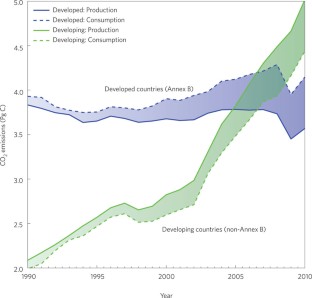
Figure 2: Historic CO2 emissions from 1990 to 2010 of developed (Annex B) and developing (non-Annex B) countries with emissions allocated to production/territorial (as in the Kyoto Protocol) and the consumption of goods and services (production plus imports minus exports).
The alternative text for this image may have been generated using AI.
References
- Raupach, M. R. et al. Proc. Natl Acad. Sci. USA 104, 10288–10293 (2007).
Article CAS Google Scholar - Vuuren, D. & Alfsen, K. Climatic Change 75, 47–57 (2006).
Article Google Scholar - International Monetary Fund World Economic Outlook — Update June (IMF, 2011).
- Bowen, A. & Stern, N. Oxford Rev. Econ. Policy 26, 137–163 (2010).
Article Google Scholar - International Monetary Fund World Economic Outlook — September 2011: Slowing Growth, Rising Risks (IMF, 2011).
- Peters, G. P., Minx, J. C., Weber, C. L. & Edenhofer, O. Proc. Natl Acad. Sci. USA 108, 8903–8908 (2011).
Article CAS Google Scholar - Davis, S. J. & Caldeira, K. Proc. Natl Acad. Sci. USA 107, 5687–5692 (2010).
Article CAS Google Scholar - Friedlingstein, P. et al. Nature Geosci. 3, 811–812 (2010).
Article CAS Google Scholar - Marland, G. J. Ind. Ecol. 12, 136–139 (2008).
Article CAS Google Scholar - Conway, T. & Tans, P. Trends in atmospheric carbon dioxide. http://www.esrl.noaa.gov/gmd/ccgg/trends (2011).
- Le Quéré, C. et al. Nature Geosci. 2, 831–836 (2009).
Article Google Scholar - Blanford, G. J., Richels, R. G. & Rutherford, T. F. Energ. Econ. 31, S82–S93 (2009).
Article Google Scholar - Rogelj, J. et al. Nature 464, 1126–1128 (2010).
Article CAS Google Scholar - Caldeira, K. & Davis, S. J. Proc. Natl Acad. Sci. USA 108, 8533–8534 (2011).
Article CAS Google Scholar
Acknowledgements
This work is a collaborative effort of the Global Carbon Project, a joint project of the Earth System Science Partnership, to provide regular analyses of the main global carbon sources and sinks (http://www.globalcarbonproject.org/carbonbudget/). We thank all people who contributed atmospheric CO2 measurements and model results to this effort. J. Karstensen (Center for International Climate and Environmental Research — Oslo) formatted the figures. T.B. and the Carbon Dioxide Information Analysis Center are supported by the US Department of Energy, Office of Science, Biological and Environmental Research. C.L.Q. thanks the UK Natural Environment Research Council and the European Commission for support. J.G.C. and M.R.R. thank the Australian Climate Change Science Program for support.
Author information
Authors and Affiliations
- Center for International Climate and Environmental Research – Oslo (CICERO), PO Box 1129 Blindern, Oslo, 0318, Norway
Glen P. Peters - Research Institute for Environment, Energy, and Economics, Appalachian State University, Boone, 28608, North Carolina, USA
Gregg Marland - Tyndall Centre for Climate Change Research, University of East Anglia, Norwich Research Park, Norwich, NR4 7TJ, UK
Corinne Le Quéré - Carbon Dioxide Information Analysis Center (CDIAC), Oak Ridge National Laboratory, Oak Ridge, 37831-6335, Tennessee, USA
Thomas Boden - Global Carbon Project, CSIRO Marine and Atmospheric Research, Canberra, Australian Capital Territory 2601, Australia,
Josep G. Canadell & Michael R. Raupach
Authors
- Glen P. Peters
- Gregg Marland
- Corinne Le Quéré
- Thomas Boden
- Josep G. Canadell
- Michael R. Raupach
Corresponding author
Correspondence toGlen P. Peters.
Supplementary information
Rights and permissions
About this article
Cite this article
Peters, G., Marland, G., Le Quéré, C. et al. Rapid growth in CO2 emissions after the 2008–2009 global financial crisis.Nature Clim Change 2, 2–4 (2012). https://doi.org/10.1038/nclimate1332
- Published: 04 December 2011
- Issue date: January 2012
- DOI: https://doi.org/10.1038/nclimate1332