Vulnerability of US and European electricity supply to climate change (original) (raw)
- Letter
- Published: 03 June 2012
- John R. Yearsley2,
- Fulco Ludwig1,
- Stefan Vögele3,
- Dennis P. Lettenmaier2 &
- …
- Pavel Kabat1,4
Nature Climate Change volume 2, pages 676–681 (2012) Cite this article
- 8180 Accesses
- 494 Citations
- 257 Altmetric
- Metrics details
Subjects
Abstract
In the United States and Europe, at present 91% and 78% (ref. [1](/articles/nclimate1546#ref-CR1 "US Energy Information Administration Independent Statistics and Analysis, International Energy Statistics http://www.eia.gov
(2011).")) of the total electricity is produced by thermoelectric (nuclear and fossil-fuelled) power plants, which directly depend on the availability and temperature of water resources for cooling. During recent warm, dry summers several thermoelectric power plants in Europe and the southeastern United States were forced to reduce production owing to cooling-water scarcity[2](/articles/nclimate1546#ref-CR2 "Forster, H. & Lilliestam, J. Modeling thermoelectric power generation in view of climate change. Regional Environ. Change 4, 327–338 (2011)."),[3](/articles/nclimate1546#ref-CR3 "Macknick, J., Newmark, R., Heath, G. & Hallett, K. C. A Review of Operational Water Consumption and Withdrawal Factors for Electricity Generating Technologies 29 (National Renewable Energy Laboratory, 2011)."),[4](/articles/nclimate1546#ref-CR4 "NETL Impact of Drought on US Steam Electric Power Plant Cooling Water Intakes and Related Water Resource Management Issues (National Energy Technology Laboratory, 2009)."). Here we show that thermoelectric power in Europe and the United States is vulnerable to climate change owing to the combined impacts of lower summer river flows and higher river water temperatures. Using a physically based hydrological and water temperature modelling framework in combination with an electricity production model, we show a summer average decrease in capacity of power plants of 6.3–19% in Europe and 4.4–16% in the United States depending on cooling system type and climate scenario for 2031–2060\. In addition, probabilities of extreme (>90%) reductions in thermoelectric power production will on average increase by a factor of three. Considering the increase in future electricity demand, there is a strong need for improved climate adaptation strategies in the thermoelectric power sector to assure futureenergy security.This is a preview of subscription content, access via your institution
Access options
Subscribe to this journal
Receive 12 print issues and online access
$259.00 per year
only $21.58 per issue
Buy this article
- Purchase on SpringerLink
- Instant access to the full article PDF.
USD 39.95
Prices may be subject to local taxes which are calculated during checkout
Additional access options:
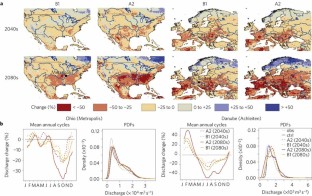
Figure 1: Changes in low river flows.
The alternative text for this image may have been generated using AI.
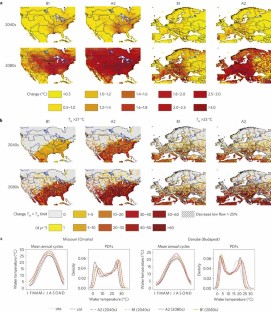
Figure 2: Increases in river water temperatures (_T_w) and exceeded water temperature limits.
The alternative text for this image may have been generated using AI.
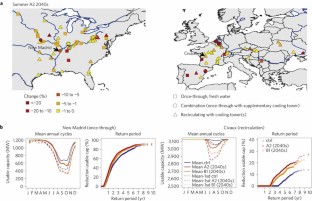
Figure 3: Changes in usable capacity of thermoelectric power plants.
The alternative text for this image may have been generated using AI.
References
- US Energy Information Administration Independent Statistics and Analysis, International Energy Statistics http://www.eia.gov (2011).
- Forster, H. & Lilliestam, J. Modeling thermoelectric power generation in view of climate change. Regional Environ. Change 4, 327–338 (2011).
Google Scholar - Macknick, J., Newmark, R., Heath, G. & Hallett, K. C. A Review of Operational Water Consumption and Withdrawal Factors for Electricity Generating Technologies 29 (National Renewable Energy Laboratory, 2011).
- NETL Impact of Drought on US Steam Electric Power Plant Cooling Water Intakes and Related Water Resource Management Issues (National Energy Technology Laboratory, 2009).
- Vassolo, S. & Doll, P. Global-scale gridded estimates of thermoelectric power and manufacturing water use. Water Res. Res. 41, W04010 (2005).
Article Google Scholar - King, C. W., Holman, A. S. & Webber, M. E. Thirst for energy. Nature Geosci. 1, 283–286 (2008).
Article CAS Google Scholar - Rubbelke, D. & Vogele, S. Impacts of climate change on European critical infrastructures: The case of the power sector. Environ. Sci. Policy 14, 53–63 (2011).
Article Google Scholar - Boogert, A. & Dupont, D. The nature of supply side effects on electricity prices: The impact of water temperature. Econom. Lett. 88, 121–125 (2005).
Article Google Scholar - McDermott, G. R. & Nilsen, Ø. A. Electricity Prices, River Temperatures and Cooling Water Scarcity (Discussion Paper Series in Economics 18/2011, Department of Economics, Norwegian School of Economics, 2011).
- Arnell, N. W. Climate change and global water resources. Glob. Environ. Change 9, S31–S49 (1999).
Article Google Scholar - Oki, T. & Kanae, S. Global hydrological cycles and world water resources. Science 313, 1068–1072 (2006).
Article CAS Google Scholar - Alcamo, J., Florke, M. & Marker, M. Future long-term changes in global water resources driven by socio-economic and climatic changes. Hydrological Sci. J.-J. Des Sci. Hydrologiques 52, 247–275 (2007).
Article Google Scholar - Hagemann, S. et al. Impact of a statistical bias correction on the projected hydrological changes obtained from three GCMs and two hydrology models. J. Hydrometeor. 12, 556–578 (2011).
Article Google Scholar - Nakicenovic, N. et al. Emissions Scenarios. A Special Report of Working Group III of the Intergovernmental Panel on Climate Change (Cambridge Univ. Press, 2000).
Google Scholar - EEA Energy and Environment Report 2008 (Copenhagen, 2008).
- IEA-NEA Projected Costs of Generating Electricity (International Energy Agency and Nuclear Energy Agency, 2010).
- Koch, H., Vögele, S., Kaltofen, M. & Grünewald, U. Trends in water demand and water availability for power plants—scenario analyses for the German capital Berlin. Climatic Change 110, 879–899 (2012).
Article Google Scholar - Liang, X., Lettenmaier, D. P., Wood, E. F. & Burges, S. J. A simple hydrologically based model of land-surface water and energy fluxes for general-circulation models. J. Geophys. Res. 99, 14415–14428 (1994).
Article Google Scholar - Yearsley, J. R. A semi-Lagrangian water temperature model for advection-dominated river systems. Water Res. Res. 45, W12405 (2009).
Article Google Scholar - NETL Coal Plant Database (US Department of National Energy Technology Laboratory; 2007).
- VGE. Jahrbuch der europäischen Energie- und Rohstoffwirtschaft Vol. 118 (VGE Verlag GmbH, 2011).
- Koch, H. & Vogele, S. Dynamic modelling of water demand, water availability and adaptation strategies for power plants to global change. Ecol. Econom. 68, 2031–2039 (2009).
Article Google Scholar
Acknowledgements
This study was financially supported by the European Commission through the FP6 WATCH project and through the FP7 ECLISE project. We thank R. Leemans for helpful comments on a previous version of this manuscript. The Global Runoff Data Centre, 56068 Koblenz, Germany, and United Nations Global Environment Monitoring System are kindly acknowledged for supplying daily observed river flow and water temperature data for river stations in the US and Europe.
Author information
Authors and Affiliations
- Earth System Science and Climate Change, Wageningen University and Research Centre, 6700 AA Wageningen, PO Box 47, The Netherlands
Michelle T. H. van Vliet, Fulco Ludwig & Pavel Kabat - Department of Civil and Environmental Engineering, University of Washington, Seattle, Washington 98195, USA
John R. Yearsley & Dennis P. Lettenmaier - Forschungszentrum Jülich, Institute of Energy and Climate Research—System Analyses and Technology Evaluation, D-52425 Jülich, Germany
Stefan Vögele - International Institute for Applied Systems Analysis, Schlossplatz 1, A-2361 Laxenburg, Austria
Pavel Kabat
Authors
- Michelle T. H. van Vliet
- John R. Yearsley
- Fulco Ludwig
- Stefan Vögele
- Dennis P. Lettenmaier
- Pavel Kabat
Contributions
M.T.H.v.V., P.K., D.P.L. and F.L. designed the study. M.T.H.v.V. performed all analyses and drafted the manuscript. J.R.Y. contributed to the model development. S.V. prepared and provided data sets of thermoelectric power plants. All authors discussed the results and contributed to the manuscript.
Corresponding author
Correspondence toMichelle T. H. van Vliet.
Ethics declarations
Competing interests
The authors declare no competing financial interests.
Supplementary information
Rights and permissions
About this article
Cite this article
van Vliet, M., Yearsley, J., Ludwig, F. et al. Vulnerability of US and European electricity supply to climate change.Nature Clim Change 2, 676–681 (2012). https://doi.org/10.1038/nclimate1546
- Received: 06 December 2011
- Accepted: 24 April 2012
- Published: 03 June 2012
- Issue date: September 2012
- DOI: https://doi.org/10.1038/nclimate1546