Beyond vulnerability assessment (original) (raw)
- Correspondence
- Published: 29 October 2013
- Sabine Fuss2,3,
- Michael Obersteiner3,
- Paolo Ruti4,
- Claas Teichmann5 &
- …
- Robert Vautard6
Nature Climate Change volume 3, pages 942–943 (2013) Cite this article
- 1219 Accesses
- 12 Citations
- 8 Altmetric
- Metrics details
Subjects
To the Editor —
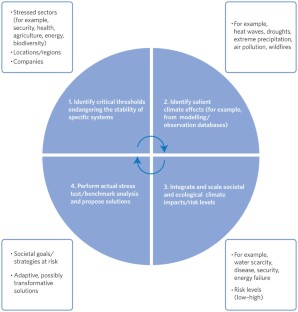
Climate stress testing is a promising way to improve preparedness for climate change hazards over a wide range of applications and actors, borrowed from the finance and nuclear power sectors. In their Commentary 'Managing risk with climate vulnerability science', Stern et al.1 build on a recent report of the National Academy of Sciences2, introducing a climate stress test to “consider how a potentially affected country, region, or socioeconomic system would be likely to perform, including how it might suffer, if struck by particular climate-related events and suggest ways to increase resilience to...disruptive events”1. We support the idea of a stress test, but believe much wider opportunities exist than the identification of security risks, and a stronger contribution from — and important challenge for — science than improved monitoring and predictive science is needed than is proposed by our US colleagues.
This is a preview of subscription content, access via your institution
Access options
Subscribe to this journal
Receive 12 print issues and online access
$259.00 per year
only $21.58 per issue
Buy this article
- Purchase on SpringerLink
- Instant access to the full article PDF.
USD 39.95
Prices may be subject to local taxes which are calculated during checkout
Additional access options:
Figure 1
The alternative text for this image may have been generated using AI.
References
- Stern, P. C. et al. Nature Clim. Change 3, 607–609 (2013).
Article Google Scholar - National Research Council Climate and Social Stress: Implications for Security Analysis (eds Steinbruner, J. D., Stern, P. C. & Husbands, J. L.) (National Academies, 2013)
- Werners, S. E. et al. Curr. Opin. Environ. Sustain. 5, 1–7 (2013).
Article Google Scholar - Haasnoot, M., Kwakkel, J. H., Walker, W. E. & Maat, J. T. Glob. Environ. Change 23, 485–498 (2013).
Article Google Scholar - Lavery, S. & Donovan, B. Phil. Trans. R. Soc. A 363 1455–1474 (2005).
Article Google Scholar - Kunreuther, H. et al. Nature Clim. Change 3, 447–450 (2012).
Article Google Scholar - Dow, K. et al. Nature Clim. Change 3, 305–307 (2013).
Article Google Scholar - Future Earth — Research for Global Sustainability Draft initial design report (ICSU, 2013); http://go.nature.com/AtPxvg
Author information
Authors and Affiliations
- Earth Systems Science/Climate Change and Adaptive Land and Management team, Alterra, Wageningen University and Research Centre, Droevendaalsesteeg 3a, Building 100, Wageningen, 6708 PB, Netherlands
Rob Swart - Resources and International Trade Group, Mercator Research Institute on Global Commons and Climate Change, Torgauer Strasse 12–15, Berlin, 10829, Germany
Sabine Fuss - Ecosystems Services and Management Program, International Institute for Applied Systems Analysis, Schlossplatz 1, Laxenburg, A-2361, Austria
Sabine Fuss & Michael Obersteiner - Climate Modelling and Impacts Group, National Agency for New Technologies, Energy and Sustainable Economic Development, Via Anguillarese 301, Roma, I-00123, Italy
Paolo Ruti - Climate Service Center and Max-Planck-Institut für Meteorologie, Bundesstrasse 53, Hamburg, 20146
Claas Teichmann - Laboratoire des Sciences du Climat et de l'Environnement, Bât. 712, Orme des Merisiers, F-91191, Gif-sur-Yvette CEDEX, France
Robert Vautard
Authors
- Rob Swart
- Sabine Fuss
- Michael Obersteiner
- Paolo Ruti
- Claas Teichmann
- Robert Vautard
Corresponding author
Correspondence toRob Swart.
Rights and permissions
About this article
Cite this article
Swart, R., Fuss, S., Obersteiner, M. et al. Beyond vulnerability assessment.Nature Clim Change 3, 942–943 (2013). https://doi.org/10.1038/nclimate2029
- Published: 29 October 2013
- Issue date: November 2013
- DOI: https://doi.org/10.1038/nclimate2029
This article is cited by
Managing unnatural disaster risk from climate extremes
- Reinhard Mechler
- Laurens M. Bouwer
- Keith Williges
Nature Climate Change (2014)