Reduced CO2 fertilization effect in temperate C3 grasslands under more extreme weather conditions (original) (raw)
- Letter
- Published: 26 December 2016
- L. W. Lehnert1,
- C. I. Kammann2,
- C. Müller3,4,
- L. Grünhage3,
- J. Luterbacher5,6,
- M. Erbs3,
- G. Moser ORCID: orcid.org/0000-0002-0030-23703,
- R. Seibert3,
- N. Yuan5 &
- …
- J. Bendix1
Nature Climate Change volume 7, pages 137–141 (2017) Cite this article
- 4745 Accesses
- 137 Citations
- 46 Altmetric
- Metrics details
Subjects
Abstract
The increase in atmospheric greenhouse gas concentrations from anthropogenic activities is the major driver of recent global climate change1. The stimulation of plant photosynthesis due to rising atmospheric carbon dioxide concentrations ([CO2]) is widely assumed to increase the net primary productivity (NPP) of C3 plants—the CO2 fertilization effect (CFE)1,2,3,4,5,6,7. However, the magnitude and persistence of the CFE under future climates, including more frequent weather extremes, are controversial1,2,3,8,9,10,11,12. Here we use data from 16 years of temperate grassland grown under ‘free-air carbon dioxide enrichment’ conditions to show that the CFE on above-ground biomass is strongest under local average environmental conditions. The observed CFE was reduced or disappeared under wetter, drier and/or hotter conditions when the forcing variable exceeded its intermediate regime. This is in contrast to predictions of an increased CO2 fertilization effect under drier and warmer conditions[13](/articles/nclimate3191#ref-CR13 "Wang, D. L., Heckathorn, S. A., Wang, X. & Philpott, S. M. A meta-analysis of plant physiological and growth responses to temperature and elevated CO2 . Oecologia http://doi.org/dsfsnq
(2012)."). Such extreme weather conditions are projected to occur more intensely and frequently under future climate scenarios[1](/articles/nclimate3191#ref-CR1 "IPCC Climate Change 2013: The Physical Science Basis (eds Stocker, T. F. et al.) (Cambridge Univ. Press, 2013)."). Consequently, current biogeochemical models might overestimate the future NPP sink capacity of temperate C3 grasslands and hence underestimate future atmospheric \[CO2\] increase.This is a preview of subscription content, access via your institution
Access options
Subscribe to this journal
Receive 12 print issues and online access
$259.00 per year
only $21.58 per issue
Buy this article
- Purchase on SpringerLink
- Instant access to the full article PDF.
USD 39.95
Prices may be subject to local taxes which are calculated during checkout
Additional access options:
Figure 1: Dependence of the CO2 fertilization effect (CFE) on drought-related variables.
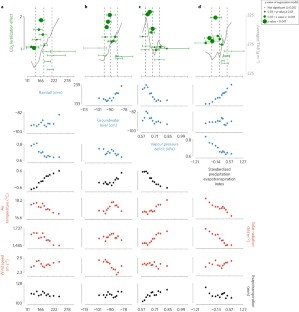
The alternative text for this image may have been generated using AI.
Figure 2: Dependence of the CO2 fertilization effect (CFE) on heat-related variables.

The alternative text for this image may have been generated using AI.
Figure 3: Synopsis of the CO2 fertilization effect dependent on different environmental conditions during the three months preceding the harvest.

The alternative text for this image may have been generated using AI.
References
- IPCC Climate Change 2013: The Physical Science Basis (eds Stocker, T. F. et al.) (Cambridge Univ. Press, 2013).
- Arneth, A. et al. Terrestrial biogeochemical cycles in the climate system. Nat. Geosci. 3, 525–532 (2010).
Article CAS Google Scholar - Ainsworth, E. & Rogers, A. The response of photosynthesis and stomatal conductance to rising [CO2]: mechanisms and environmental interactions. Plant Cell Environ. 30, 258–270 (2007).
Article CAS Google Scholar - Luo, Y. Terrestrial carbon–cycle feedback to climate warming. Annu. Rev. Ecol. Evolut. Syst. 38, 683–712 (2007).
Article Google Scholar - Long, S. P. Modification of the response of photosynthetic productivity to rising temperature by atmospheric CO2 concentrations: has its importance been underestimated? Plant Cell Environ. 14, 729–739 (1991).
Article CAS Google Scholar - Nowak, R. S., Ellsworth, D. S. & Smith, S. D. Functional responses of plants to elevated atmospheric CO2—do photosynthetic and productivity data from FACE experiments support early predictions? New Phytol. 162, 253–280 (2004).
Article Google Scholar - Soussana, J.-F. & Lüscher, A. Temperate grasslands and global atmospheric change: a review. Grass Forage Sci. 62, 127–134 (2007).
Article CAS Google Scholar - Friedlingstein, P. et al. Uncertainties in CMIP5 climate projections due to carbon cycle feedbacks. J. Clim. 27, 511–526 (2014).
Article Google Scholar - Kolby Smith, W. et al. Large divergence of satellite and Earth system model estimates of global terrestrial CO2 fertilization. Nat. Clim. Change 6, 306–310 (2016).
Article CAS Google Scholar - Reich, P. B., Hobbie, S. E. & Lee, T. D. Plant growth enhancement by elevated CO2 eliminated by joint water and nitrogen limitation. Nat. Geosci. 7, 2–6 (2014).
Article Google Scholar - Hovenden, M. J., Newton, P. C. D. & Wills, K. E. Seasonal not annual rainfall determines grassland biomass response to carbon dioxide. Nature 511, 583–586 (2014).
Article CAS Google Scholar - Reichstein, M. et al. Climate extremes and the carbon cycle. Nature 500, 287–295 (2013).
Article CAS Google Scholar - Wang, D. L., Heckathorn, S. A., Wang, X. & Philpott, S. M. A meta-analysis of plant physiological and growth responses to temperature and elevated CO2 . Oecologia http://doi.org/dsfsnq (2012).
- Foley, J. A. et al. Solutions for a cultivated planet. Nature 478, 337–342 (2011).
Article CAS Google Scholar - Food and Agriculture Organization of the United Nations Statistics Division (2011 accessed January 2016); http://faostat3.fao.org/browse/E/EL/E
- Booth, B. B. B. et al. High sensitivity of future global warming to land carbon cycle processes. Environ. Res. Lett. 7, 024002 (2012).
Article Google Scholar - Schimel, D., Stephens, B. B. & Fisher, J. B. Effect of increasing CO2 on the terrestrial carbon cycle. Proc. Natl Acad. Sci. USA 112, 436–441 (2015).
Article CAS Google Scholar - Morison, J. I. L. & Lawlor, D. W. Interactions between increasing CO2 concentration and temperature on plant growth. Plant Cell Environ. 22, 659–682 (1999).
Article CAS Google Scholar - Morgan, J. A. et al. Water relations in grassland and desert ecosystems exposed to elevated atmospheric CO2 . Oecologia 140, 11–25 (2004).
Article CAS Google Scholar - Volk, M., Niklaus, P. A. & Körner, C. Soil moisture effects determine CO2 responses of grassland species. Oecologia 125, 380–388 (2000).
Article Google Scholar - Owensby, C. E., Ham, J. M., Knapp, A. K. & Auen, L. M. Biomass production and species composition change in a tallgrass prairie ecosystem after long-term exposure to elevated atmospheric CO2 . Glob. Change Biol. 5, 497–506 (1999).
Article Google Scholar - Farrior, C. E. et al. Resource limitation in a competitive context determines complex plant responses to experimental resource additions. Ecology 94, 2505–2517 (2013).
Article Google Scholar - Fatichi, S., Leuzinger, S. & Körner, C. Moving beyond photosynthesis: from carbon-source to sink-driven vegetation modeling. New Phytol. 201, 1086–1095 (2014).
Article CAS Google Scholar - Körner, C. Paradigm shift in plant growth control. Curr. Opin. Plant Biol. 25, 107–114 (2015).
Article Google Scholar - Shaw, M. R. et al. Grassland responses to global environmental changes suppressed by elevated CO2 . Science 298, 1987–1990 (2002).
Article CAS Google Scholar - Dukes, J. S. et al. Responses of grassland production to single and multiple global environmental changes. PLoS Biol. 3, 1829–1837 (2005).
Article CAS Google Scholar - Oren, R. et al. Survey and synthesis of intra- and interspecific variation in stomatal sensitivity to vapour pressure deficit. Plant Cell Environ. 22, 1515–1526 (1999).
Article Google Scholar - De Boeck, H. J. & Verbeeck, H. Drought-associated changes in climate and their relevance for ecosystem experiments and models. Biogeosciences 8, 1121–1130 (2011).
Article Google Scholar - Cox, P. M., Betts, R. A., Jones, C. D., Spall, S. A. & Totterdell, I. J. Acceleration of global warming due to carbon-cycle feedbacks in a coupled climate model. Nature 408, 184–187 (2000).
Article CAS Google Scholar - Ciais, P. et al. Europe-wide reduction in primary productivity caused by the heat and drought in 2003. Nature 437, 529–533 (2005).
Article CAS Google Scholar - Jäger, H.-J. et al. The University of Giessen free-air carbon dioxide enrichment study: description of the experimental site and of a new enrichment system. J. Appl. Bot. 77, 117–127 (2003).
Google Scholar - Kammann, C., Grünhage, L., Grüters, U., Janze, S. & Jäger, H.-J. Response of aboveground grassland biomass and soil moisture to moderate long-term CO2 enrichment. Basic Appl. Ecol. 6, 351–365 (2005).
Article CAS Google Scholar - Reich, P. B. et al. Plant diversity enhances ecosystem responses to elevated CO2 and nitrogen deposition. Nature 410, 809–810 (2001).
Article CAS Google Scholar - FAO, Draft World Reference Base for Soil Resources (FAO, ISSS and ISRIC, 1994).
- Allen, R. G., Pereira, L. S., Raes, D. & Smith, M. Crop Evapotranspiration: Guidelines for Computing Crop Water Requirements. Irrigation and Drainage Paper Vol. 56 (Food and Agriculture Organization of the United Nations, 1998).
Google Scholar - R Core Team. R: A language and environment for statistical computing. R Foundation for Statistical Computing (2014).
- Obermeier, W. A., Lehnert, W. L. & Bendix, J. msaFACE: Moving Subset Analysis FACE. R package version 0.1.0. (R-project, 2016); https://CRAN.R-project.org/package=msaFACE
- Obermeier, W. A. Longterm Time Series of the Giessen Free Air Carbon Enrichment Experiment (GiFACE) (Laboratory for Climatology and Remote Sensing (LCRS), 2016); http://dx.doi.org/10.5678/LCRS/DAT.265
Acknowledgements
The contribution of the following individuals to the initiation, construction, installation and long-term, ongoing maintenance of the Giessen FACE experiment is gratefully acknowledged: H.-J. Jäger (deceased 2013), S. Schmidt, J. Senkbeil, W. Stein, B. Lenz, J. Franz, T. Strohbusch, G. Mayer and A. Brück. The continued financial support of the Hessian Agency for Nature Conservation, Environment and Geology is gratefully acknowledged since it allowed an exceptionally long data set to be obtained. This research has been funded by the LOEWE excellence cluster FACE2FACE of the Hessian State Ministry of Higher Education, Research and the Arts.
Author information
Authors and Affiliations
- Faculty of Geography, Laboratory for Climatology and Remote Sensing, Philipps-University of Marburg, Deutschhausstr. 10, 35032 Marburg, Germany
W. A. Obermeier, L. W. Lehnert & J. Bendix - Department of Soil Science and Plant Nutrition, WG Climate Change Research for Special Crops, Hochschule Geisenheim University, Von-Lade Str. 1, 65366 Geisenheim, Germany
C. I. Kammann - Department of Plant Ecology, Justus Liebig University, Heinrich-Buff-Ring 26-32, 35392 Giessen, Germany
C. Müller, L. Grünhage, M. Erbs, G. Moser & R. Seibert - School of Biology and Environmental Science and Earth Institute, University College Dublin, Dublin 4, Ireland
C. Müller - Department of Geography, Climatology, Climate Dynamics and Climate Change, Justus Liebig University, Senckenbergstr. 1, 35390 Giessen, Germany
J. Luterbacher & N. Yuan - Centre for International Development and Environmental Research, Justus Liebig University Giessen, Senckenbergstrasse 3, 35390 Giessen, Germany
J. Luterbacher
Authors
- W. A. Obermeier
- L. W. Lehnert
- C. I. Kammann
- C. Müller
- L. Grünhage
- J. Luterbacher
- M. Erbs
- G. Moser
- R. Seibert
- N. Yuan
- J. Bendix
Contributions
The statistical analysis was designed and implemented by W.A.O., L.W.L. and J.B.; all authors contributed to the interpretation of the results and the writing of the manuscript.
Corresponding author
Correspondence toW. A. Obermeier.
Ethics declarations
Competing interests
The authors declare no competing financial interests.
Supplementary information
Rights and permissions
About this article
Cite this article
Obermeier, W., Lehnert, L., Kammann, C. et al. Reduced CO2 fertilization effect in temperate C3 grasslands under more extreme weather conditions.Nature Clim Change 7, 137–141 (2017). https://doi.org/10.1038/nclimate3191
- Received: 01 February 2016
- Accepted: 29 November 2016
- Published: 26 December 2016
- Issue date: February 2017
- DOI: https://doi.org/10.1038/nclimate3191
This article is cited by
Associated content
Average is best
- Robert S. Nowak
Nature Climate Change News & Views 01 Feb 2017