Mangroves among the most carbon-rich forests in the tropics (original) (raw)
- Letter
- Published: 03 April 2011
- J. Boone Kauffman2,
- Daniel Murdiyarso3,
- Sofyan Kurnianto3,
- Melanie Stidham4 &
- …
- Markku Kanninen5
Nature Geoscience volume 4, pages 293–297 (2011)Cite this article
- 23k Accesses
- 2711 Citations
- 969 Altmetric
- Metrics details
Subjects
Abstract
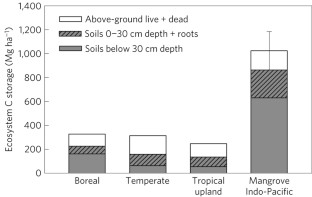
Mangrove forests occur along ocean coastlines throughout the tropics, and support numerous ecosystem services, including fisheries production and nutrient cycling. However, the areal extent of mangrove forests has declined by 30–50% over the past half century as a result of coastal development, aquaculture expansion and over-harvesting1,2,3,4. Carbon emissions resulting from mangrove loss are uncertain, owing in part to a lack of broad-scale data on the amount of carbon stored in these ecosystems, particularly below ground5. Here, we quantified whole-ecosystem carbon storage by measuring tree and dead wood biomass, soil carbon content, and soil depth in 25 mangrove forests across a broad area of the Indo-Pacific region—spanning 30° of latitude and 73° of longitude—where mangrove area and diversity are greatest4,6. These data indicate that mangroves are among the most carbon-rich forests in the tropics, containing on average 1,023 Mg carbon per hectare. Organic-rich soils ranged from 0.5 m to more than 3 m in depth and accounted for 49–98% of carbon storage in these systems. Combining our data with other published information, we estimate that mangrove deforestation generates emissions of 0.02–0.12 Pg carbon per year—as much as around 10% of emissions from deforestation globally, despite accounting for just 0.7% of tropical forest area6,7.
This is a preview of subscription content, access via your institution
Access options
Subscribe to this journal
Receive 12 print issues and online access
$259.00 per year
only $21.58 per issue
Buy this article
- Purchase on SpringerLink
- Instant access to the full article PDF.
USD 39.95
Prices may be subject to local taxes which are calculated during checkout
Additional access options:
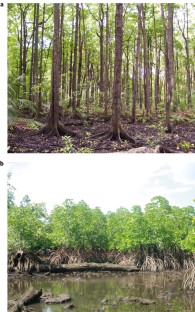
Figure 1: Examples of Indo-Pacific mangroves.
The alternative text for this image may have been generated using AI.
Figure 2: Comparison of mangrove C storage (mean ±95% confidence interval) with that of major global forest domains.
The alternative text for this image may have been generated using AI.
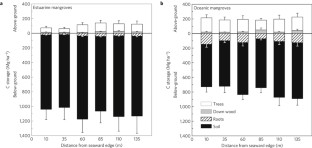
Figure 3: Above- and below-ground C pools in Indo-Pacific mangroves, assessed by distance from the seaward edge.
The alternative text for this image may have been generated using AI.
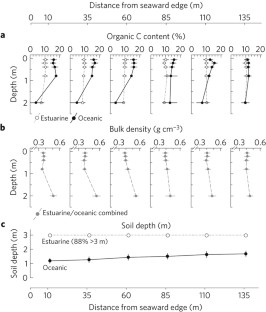
Figure 4: Soil properties determining below-ground carbon storage in Indo-Pacific mangroves.
The alternative text for this image may have been generated using AI.
References
- Duke, N. C. et al. A world without mangroves? Science 317, 41–42 (2007).
Article Google Scholar - Polidoro, B. A. et al. The loss of species: Mangrove extinction risk and geographic areas of global concern. PLoS ONE 5, e10095 (2010).
Article Google Scholar - Alongi, D. M. Present state and future of the world’s mangrove forests. Environ. Conserv. 29, 331–349 (2002).
Article Google Scholar - Food and Agriculture Organization of the United Nations (FAO). The World’s Mangroves 1980–2005 (FAO Forestry Paper 153. FAO, 2007).
- Bouillon, S., Rivera-Monroy, V. H., Twilley, R. R., Kairo, J. G. & Mangroves, in The Management of Natural Coastal Carbon Sinks (eds Laffoley, D. & Grimsditch) (IUCN, 2009).
- Giri, C. et al. Status and distribution of mangrove forests of the world using earth observation satellite data. Glob. Ecol. Biogeogr. 20, 154–159 (2011).
Article Google Scholar - van der Werf, G. R. et al. CO2 emissions from forest loss. Nature Geosci. 2, 737–738 (2009).
Article Google Scholar - IPCC in The Fourth Assessment Report Climate Change 2007 (eds Pachauri, R. K. & Reisinger, A.) (IPCC, 2007).
- Intergovernmental Panel on Climate Change (IPCC) in Good Practice Guidance for Land use, Land-use Change, and Forestry (eds Penman, J. et al.) (Institute for Global Environmental Strategies, 2003).
- Keith, H., Mackey, B. G. & Lindenmayer, D. B. Re-evaluation of forest biomass carbon stocks and lessons from the world’s most carbon-dense forests. Proc. Natl Acad. Sci. USA 106, 11635–11640 (2009).
Article Google Scholar - Page, S. E. et al. The amount of carbon released from peat and forest fires in Indonesia during 1997. Nature 420, 61–65 (2002).
Article Google Scholar - Page, S. E., Rieley, J. O. & Banks, C. J. Global and regional importance of the tropical peatland carbon pool. Glob. Change Biol. 17, 798–818 (2011).
Article Google Scholar - Murdiyarso, D. M., Hergoualc’h, K. & Verchot, L. V. Opportunities for reducing greenhouse gas emissions in tropical peatlands. Proc. Natl Acad. Sci. USA 107, 19655–19660 (2010).
Article Google Scholar - Gilman, E. L., Ellison, J., Duke, N. C. & Field, C. Threats to mangroves from climate change and adaptation options. Aquat. Bot. 89, 237–250 (2008).
Article Google Scholar - Alongi, D. M. Mangrove forests: Resilience, protection from tsunamis, and responses to global climate change. Estuar. Coast Shelf Sci. 76, 1–13 (2008).
Article Google Scholar - Kristensen, E., Bouillon, S., Dittmar, T. & Marchand, C. Organic carbon dynamics in mangrove ecosystems. Aquat. Bot. 89, 201–219 (2008).
Article Google Scholar - Komiyama, A., Ong, J. E. & Poungparn, S. Allometry, biomass, and productivity of mangrove forests. Aquat. Bot. 89, 128–137 (2008).
Article Google Scholar - Twilley, R. R., Chen, R. H. & Hargis, T. Carbon sinks in mangroves and their implications to carbon budget of tropical coastal ecosystems. Water Air Soil Pollut. 64, 265–288 (1992).
Article Google Scholar - Bouillon, S. et al. Mangrove production and carbon sinks: A revision of global budget estimates. Glob. Biogeochem. Cycles 22, GB2013 (2008).
Article Google Scholar - Alongi, D. M. et al. Sediment accumulation and organic material flux in a managed mangrove ecosystem: Estimates of land–ocean–atmosphere exchange in peninsular Malaysia. Mar. Geol. 208, 383–402 (2004).
Article Google Scholar - Chmura, G. L., Anisfeld, S. C., Cahoon, D. R. & Lynch, J. C. Global carbon sequestration in tidal, saline wetland soils. Glob. Biogeochem. Cycles 17, 1111 (2003).
Article Google Scholar - Eong, O. J. Mangroves—a carbon source and sink. Chemosphere 27, 1097–1107 (1993).
Article Google Scholar - Golley, F., Odum, H. T. & Wilson, R. F. The structure and metabolism of a Puerto Rican red mangrove forest in May. Ecology 43, 9–19 (1962).
Article Google Scholar - Fujimoto, K. et al. Belowground carbon storage of Micronesian mangrove forests. Ecol. Res. 14, 409–413 (1999).
Article Google Scholar - Matsui, N. Estimated stocks of organic carbon in mangrove roots and sediments in Hinchinbrook Channel, Australia. Mangr. Salt Marsh. 2, 199–204 (1998).
Article Google Scholar - Sjöling, S., Mohammed, S. M., Lyimo, T. J. & Kyaruzi, J. J. Benthic bacterial diversity and nutrient processes in mangroves: Impact of deforestation. Estuar. Coast Shelf Sci. 63, 397–406 (2005).
Article Google Scholar - Strangmann, A., Bashan, Y. & Giani, L. Methane in pristine and impaired mangrove soils and its possible effects on establishment of mangrove seedlings. Biol. Fertil. Soils 44, 511–519 (2008).
Article Google Scholar - Granek, E. & Ruttenberg, B. I. Changes in biotic and abiotic processes following mangrove clearing. Estuar. Coast Shelf Sci. 80, 555–562 (2008).
Article Google Scholar - Hooijer, A., Silvius, M., Wösten, H. & Page, S. PEAT-CO2: Assessment of CO 2 Emissions from Drained Peatlands in SE Asia. Delft Hydraulics Report Q3943 (2006).
- Church, J. A. et al. Understanding global sea levels: Past, present and future. Sustain. Sci. 3, 9–22 (2008).
Article Google Scholar
Acknowledgements
We thank our many international partners and field personnel for assistance with logistics and data collection: Kosrae Island Resource Management Authority; Yap State Forestry; Orangutan Foundation International; Indonesian Directorate General for Forest Protection and Nature Conservation; University of Manado and Bogor Agricultural University, Indonesia; Bangladesh Forest Department; and KPSKSA (Cilacap, Indonesia). We thank K. Gerow for statistical assistance, and R. Mackenzie, C. Kryss and J. Bonham for assistance compiling site data. Funding was provided by USDA Forest Service International Programs and the Australian Agency for International Development (AusAID).
Author information
Authors and Affiliations
- USDA Forest Service, Pacific Southwest Research Station, 60 Nowelo St., Hilo, Hawaii 96720, USA
Daniel C. Donato - USDA Forest Service, Northern Research Station, 271 Mast Rd., Durham, New Hampshire 03824, USA
J. Boone Kauffman - Center for International Forestry Research (CIFOR), Bogor 16000, PO Box 0113 BOCBD, Indonesia
Daniel Murdiyarso & Sofyan Kurnianto - USDA Forest Service, International Programs, 1099 14th street NW, Suite 5500W, Washington, District of Columbia 20005, USA
Melanie Stidham - Viikki Tropical Resources Institute (VITRI), University of Helsinki, PO Box 27, FIN-00014, Finland
Markku Kanninen
Authors
- Daniel C. Donato
- J. Boone Kauffman
- Daniel Murdiyarso
- Sofyan Kurnianto
- Melanie Stidham
- Markku Kanninen
Contributions
D.C.D. co-designed the study, collected field data, performed data analyses, and led the writing of the paper. J.B.K. conceived and co-designed the study, and contributed to data collection and writing. D.M. co-conceived the study, arranged for and contributed to data collection, and contributed to writing. S.K. contributed to data collection, data analysis, and writing. M.S. collected field data and contributed to writing. M.K. co-conceived the study and contributed to writing.
Corresponding author
Correspondence toDaniel C. Donato.
Ethics declarations
Competing interests
The authors declare no competing financial interests.
Supplementary information
Rights and permissions
About this article
Cite this article
Donato, D., Kauffman, J., Murdiyarso, D. et al. Mangroves among the most carbon-rich forests in the tropics.Nature Geosci 4, 293–297 (2011). https://doi.org/10.1038/ngeo1123
- Received: 30 September 2010
- Accepted: 23 February 2011
- Published: 03 April 2011
- Issue date: May 2011
- DOI: https://doi.org/10.1038/ngeo1123