Atlantic overturning in decline? (original) (raw)
- Correspondence
- Published: 23 December 2013
Nature Geoscience volume 7, pages 2–3 (2014) Cite this article
- 6013 Accesses
- 133 Citations
- 73 Altmetric
- Metrics details
Subjects
To the Editor
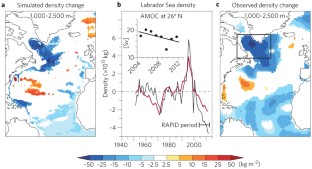
Global ocean circulation is an important factor in climate variability and change. In particular, changes in the strength of the Atlantic meridional overturning circulation (AMOC) have been implicated in ancient climate events1, as well as in recent climate anomalies such as the rapid warming of the North Atlantic Ocean in the mid-1990s2. A series of moored current meters and temperature sensors deployed in the Atlantic at 26° N known as the RAPID-MOCHA array has been used to monitor the strength of meridional overturning since 2004. The data indicate a decline in this strength over the period 2004–20123. Here, using additional observations and climate model simulations4,5,6, we suggest that this measured decline is not merely a short-term fluctuation, but is part of a substantial reduction in meridional overturning occurring on a decadal timescale.
This is a preview of subscription content, access via your institution
Relevant articles
Open Access articles citing this article.
Access options
Subscribe to this journal
Receive 12 print issues and online access
$259.00 per year
only $21.58 per issue
Buy this article
- Purchase on SpringerLink
- Instant access to the full article PDF.
USD 39.95
Prices may be subject to local taxes which are calculated during checkout
Additional access options:
Figure 1: Labrador Sea density and the Atlantic meridional overturning circulation.
The alternative text for this image may have been generated using AI.
References
- McManus, J. F., Francois, R., Gherardi, J-M., Keigwin L. D. & Brown-Leger, S. Nature 428, 834–837 (2004).
Article Google Scholar - Robson, J., Sutton, R., Lohmann, K., Smith, D. & Palmer, M. D. J. Clim. 25, 4116–4134 (2012).
Article Google Scholar - Smeed, D. A. et al. Ocean Sci. Discuss. 10, 1619–1645 (2013).
Article Google Scholar - Hodson, D. L. R. & Sutton, R. T. Clim. Dyn. 39, 3057–3073 (2012).
Article Google Scholar - Ingleby, B. & Huddleston, M. J. Marine Sys. 65, 158–175 (2007).
Article Google Scholar - Roberts, C. D., Garry, F. K. & Jackson, L. C. J. Clim. 26, 9155–9174 (2013).
Article Google Scholar - Lozier, M. S., Roussenov, V, Reed, M. S. C. & Williams, R. G. Nature Geosci. 3, 728–734 (2010).
Article Google Scholar - Fischer, J., Visbeck, M., Zantopp, R. & Nunes, N. Geophys. Res. Lett. 37, L24610 (2010).
Article Google Scholar - Hecht, M. W. & Smith, R. D. Geophys. Monogr. Series 177, 213–239 (American Geophysical Union, 2008)
Google Scholar - Cabanes, C., Lee, T. & Fu, L. L. J. Phys. Oceanogr. 38, 467–480 (2008).
Article Google Scholar - Shaffrey, L. C. et al. J. Clim. 22, 1861–1896 (2009).
Article Google Scholar - Smith, D. M. & Murphy, J. M. J. Geophys. Res. 112, C02022 (2007).
Article Google Scholar
Acknowledgements
We thank the RAPID science team for making the RAPID-MOCHA observations available (www.rapid.ac.uk/rapidmoc/). The EN3 data set was downloaded from the Met Office (http://www.metoffice.gov.uk/hadobs/). Thanks also to D. Smith for making the Smith and Murphy analysis available, and L. Shaffrey and the HiGEM project (http://higem.nerc.ac.uk/) for use of the HiGEM data. J.R. was supported by the the BNP-Paribas Foundation through the PRECLIDE project under the CNRS research convention agreement no. 30023488, and through the European Community's 7th Framework Programme through SPECS. D.H., E.H. and R.S. were supported by NERC through the National Centre for Atmospheric Science.
Author information
Authors and Affiliations
- Department of Meteorology, NCAS Climate, University of Reading, Reading, RG6 6BB, UK
Jon Robson, Dan Hodson, Ed Hawkins & Rowan Sutton
Authors
- Jon Robson
- Dan Hodson
- Ed Hawkins
- Rowan Sutton
Corresponding author
Correspondence toJon Robson.
Supplementary information
Rights and permissions
About this article
Cite this article
Robson, J., Hodson, D., Hawkins, E. et al. Atlantic overturning in decline?.Nature Geosci 7, 2–3 (2014). https://doi.org/10.1038/ngeo2050
- Published: 23 December 2013
- Issue date: January 2014
- DOI: https://doi.org/10.1038/ngeo2050