Increase in hourly precipitation extremes beyond expectations from temperature changes (original) (raw)
- Letter
- Published: 20 July 2008
Nature Geoscience volume 1, pages 511–514 (2008) Cite this article
- 6683 Accesses
- 947 Citations
- 114 Altmetric
- Metrics details
Abstract
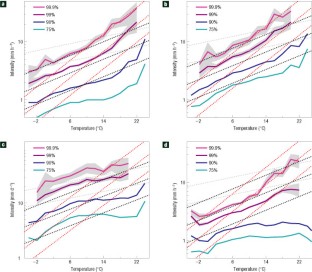
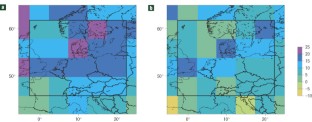
Changes in precipitation extremes under greenhouse warming are commonly assumed to be constrained by changes in the amounts of precipitable water in the atmosphere1,2,3,4. Global climate models generally predict only marginal changes in relative humidity5, implying that the actual amount of atmospheric precipitable water scales with the water vapour content of saturation, which is governed by the Clausius–Clapeyron relation. Indeed, changes in daily precipitation extremes in global climate models seem to be consistent with the 7% increase per degree of warming given by the Clausius–Clapeyron relation3,4, but it is uncertain how general this scaling behaviour is across timescales. Here, we analyse a 99-year record of hourly precipitation observations from De Bilt, the Netherlands, and find that one-hour precipitation extremes increase twice as fast with rising temperatures as expected from the Clausius–Clapeyron relation when daily mean temperatures exceed 12 ∘C. In addition, simulations with a high-resolution regional climate model show that one-hour precipitation extremes increase at a rate close to 14% per degree of warming in large parts of Europe. Our results demonstrate that changes in short-duration precipitation extremes may well exceed expectations from the Clausius–Clapeyron relation. These short-duration extreme events can have significant impacts, such as local flooding, erosion and water damage.
This is a preview of subscription content, access via your institution
Access options
Subscribe to this journal
Receive 12 print issues and online access
$259.00 per year
only $21.58 per issue
Buy this article
- Purchase on SpringerLink
- Instant access to the full article PDF.
USD 39.95
Prices may be subject to local taxes which are calculated during checkout
Additional access options:
Figure 1: Percentiles of precipitation intensity on a logarithmic scale as a function of temperature.
The alternative text for this image may have been generated using AI.
Figure 2: Normalized change of extreme hourly and daily summer precipitation in a climate change simulation.
The alternative text for this image may have been generated using AI.
References
- Trenberth, K. E., Dai, A., Rasmussen, R. & Parsons, D. The changing character of precipitation. Bull. Am. Meteorol. Soc. 84, 1205–1217 (2003).
Article Google Scholar - Hegerl, G. et al. Climate Change 2007: The Physical Science Basis. Contribution of Working Group I to the Fourth Assessment Report of the Intergovernmental Panel on Climate 664–745 (Cambridge Univ. Press, Cambridge, 2007).
Google Scholar - Pall, P., Allen, M. & Stone, D. Testing the Clausius–Clapeyron constraint on changes in extreme precipitation under CO2 warming. Clim. Dyn. 28, 351–363 (2007).
Article Google Scholar - Allen, M. R. & Ingram, W. J. Constraints on the future changes in climate and the hydrological cycle. Nature 419, 224–232 (2002).
Google Scholar - Bony, S. et al. How well do we understand and evaluate climate change feedback processes? J. Clim. 19, 3445–3482 (2006).
Article Google Scholar - Semenov, V. & Bengtsson, L. Secular trends in daily precipitation characteristics: Greenhouse gas simulation with a coupled AOGCM. Clim. Dyn. 19, 123–140 (2002).
Article Google Scholar - Frei, C., Schöll, R., Fukutome, S., Schmidli, J. & Vidale, P. Future change of precipitation extremes in Europe: Intercomparison of scenarios from regional climate models. J. Geophys. Res. 111, D06105 (2006).
Article Google Scholar - Emori, S. & Brown, S. Dynamic and thermodynamic change in mean and extreme precipitation under climate change. Geophys. Res. Lett. 32, L17706 (2005).
Article Google Scholar - van Ulden, A. P. & van Oldenborgh, G. Large-scale atmospheric circulation biases in global climate model simulations and their importance for climate change in central Europe. Atmos. Chem. Phys. 6, 863–881 (2006).
Article Google Scholar - Trapp, R. J. et al. Changes in severe thunderstorm environment frequency during the 21st century caused by anthropogenically enhanced global radiative forcing. Proc. Natl Acad. Sci. 104, 19719–19723 (2007).
Article Google Scholar - Baker, M. B. & Peter, T. Small-scale cloud processes and climate. Nature 451, 299–300 (2008).
Article Google Scholar - Trenberth, K. E. Atmospheric moisture recycling: Role of advection and local evaporation. J. Clim. 12, 1368–1381 (1999).
Article Google Scholar - Ingram, W. J. On the robustness of the water vapor feedback: GCM vertical resolution and formulation. J. Clim. 15, 1917–1921 (2002).
Article Google Scholar - Held, I. M. & Soden, B. J. Robust responses of the hydrological cycle to global warming. J. Clim. 19, 5686–5699 (2006).
Article Google Scholar - Guichard, F. et al. Modelling the diurnal cycle of deep precipitating convection over land with cloud-resolving models and single-column models. Q. J. R. Meteorol. Soc. 130, 3139–3172 (2004).
Article Google Scholar - Lenderink, G., van den Hurk, B., van Meijgaard, E., van Ulden, A. & Cuijpers, H. Simulation of present-day climate in RACMO2: First results and model developments. Tech. Rep. TR-252 (Royal Netherlands Meteorological Institute, De Bilt, 2003).
- Lenderink, G., van Meijgaard, E. & Selten, F. Intense coastal rainfall in the Netherlands in response to high sea water temperatures: Analysis of the event of august 2006 from the perspective of a changing climate. Clim. Dyn. (2008, in the press).
- Lenderink, G., van Ulden, A., van den Hurk, B. & Keller, F. A study on combining global and regional climate model results for generating climate scenarios of temperature and precipitation for the Netherlands. Clim. Dyn. 29, 157–176 (2007).
Article Google Scholar - Schneider, T. & O’Gorman, P. A. Proc. Hawaiian Aha Huliko’a Winter Workshop 61–66 (University of Hawaii, Honolulu, 2007).
Google Scholar - <http://www.knmi.nl/klimatologie/onderzoeksgegevens/index.html>.
- Uppala, S. et al. The ERA-40 re-analysis. Q. J. R. Meteorol. Soc. 131, 2961–3012 (2005).
Article Google Scholar - Hewitt, C. & Griggs, D. Ensembles-based predictions of climate changes and their impacts (ENSEMBLES). Eos 85, 566 (2004).
Article Google Scholar
Acknowledgements
Financial support by the EU FP6 Integrated Project ENSEMBLES (Contract number 505539) and the Dutch Climate Change and Spatial Planning program (BSIK) is gratefully acknowledged. We thank G. J. v. Oldenborgh, F. Selten, R. Haarsma, A. v. Ulden and R. Boers for comments on earlier drafts of this paper. This work is partly motivated by earlier unpublished work on precipitation temperature relations by A. Klein Tank and G. Können.
Author information
Authors and Affiliations
- Royal Netherlands Meteorological Institute (KNMI), 3730 AE De Bilt, The Netherlands
Geert Lenderink & Erik van Meijgaard
Authors
- Geert Lenderink
- Erik van Meijgaard
Contributions
The main idea and most analyses were by G.L and E.v.M. carried out the regional climate simulations and contributed to the text.
Corresponding author
Correspondence toGeert Lenderink.
Supplementary information
Rights and permissions
About this article
Cite this article
Lenderink, G., van Meijgaard, E. Increase in hourly precipitation extremes beyond expectations from temperature changes.Nature Geosci 1, 511–514 (2008). https://doi.org/10.1038/ngeo262
- Received: 07 March 2008
- Accepted: 30 June 2008
- Published: 20 July 2008
- Issue date: August 2008
- DOI: https://doi.org/10.1038/ngeo262