Interdependence of groundwater dynamics and land-energy feedbacks under climate change (original) (raw)
- Letter
- Published: 28 September 2008
Nature Geoscience volume 1, pages 665–669 (2008) Cite this article
- 3194 Accesses
- 363 Citations
- 11 Altmetric
- Metrics details
Abstract
Climate change will have a significant impact on the hydrologic cycle, creating changes in freshwater resources, land cover and land–atmosphere feedbacks. Recent studies have investigated the response of groundwater to climate change but do not account for energy feedbacks across the complete hydrologic cycle1,2. Although land-surface models have begun to include an operational groundwater-type component3,4,5, they do not include physically based lateral surface and subsurface flow and allow only for vertical transport processes. Here we use a variably saturated groundwater flow model with integrated overland flow and land-surface model processes6,7,8 to examine the interplay between water and energy flows in a changing climate for the southern Great Plains, USA, an important agricultural region that is susceptible to drought. We compare three scenario simulations with modified atmospheric forcing in terms of temperature and precipitation with a simulation of present-day climate. We find that groundwater depth, which results from lateral water flow at the surface and subsurface, determines the relative susceptibility of regions to changes in temperature and precipitation. This groundwater control is critical to understand processes of recharge and drought in a changing climate.
This is a preview of subscription content, access via your institution
Access options
Subscribe to this journal
Receive 12 print issues and online access
$259.00 per year
only $21.58 per issue
Buy this article
- Purchase on SpringerLink
- Instant access to the full article PDF.
USD 39.95
Prices may be subject to local taxes which are calculated during checkout
Additional access options:
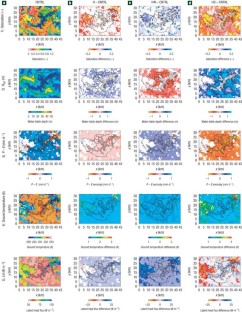
Figure 1: Spatial distribution of yearly averaged water and energy components from CNTRL and scenario calculations.
The alternative text for this image may have been generated using AI.
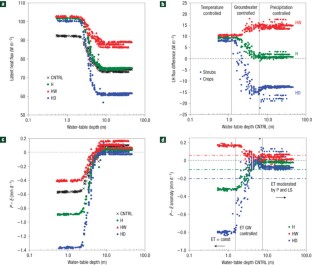
Figure 2: Semi-logarithmic plots of latent heat and P_−_E as a function of water-table depth.
The alternative text for this image may have been generated using AI.
References
- Allen, D. M., Mackie, D. C. & Wei, M. Groundwater and climate change: A sensitivity analysis for the Grand Forks aquifer, southern British Columbia, Canada. Hydrogeol. J. 12, 270–290 (2004).
Article Google Scholar - Scibek, J. & Allen, D. M. Modeled impacts of predicted climate change on recharge and groundwater levels. Wat. Resour. Res. 42, W11405 (2006).
Article Google Scholar - Gulden, L. E. et al. Improving land-surface model hydrology: Is an explicit aquifer model better than a deeper soil profile? Geophys. Res. Lett. 34, L09402 (2007).
Article Google Scholar - Liang, X., Xie, Z. H. & Huang, M. Y. A new parameterization for surface and groundwater interactions and its impact on water budgets with the variable infiltration capacity (VIC) land surface model. J. Geophys. Res.-Atmos. 108, 8613 (2003).
Article Google Scholar - Yeh, P. J. F. & Eltahir, E. A. B. Representation of water table dynamics in a land surface scheme. Part I: Model development. J. Clim. 18, 1861–1880 (2005).
Article Google Scholar - Kollet, S. J. & Maxwell, R. M. Integrated surface-groundwater flow modeling: A free-surface overland flow boundary condition in a parallel groundwater flow model. Adv. Wat. Resour. 29, 945–958 (2006).
Article Google Scholar - Kollet, S. J. & Maxwell, R. M. Capturing the influence of groundwater dynamics on land surface processes using an integrated, distributed watershed model. Wat. Resour. Res. 44, W02402 (2008).
Article Google Scholar - Maxwell, R. M. & Miller, N. L. Development of a coupled land surface and groundwater model. J. Hydrometeorol. 6, 233–247 (2005).
Article Google Scholar - Schubert, S. D. et al. Potential predictability of long-term drought and pluvial conditions in the US Great Plains. J. Clim. 21, 802–816 (2008).
Article Google Scholar - Cayan, D. R. et al. Climate change scenarios for the California region. Clim. Change 87, S21–S42 (2008).
Article Google Scholar - Dettinger, M. D. et al. Simulated hydrologic responses to climate variations and change in the Merced, Carson, and American River basins, Sierra Nevada, California, 1900–2099. Clim. Change 62, 283–317 (2004).
Article Google Scholar - Vanrheenen, N. T. et al. Potential implications of PCM climate change scenarios for Sacramento-San Joaquin River Basin hydrology and water resources. Clim. Change 62, 257–281 (2004).
Article Google Scholar - Hong, S. Y. & Kalnay, E. Role of sea surface temperature and soil-moisture feedback in the 1998 Oklahoma-Texas drought. Nature 408, 842–844 (2000).
Article Google Scholar - Hong, S. Y. & Kalnay, E. The 1998 Oklahoma-Texas drought: Mechanistic experiments with NCEP global and regional models. J. Clim. 15, 945–963 (2002).
Article Google Scholar - Schubert, S. D. et al. On the cause of the 1930s dust bowl. Science 303, 1855–1859 (2004).
Article Google Scholar - Tague, C. et al. Deep groundwater mediates streamflow response to climate warming in the Oregon Cascades. Clim. Change 86, 189–210 (2008).
Article Google Scholar - Scibek, J. et al. Groundwater-surface water interaction under scenarios of climate change using a high-resolution transient groundwater model. J. Hydrol. 333, 165–181 (2007).
Article Google Scholar - York, J. P. et al. Putting aquifers into atmospheric simulation models: An example from the Mill Creek Watershed, northeastern Kansas. Adv. Wat. Resour. 25, 221–238 (2002).
Article Google Scholar - Maxwell, R. M., Chow, F. K. & Kollet, S. J. The groundwater-land-surface-atmosphere connection: Soil moisture effects on the atmospheric boundary layer in fully-coupled simulations. Adv. Wat. Resour. 30, 2447–2466 (2007).
Article Google Scholar - Christensen, J. H. et al. in Climate Change 2007: The Physical Science Basis. Contribution of Working Group I to the Fourth Assessment Report of the Intergovernmental Panel on Climate Change (eds Solomon, S. et al.) (Cambridge Univ. Press, Cambridge, 2007).
Google Scholar - Seager, R. et al. Model projections of an imminent transition to a more arid climate in southwestern North America. Science 316, 1181–1184 (2007).
Article Google Scholar - Chen, F. & Avissar, R. The impact of land-surface wetness heterogeneity on mesoscale heat fluxes. J. Appl. Meteorol. 33, 1323–1340 (1994).
Article Google Scholar - Patton, E. G., Sullivan, P. P. & Moeng, C. H. The influence of idealized heterogeneity on wet and dry planetary boundary layers coupled to the land surface. J. Atmos. Sci. 62, 2078–2097 (2005).
Article Google Scholar - Seiffert, R. & von Storch, J.-S. Impact of atmospheric small-scale fluctuations on climate sensitivity. Geophys. Res. Lett. 25, L10704 (2008).
Google Scholar - Jones, J. E. & Woodward, C. S. Newton–Krylov–multigrid solvers for large-scale, highly heterogeneous, variably saturated flow problems. Adv. Wat. Resour. 24, 763–774 (2001).
Article Google Scholar - Ashby, S. F. & Falgout, R. D. A parallel multigrid preconditioned conjugate gradient algorithm for groundwater flow simulations. Nucl. Sci. Eng. 124, 145–159 (1996).
Article Google Scholar - Dai, Y. J. et al. The common land model. Bull. Am. Meteorol. Soc. 84, 1013–1023 (2003).
Article Google Scholar
Acknowledgements
This work carried out under the auspices of the US Department of Energy by Lawrence Livermore National Laboratory under Contract DE-AC52-07NA27344 and was supported by the LLNL Climate Change Initiative.
Author information
Author notes
- Current address: Department of Geology and Geologic Engineering, Colorado School of Mines, Golden, Colorado 80401, USA
- rmaxwell@mines.edu
Authors and Affiliations
- Earth and Energy Sciences Division, Atmospheric, Lawrence Livermore National Laboratory (L-103), 7000 East Avenue, Livermore, California 94550, USA
Reed M. Maxwell - Metereological Institute, Bonn University, Auf dem Huegel 20, 53121 Bonn, Germany
Stefan J. Kollet
Authors
- Reed M. Maxwell
- Stefan J. Kollet
Corresponding authors
Correspondence toReed M. Maxwell or Stefan J. Kollet.
Rights and permissions
About this article
Cite this article
Maxwell, R., Kollet, S. Interdependence of groundwater dynamics and land-energy feedbacks under climate change.Nature Geosci 1, 665–669 (2008). https://doi.org/10.1038/ngeo315
- Received: 12 June 2008
- Accepted: 28 August 2008
- Published: 28 September 2008
- Issue date: October 2008
- DOI: https://doi.org/10.1038/ngeo315