The case for mandatory sequestration (original) (raw)
- Commentary
- Published: December 2009
Nature Geoscience volume 2, pages 813–814 (2009) Cite this article
- 2284 Accesses
- 38 Citations
- 54 Altmetric
- Metrics details
The fact that cumulative carbon dioxide emissions are more important than annual emission rates calls for a fresh approach to climate change mitigation. One option would be a mandatory link between carbon sequestration and fossil fuel extraction.
This is a preview of subscription content, access via your institution
Relevant articles
Open Access articles citing this article.
Access options
Subscribe to this journal
Receive 12 print issues and online access
$259.00 per year
only $21.58 per issue
Buy this article
- Purchase on SpringerLink
- Instant access to the full article PDF.
USD 39.95
Prices may be subject to local taxes which are calculated during checkout
Additional access options:
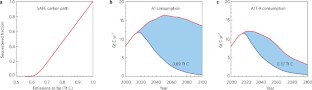
Figure 1: SAFE carbon futures.
The alternative text for this image may have been generated using AI.
References
- Hansen J. E. et al. Open Atmos. Sci. J. 2, 217–231 (2009).
Google Scholar - Solomon, S., Plattner, G.-K., Knutti, R. & Friedlingstein, P. Proc. Natl Acad. Sci. USA 106, 1704–1709 (2009).
Google Scholar - Allen, M. R. et al. Nature 458, 1163–1166 (2009).
Google Scholar - Meinshausen, M. et al. Nature 458, 1158–1162 (2009).
Google Scholar - Matthews, H. D. et al. Nature 459, 829–832 (2009).
Google Scholar - Zickfeld, K. et al. Proc. Natl Acad. Sci. USA 106, 16129–16134 (2009).
Google Scholar - German Advisory Council on Global Change Solving the Climate Dilemma: The Budget Approach (WGBU, 2009).
- Stern, N. The Economics of Climate Change (Cambridge Univ. Press, 2007).
Google Scholar - International Energy Agency World Energy Outlook 2009 (IEA, 2009).
- Jackson, T. Alternatives to Growth (Sustainable Development Commission, 2009).
Google Scholar - IPCC Special Report on Carbon Capture and Storage (eds Metz, B. et al.) (Cambridge Univ. Press, 2005).
- Tickell, O. Kyoto 2: How to Manage the Global Greenhouse (Zed Books, 2008).
Google Scholar - Victor, D. Nature 459, 909 (2009).
Google Scholar - Keith, D. W. et al. in Geo-Engineering Climate Change (eds Launder, B. & Thompson, M.) Ch. 6 (Cambridge Univ. Press, 2009).
Google Scholar - IPCC Special Report on Emissions Scenarios (eds Nakicenovic, N. & Swart, R.) (Cambridge Univ. Press, 2000).
- Prins, G. & Rayner, S. Nature 449, 973–975 (2007).
Google Scholar - Tol, R. S. J. Economics E-Journal 2, 2008–25 (2008).
Google Scholar
Acknowledgements
The authors acknowledge support from the Smith School Associates and Visitors Programme.
Author information
Authors and Affiliations
- Department of Physics, University of Oxford, Oxford, OX1 3PU, UK
Myles R. Allen & David J. Frame - Smith School of Enterprise and the Environment, University of Oxford, Oxford, OX1 2BQ, UK
David J. Frame & Charles F. Mason - Department of Economics and Finance, University of Wyoming, Laramie, 82071, Wyoming, USA
Charles F. Mason
Authors
- Myles R. Allen
- David J. Frame
- Charles F. Mason
Corresponding author
Correspondence toMyles R. Allen.
Rights and permissions
About this article
Cite this article
Allen, M., Frame, D. & Mason, C. The case for mandatory sequestration.Nature Geosci 2, 813–814 (2009). https://doi.org/10.1038/ngeo709
- Issue date: December 2009
- DOI: https://doi.org/10.1038/ngeo709