Increased tree carbon storage in response to nitrogen deposition in the US (original) (raw)
- Letter
- Published: 22 December 2009
Nature Geoscience volume 3, pages 13–17 (2010) Cite this article
- 4452 Accesses
- 677 Citations
- 65 Altmetric
- Metrics details
Abstract
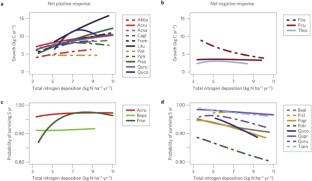
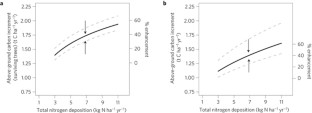
Human activities have greatly accelerated emissions of both carbon dioxide and biologically reactive nitrogen to the atmosphere1,2. As nitrogen availability often limits forest productivity3, it has long been expected that anthropogenic nitrogen deposition could stimulate carbon sequestration in forests4. However, spatially extensive evidence for deposition-induced stimulation of forest growth has been lacking, and quantitative estimates from models and plot-level studies are controversial5,6,7,8,9,10. Here, we use forest inventory data to examine the impact of nitrogen deposition on tree growth, survival and carbon storage across the northeastern and north-central USA during the 1980s and 1990s. We show a range of growth and mortality responses to nitrogen deposition among the region’s 24 most common tree species. Nitrogen deposition (which ranged from 3 to 11 kg ha−1 yr−1) enhanced the growth of 11 species and decreased the growth of 3 species. Nitrogen deposition enhanced growth of all tree species with arbuscular mycorrhizal fungi associations. In the absence of disturbances that reduced carbon stocks by more than 50%, above-ground biomass increment increased by 61 kg of carbon per kg of nitrogen deposited, amounting to a 40% enhancement over pre-industrial conditions. Extrapolating to the globe, we estimate that nitrogen deposition could increase tree carbon storage by 0.31 Pg carbon yr−1.
This is a preview of subscription content, access via your institution
Access options
Subscribe to this journal
Receive 12 print issues and online access
$259.00 per year
only $21.58 per issue
Buy this article
- Purchase on SpringerLink
- Instant access to the full article PDF.
USD 39.95
Prices may be subject to local taxes which are calculated during checkout
Additional access options:
Figure 1: Growth and survival response to increasing nitrogen deposition.
The alternative text for this image may have been generated using AI.
Figure 2: Annual above-ground carbon increment increases with nitrogen deposition.
The alternative text for this image may have been generated using AI.
References
- Denman, K. L. et al. in IPCC Climate Change 2007: The Physical Science Basis (eds Solomon, S. et al.) (Cambridge Univ. Press, 2007).
Google Scholar - Galloway, J. N. et al. Nitrogen cycles: Past, present, and future. Biogeochemistry 70, 153–226 (2004).
Article Google Scholar - LeBauer, D. S. & Treseder, K. K. Nitrogen limitation of net primary productivity in terrestrial ecosystems is globally distributed. Ecology 89, 371–379 (2008).
Article Google Scholar - Melillo, J. M. & Gosz, J. R. in The Major Biogeochemical Cycles and Their Interactions (eds Bolin, B. & Cook, R. B.) 177–222 (John Wiley & Sons, 1983).
Google Scholar - Janssens, I. A. & Luyssaert, S. Nitrogen’s carbon bonus. Nature Geosci. 2, 318–319 (2009).
Article Google Scholar - Magnani, F. et al. The human footprint in the carbon cycle of temperate and boreal forests. Nature 447, 849–851 (2007).
Article Google Scholar - Magnani, F. et al. Ecologically implausible carbon response? Reply. Nature 451, E3–E4 (2008).
Article Google Scholar - De Vries, W. et al. Ecologically implausible carbon response? Nature 451, E1–E3 (2008).
Article Google Scholar - Sutton, M. et al. Uncertainties in the relationship between atmospheric nitrogen deposition and forest carbon sequestration. Glob. Change Biol. 14, 2057–2063 (2008).
Article Google Scholar - Reay, D. S et al. Global nitrogen deposition and carbon sinks. Nature Geosci. 1, 430–437 (2008).
Article Google Scholar - Holland, E. A. et al. Variations in the predicted spatial distribution of atmospheric nitrogen deposition and their impact on carbon uptake by terrestrial ecosystems. J. Geophys. Res. 102, 15849–15866 (1997).
Article Google Scholar - Townsend, A. R., Braswell, B. H., Holland, E. A. & Penner, J. E. Spatial and temporal patterns in terrestrial carbon storage due to deposition of fossil fuel nitrogen. Ecol. Appl. 6, 806–814 (1996).
Article Google Scholar - Thornton, P. E., Lamarque, J., Rosenbloom, N. A. & Mahowald, N. M. Influence of carbon-nitrogen cycle coupling on land model response to CO2 fertilization and climate variability. Glob. Biogeochem. Cycles 21, GB4018 (2007).
Article Google Scholar - Caspersen, J. P. et al. Contributions of land-use history to carbon accumulation in US forests. Science 290, 1148–1151 (2000).
Article Google Scholar - Nadelhoffer, K. J. et al. Nitrogen deposition makes a minor contribution to carbon sequestration in temperate forests. Nature 398, 145–148 (1999).
Article Google Scholar - Hyvönen, R. et al. Impact of long-term nitrogen addition on carbon stocks in trees and soils in northern Europe. Biogeochemistry 89, 121–137 (2008).
Article Google Scholar - Magill, A. H. et al. Ecosystem response to 15 years of chronic nitrogen additions at the Harvard Forest LTER, Massachusetts, USA. Forest Ecol. Management 196, 7–28 (2004).
Article Google Scholar - Wallace, Z., Lovett, G., Hart, J. & Machona, B. Effects of nitrogen saturation on tree growth and death in a mixed-oak forest. Forest Ecol. Manage. 243, 210–218 (2007).
Article Google Scholar - Ollinger, S. V., Aber, J. D., Reich, P. B. & Freuder, R. J. Interactive effects of nitrogen deposition, tropospheric ozone, elevated CO2 and land use history on the carbon dynamics of northern hardwood forests. Glob. Change Biol. 8, 545–562 (2002).
Article Google Scholar - Lovett, G. M. et al. Forest ecosystem responses to exotic pests and pathogens in eastern North America. Bioscience 56, 395–405 (2006).
Article Google Scholar - Chalot, M. & Brun, A. Physiology of organic nitrogen acquisition by ectomycorrhizal fungi and ectomycorrhizas. Fems Microbiol. Rev. 22, 21–44 (1998).
Article Google Scholar - Aber, J. et al. Nitrogen saturation in temperate forest ecosystems—hypotheses revisited. Bioscience 48, 921–934 (1998).
Article Google Scholar - Hautier, Y., Niklaus, P. A. & Hector, A. Competition for light causes plant biodiversity loss after eutrophication. Science 324, 636–638 (2009).
Article Google Scholar - Solberg, S. et al. Analyses of the impact of changes in atmospheric deposition and climate on forest growth in European monitoring plots: A stand growth approach. Forest Ecol. Manage. 258, 1735–1750 (2009).
Article Google Scholar - Joos, F., Prentice, I. C. & House, J. I. Growth enhancement due to global atmospheric change as predicted by terrestrial ecosystem models: Consistent with US forest inventory data. Glob. Change Biol. 8, 299–303 (2002).
Article Google Scholar - Norby, R. J. et al. Forest response to elevated CO2 is conserved across a broad range of productivity. Proc. Natl Acad. Sci. USA 102, 18052–18056 (2005).
Article Google Scholar - Jenkins, J. C., Chojnacky, D. C., Heath, L. S. & Birdsey, R. A. National-scale biomass estimators for United States tree species. Forest Sci. 49, 12–35 (2003).
Google Scholar - Schindler, D. W. & Bayley, S. E. The biosphere as an increasing sink for atmospheric carbon—estimates from increased nitrogen deposition. Glob. Biogeochem. Cycles 7, 717–733 (1993).
Article Google Scholar - Hurtt, G. C. et al. Projecting the future of the US carbon sink. Proc. Natl Acad. Sci. USA 99, 1389–1394 (2002).
Article Google Scholar - Burnham, K. P. & Anderson, D. R. Model Selection and Multimodel Inference: A Practical Information-Theoretic Approach 2nd edn (Springer, 2002).
Google Scholar
Acknowledgements
This research was supported, in part, by a grant to C.D.C. from the US Department of Energy, National Institute for Climatic Change Research, a Marie Tharp Fellowship, Columbia University to K.C.W., NSF-DEB award #0614099 to C.L.G. and a Kieckhefer Adirondack Foundation grant to R.Q.T. We would like to thank staff from the US Forest Service FIA Program, particularly E. LaPoint, for making the FIA data available to us, and for their considerable help in compiling this particular data set. We also thank C. Carey, J. Caspersen, W. De Vries, F. Magnani, N. Mahowald and W. Schlesinger for suggestions and comments on the manuscript.
Author information
Authors and Affiliations
- Department of Ecology and Evolutionary Biology, Cornell University, Corson Hall, Ithaca, New York 14853, USA
R. Quinn Thomas & Christine L. Goodale - Cary Institute of Ecosystem Studies, Box AB, Millbrook, New York, 12545, USA
Charles D. Canham & Kathleen C. Weathers
Authors
- R. Quinn Thomas
- Charles D. Canham
- Kathleen C. Weathers
- Christine L. Goodale
Contributions
R.Q.T., C.D.C., K.C.W. and C.L.G. all contributed to the development of project ideas, design, analysis interpretation and to writing of the manuscript, with C.L.G. and R.Q.T. originating the project. In addition, C.D.C. and R.Q.T. assembled the FIA and climate data and carried out the statistical analyses, K.C.W. developed the N deposition estimates and C.L.G. and R.Q.T. provided the carbon framework.
Corresponding author
Correspondence toR. Quinn Thomas.
Ethics declarations
Competing interests
The authors declare no competing financial interests.
Supplementary information
Rights and permissions
About this article
Cite this article
Quinn Thomas, R., Canham, C., Weathers, K. et al. Increased tree carbon storage in response to nitrogen deposition in the US.Nature Geosci 3, 13–17 (2010). https://doi.org/10.1038/ngeo721
- Received: 05 October 2009
- Accepted: 17 November 2009
- Published: 22 December 2009
- Issue date: January 2010
- DOI: https://doi.org/10.1038/ngeo721