Patterns of Indian Ocean sea-level change in a warming climate (original) (raw)
- Letter
- Published: 11 July 2010
- Gerald A. Meehl2,
- Balaji Rajagopalan3,
- John T. Fasullo2,
- Aixue Hu2,
- Jialin Lin4,
- William G. Large2,
- Jih-wang Wang1,
- Xiao-Wei Quan5,
- Laurie L. Trenary1,
- Alan Wallcraft6,
- Toshiaki Shinoda6 &
- …
- Stephen Yeager2
Nature Geoscience volume 3, pages 546–550 (2010) Cite this article
- 4536 Accesses
- 238 Citations
- 41 Altmetric
- Metrics details
Subjects
Abstract
Global sea level has risen during the past decades as a result of thermal expansion of the warming ocean and freshwater addition from melting continental ice1. However, sea-level rise is not globally uniform1,2,3,4,5. Regional sea levels can be affected by changes in atmospheric or oceanic circulation. As long-term observational records are scarce, regional changes in sea level in the Indian Ocean are poorly constrained. Yet estimates of future sea-level changes are essential for effective risk assessment2. Here we combine in situ and satellite observations of Indian Ocean sea level with climate-model simulations, to identify a distinct spatial pattern of sea-level rise since the 1960s. We find that sea level has decreased substantially in the south tropical Indian Ocean whereas it has increased elsewhere. This pattern is driven by changing surface winds associated with a combined invigoration of the Indian Ocean Hadley and Walker cells, patterns of atmospheric overturning circulation in the north–south and east–west direction, respectively, which is partly attributable to rising levels of atmospheric greenhouse gases. We conclude that—if ongoing anthropogenic warming dominates natural variability—the pattern we detected is likely to persist and to increase the environmental stress on some coasts and islands in the Indian Ocean.
This is a preview of subscription content, access via your institution
Access options
Subscribe to this journal
Receive 12 print issues and online access
$259.00 per year
only $21.58 per issue
Buy this article
- Purchase on SpringerLink
- Instant access to the full article PDF.
USD 39.95
Prices may be subject to local taxes which are calculated during checkout
Additional access options:
Figure 1: Tide-gauge-observed and HYCOM-simulated annual mean sea level anomalies (SLAs) and their Kendall Theil trends[26](/articles/ngeo901#ref-CR26 "Helsel, D. R. & Hirsch, R. M. Statistical Methods in Water Resources, online book, http://pubs.usgs.gov/twri/twri4a3/html/pdf_new.html
.") during 1961–2008.
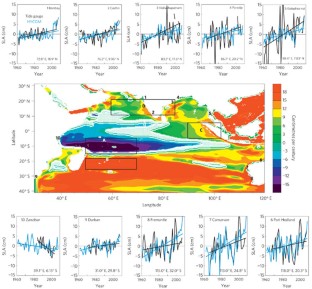
The alternative text for this image may have been generated using AI.
Figure 2: Time series of annual mean SLA from HYCOM during 1961–2008 and from satellite-observed sea level for 1993–2008.

The alternative text for this image may have been generated using AI.
Figure 3: Kendall Theil trends of surface wind stress, Ekman pumping velocity and time series of SST.
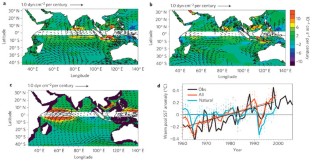
The alternative text for this image may have been generated using AI.
Figure 4: A schematic diagram showing the mechanisms for the Indo-Pacific warm-pool warming to cause the Indian Ocean sea-level change.
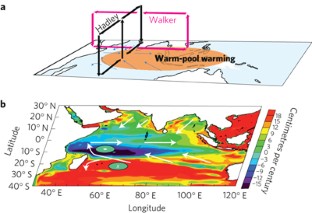
The alternative text for this image may have been generated using AI.
References
- Bindoff, N. et al. in IPCC WG1 Fourth Assessment Report (eds Solomon, S. et al.) (Cambridge Univ. Press, 2007).
Google Scholar - Milne, G. A. et al. Identifying the causes of sea-level change. Nature Geosci. 2, 471–478 (2009).
Article Google Scholar - Unnikrishnan, A. S. & Shankar, D. Are sea-level-rise trends along the coasts of the north Indian Ocean consistent with global estimates? Global Planet. Change 57, 301–307 (2007).
Article Google Scholar - Solomon, S. et al. (eds) IPCC WG1 Fourth Assessment Report (Cambridge Univ. Press, 2007).
- Woodworth, P. L. et al. Evidence for the accelerations of sea level on multi-decade and century timescales. Int. J. Climatol. 29, 777–789 (2009).
Article Google Scholar - Woodworth, P. L. & Player, R. The permanent service for mean sea level: An update to the 21st century. J. Coast. Res. 19, 287–295 (2003).
Google Scholar - Peltier, W. R. Global glacial isostasy and the surface of the ice-age Earth: The ICE-5G (VM2) Model and GRACE. Annu. Rev. Earth Planet. Sci. 32, 111–149 (2004).
Article Google Scholar - Church, J. A. et al. Estimates of the regional distribution of sea level rise over the 1950–2000 period. J. Clim. 17, 2609–2625 (2004).
Article Google Scholar - McCreary, J. P. et al. A numerical investigation of dynamics, thermodynamics and mixed-layer processes in the Indian Ocean. Prog. Oceanogr. 31, 181–244 (1993).
Article Google Scholar - Han, W. et al. Interpretation of tropical thermocline cooling in the Indian and Pacific Oceans during recent decades. Geophys. Res. Lett. 33, L03609 (2006).
Google Scholar - Alory, G. S. et al. Observed temperature trends in the Indian Ocean over 1960–1999 and associated mechanisms. Geophys. Res. Lett. 34, L02606 (2007).
Article Google Scholar - Trenary, L. L. & Han, W. Causes of decadal subsurface cooling in the tropical Indian Ocean during 1961–2000. Geophys. Res. Lett. 35, L17602 (2008).
Article Google Scholar - Ducet, N. et al. Global high resolution mapping of ocean circulation from TOPEX/Poseidon and ERS-1/2. J. Geophys. Res. 105, 19477–19498 (2000).
Article Google Scholar - Douglas, B. C. et al. (eds) Sea Level Rise– History and Consequences (International Geophysics Series, Vol. 75, Academic, 2001).
- Domingues, C. M. et al. Improved estimates of upper-ocean warming and multi-decadal sea-level rise. Nature 453, 1090–1094 (2008).
Article Google Scholar - Mitrovica, J. X. et al. The sea-level fingerprint of West Antarctic collapse. Science 323, 753 (2009).
Article Google Scholar - Carton, J. A. & Giese, B. A reanalysis of ocean climate using Simple Ocean Data Assimilation (SODA). Mon. Weath. Rev. 136, 2999–3017 (2008).
Article Google Scholar - Greatbatch, R. J. A note on the representation of steric sea level in models that conserve volume rather than mass. J. Geophys. Res. 99, 12767–12771 (1994).
Article Google Scholar - Timmermann, A. et al. Wind effects on past and future regional sea-level trends in the southern Indo-Pacific. J. Clim. 1175/2010JCLI3519.1(2010, in the press).
- Yu, B. & Zwiers, F. W. Changes in equatorial atmospheric zonal circulations in recent decades. Geophys. Res. Lett. 37, L05701 (2010).
Google Scholar - Worley, S. J. et al. ICOADS release 2.1 data and products. Int. J. Clim. 25, 823–842 (2005).
Article Google Scholar - Cardone, V. J. et al. On trends in historical marine wind data. J. Clim. 3, 113–127 (1990).
Article Google Scholar - Ramesh Kumar, M. R. et al. Increasing trend of break-monsoon conditions over India—role of ocean-atmosphere processes in the Indian Ocean. Remote Sens. Lett. 6, 332–336 (2009).
Article Google Scholar - Giannini, A. et al. Oceanic forcing of Sahel rainfall on interannual to interdecadal time scales. Science 302, 1027–1030 (2003).
Article Google Scholar - Hoerling, M. et al. Twentieth century north Atlantic climate change. Part II: Understanding the effect of Indian Ocean warming. Clim. Dyn. 23, 391–405 (2004).
Article Google Scholar - Helsel, D. R. & Hirsch, R. M. Statistical Methods in Water Resources, online book, http://pubs.usgs.gov/twri/twri4a3/html/pdf_new.html.
- Rayner, N. A. et al. Improved analyses of changes and uncertainties in marine temperature measured in situ since the mid-nineteenth century: The HadSST2 dataset. J. Clim. 19, 446–469 (2006).
Article Google Scholar
Acknowledgements
This work was completed when W.H. was on sabbatical leave at NCAR. She thanks CCR/NCAR for providing partial summer salary support. Thanks also go to K. Trenberth, A. Timmermann, C. Deser and A. Dai for their insightful comments and stimulating discussions. W.H., J-W.W. and L.L.T. are supported by NSF CAREER award OCE 0847605 and NASA OSTST award NNX08AR62G. Portions of this study were supported by the Office of Science (BER), US Department of Energy, Cooperative Agreement No. DE-FC02-97ER62402, and the National Science Foundation. NCAR is sponsored by the National Science Foundation. J.T.F’s participation is sponsored by NASA Award No. NNX07AKG82G. We thank NCAR CISL for computational support.
Author information
Authors and Affiliations
- Department of Atmospheric and Oceanic Sciences, University of Colorado, UCB 311, Boulder, Colorado 80309, USA
Weiqing Han, Jih-wang Wang & Laurie L. Trenary - Climate and Global Dynamics Division, National Center for Atmospheric Research, Boulder, Colorado 80305, USA
Gerald A. Meehl, John T. Fasullo, Aixue Hu, William G. Large & Stephen Yeager - Department of Civil, Environmental and Architectural Engineering/CIRES, University of Colorado, Boulder, Colorado 80309, USA
Balaji Rajagopalan - Department of Geography, The Ohio State University, Columbus, Ohio 43210, USA
Jialin Lin - CIRES, University of Colorado/ESRL NOAA, Boulder, Colorado 80309, USA
Xiao-Wei Quan - Naval Research Laboratory, Stennis Space Center, Mississippi 39529, USA
Alan Wallcraft & Toshiaki Shinoda
Authors
- Weiqing Han
- Gerald A. Meehl
- Balaji Rajagopalan
- John T. Fasullo
- Aixue Hu
- Jialin Lin
- William G. Large
- Jih-wang Wang
- Xiao-Wei Quan
- Laurie L. Trenary
- Alan Wallcraft
- Toshiaki Shinoda
- Stephen Yeager
Contributions
W.H. led the project and did the main analyses and primary HYCOM experiment, J.T.F. analysed atmospheric reanalysis products, A.H. processed the climate-model results, J-W.W. processed the tide-gauge data, X-W.Q. carried out the AGCM experiments, L.L.T. did the extended HYCOM run, A.W. helped to design and run all HYCOM experiments, S.Y. carried out the POP model experiment and G.A.M., B.R., W.G.L., J.L. and T.S. contributed to the scientific results through stimulating discussions and analyses. All authors contributed extensively to writing the paper and analysing the results.
Corresponding author
Correspondence toWeiqing Han.
Ethics declarations
Competing interests
The authors declare no competing financial interests.
Supplementary information
Rights and permissions
About this article
Cite this article
Han, W., Meehl, G., Rajagopalan, B. et al. Patterns of Indian Ocean sea-level change in a warming climate.Nature Geosci 3, 546–550 (2010). https://doi.org/10.1038/ngeo901
- Received: 26 March 2010
- Accepted: 04 June 2010
- Published: 11 July 2010
- Issue date: August 2010
- DOI: https://doi.org/10.1038/ngeo901