Multiple microRNAs modulate p21Cip1/Waf1 expression by directly targeting its 3′ untranslated region (original) (raw)
- Short Communication
- Published: 01 March 2010
Oncogene volume 29, pages 2302–2308 (2010)Cite this article
- 4123 Accesses
- 351 Citations
- 3 Altmetric
- Metrics details
Subjects
Abstract
Cyclin-dependent kinase inhibitor 1A (CDKN1A), also known as p21Cip1/Waf1, is a master downstream effector of tumor suppressors. In this study, we experimentally demonstrate through a high-throughput luciferase reporter screen that p21Cip1/Waf1 can be directly targeted by nearly 28 microRNAs (miRNAs). The results were further confirmed by a series of mutational analyses and luciferase reporter assays. These 28 miRNAs can substantially inhibit p21Cip1/Waf1 expression, predominantly at translational level. Many of these miRNAs were upregulated in cancers and might serve as modulators of oncogenesis. Furthermore, 8 of these 28 p21-regulating miRNAs are located in the chromosome 19 miRNA cluster, the largest miRNA gene cluster in humans, and they can clearly promote cell proliferation and cell-cycle progression in choriocarcinoma cells. In conclusion, our screening strategy provides an alternative approach to uncovering miRNA modulators of an individual mRNA, and it has identified multiple miRNAs that can suppress p21Cip1/Waf1 expression by directly targeting its 3′ untranslated region.
This is a preview of subscription content, access via your institution
Access options
Subscribe to this journal
Receive 50 print issues and online access
$259.00 per year
only $5.18 per issue
Buy this article
- Purchase on SpringerLink
- Instant access to the full article PDF.
USD 39.95
Prices may be subject to local taxes which are calculated during checkout
Additional access options:
Figure 1

The alternative text for this image may have been generated using AI.
Figure 2
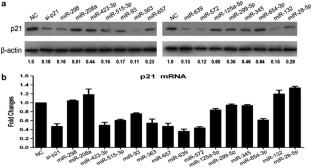
The alternative text for this image may have been generated using AI.
Figure 3

The alternative text for this image may have been generated using AI.
Figure 4
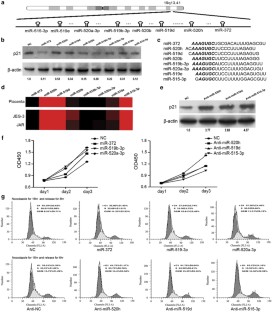
The alternative text for this image may have been generated using AI.
References
- Abbas T, Dutta A . (2009). p21 in cancer: intricate networks and multiple activities. Nat Rev Cancer 9: 400–414.
Article CAS PubMed PubMed Central Google Scholar - Ambros V . (2004). The functions of animal microRNAs. Nature 431: 350–355.
Article CAS PubMed Google Scholar - Bartel DP . (2004). MicroRNAs: genomics, biogenesis, mechanism, and function. Cell 116: 281–297.
Article CAS PubMed Google Scholar - Bentwich I, Avniel A, Karov Y, Aharonov R, Gilad S, Barad O et al. (2005). Identification of hundreds of conserved and nonconserved human microRNAs. Nat Genet 37: 766–770.
Article CAS PubMed Google Scholar - Bortolin-Cavaille ML, Dance M, Weber M, Cavaille J . (2009). C19MC microRNAs are processed from introns of large Pol-II, non-protein-coding transcripts. Nucleic Acids Res 37: 3464–3473.
Article CAS PubMed PubMed Central Google Scholar - Gartel AL, Tyner AL . (1999). Transcriptional regulation of the p21((WAF1/CIP1)) gene. Exp Cell Res 246: 280–289.
Article CAS PubMed Google Scholar - Gottardo F, Liu CG, Ferracin M, Calin GA, Fassan M, Bassi P et al. (2007). Micro-RNA profiling in kidney and bladder cancers. Urol Oncol 25: 387–392.
Article CAS PubMed Google Scholar - Guled M, Lahti L, Lindholm PM, Salmenkivi K, Bagwan I, Nicholson AG et al. (2009). CDKN2A, NF2, and JUN are dysregulated among other genes by miRNAs in malignant mesothelioma-A miRNA microarray analysis. Genes Chromosomes Cancer 48: 615–623.
Article CAS PubMed Google Scholar - Harper JW, Adami GR, Wei N, Keyomarsi K, Elledge SJ . (1993). The p21 Cdk-interacting protein Cip1 is a potent inhibitor of G1 cyclin-dependent kinases. Cell 75: 805–816.
Article CAS PubMed Google Scholar - Hausser J, Berninger P, Rodak C, Jantscher Y, Wirth S, Zavolan M . (2009). MirZ: an integrated microRNA expression atlas and target prediction resource. Nucleic Acids Res 37: 266–W272.
Article Google Scholar - Ivanovska I, Ball AS, Diaz RL, Magnus JF, Kibukawa M, Schelter JM et al. (2008). MicroRNAs in the miR-106b family regulate p21/CDKN1A and promote cell cycle progression. Mol Cell Biol 28: 2167–2174.
Article CAS PubMed PubMed Central Google Scholar - Jongen-Lavrencic M, Sun SM, Dijkstra MK, Valk PJ, Lowenberg B . (2008). MicroRNA expression profiling in relation to the genetic heterogeneity of acute myeloid leukemia. Blood 111: 5078–5085.
Article CAS PubMed Google Scholar - Krek A, Grun D, Poy MN, Wolf R, Rosenberg L, Epstein EJ et al. (2005). Combinatorial microRNA target predictions. Nat Genet 37: 495–500.
Article CAS PubMed Google Scholar - Lewis BP, Burge CB, Bartel DP . (2005). Conserved seed pairing, often flanked by adenosines, indicates that thousands of human genes are microRNA targets. Cell 120: 15–20.
Article CAS PubMed Google Scholar - Lionetti M, Biasiolo M, Agnelli L, Todoerti K, Mosca L, Fabris S et al. (2009). Identification of microRNA expression patterns and definition of a microRNA/mRNA regulatory network in distinct molecular groups of multiple myeloma. Blood 114: e20–e26.
Article CAS PubMed Google Scholar - Lv K, Guo Y, Zhang Y, Wang K, Jia Y, Sun S . (2008). Allele-specific targeting of hsa-miR-657 to human IGF2R creates a potential mechanism underlying the association of ACAA-insertion/deletion polymorphism with type 2 diabetes. Biochem Biophys Res Commun 374: 101–105.
Article CAS PubMed Google Scholar - Martin-Caballero J, Flores JM, Garcia-Palencia P, Serrano M . (2001). Tumor susceptibility of p21(Waf1/Cip1)-deficient mice. Cancer Res 61: 6234–6238.
CAS PubMed Google Scholar - Petrocca F, Visone R, Onelli MR, Shah MH, Nicoloso MS, de Martino I et al. (2008). E2F1-regulated microRNAs impair TGFbeta-dependent cell-cycle arrest and apoptosis in gastric cancer. Cancer Cell 13: 272–286.
Article CAS PubMed Google Scholar - Topley GI, Okuyama R, Gonzales JG, Conti C, Dotto GP . (1999). p21(WAF1/Cip1) functions as a suppressor of malignant skin tumor formation and a determinant of keratinocyte stem-cell potential. Proc Natl Acad Sci USA 96: 9089–9094.
Article CAS PubMed PubMed Central Google Scholar - van Rooij E, Sutherland LB, Qi X, Richardson JA, Hill J, Olson EN . (2007). Control of stress-dependent cardiac growth and gene expression by a microRNA. Science 316: 575–579.
Article CAS PubMed Google Scholar - Voorhoeve PM, le Sage C, Schrier M, Gillis AJ, Stoop H, Nagel R et al. (2006). A genetic screen implicates miRNA-372 and miRNA-373 as oncogenes in testicular germ cell tumors. Cell 124: 1169–1181.
Article CAS PubMed Google Scholar - Wong TS, Liu XB, Wong BY, Ng RW, Yuen AP, Wei WI . (2008). Mature miR-184 as potential oncogenic microRNA of squamous cell carcinoma of tongue. Clin Cancer Res 14: 2588–2592.
Article CAS PubMed Google Scholar - Xiong Y, Hannon GJ, Zhang H, Casso D, Kobayashi R, Beach D . (1993). p21 is a universal inhibitor of cyclin kinases. Nature 366: 701–704.
Article CAS PubMed Google Scholar
Acknowledgements
We are most grateful for Dr T Didier's gifts of the pWPXL, psPAX2 and pMD2.G lentivirus plasmids. This work was supported by grants from the Science & Technology Commission of Shanghai Municipality (07DJ14006), the Ministry of Health of China (2008ZX10002-017), the Ministry of Human Resources and Social Security of China (2007-170) and the Doctoral Program of Higher Education of China (200802480076).
Author information
Author notes
- S Wu and S Huang: These authors contributed equally to this work.
Authors and Affiliations
- Department of Hematology, Fujian Medical University Union Hospital, Fujian Institute of Hematology, Fuzhou, China
S Wu & R Zhan - State Key Laboratory of Oncogenes and Related Genes, Shanghai Cancer Institute, Shanghai Jiao Tong University School of Medicine, Shanghai, China
S Wu, S Huang, J Ding, Y Zhao, L Liang & X He - The International Peace Maternity and Child Health Hospital, Shanghai Jiao Tong University School of Medicine, Shanghai, China
T Liu
Authors
- S Wu
- S Huang
- J Ding
- Y Zhao
- L Liang
- T Liu
- R Zhan
- X He
Corresponding authors
Correspondence toR Zhan or X He.
Ethics declarations
Competing interests
The authors declare no conflict of interest.
Additional information
Supplementary Information accompanies the paper on the Oncogene website
Supplementary information
Rights and permissions
About this article
Cite this article
Wu, S., Huang, S., Ding, J. et al. Multiple microRNAs modulate p21Cip1/Waf1 expression by directly targeting its 3′ untranslated region.Oncogene 29, 2302–2308 (2010). https://doi.org/10.1038/onc.2010.34
- Received: 03 November 2009
- Accepted: 17 January 2010
- Published: 01 March 2010
- Issue date: 15 April 2010
- DOI: https://doi.org/10.1038/onc.2010.34