Protecting the poor with a carbon tax and equal per capita dividend (original) (raw)
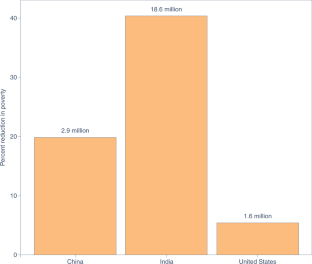
We find that if all countries adopt the necessary uniform global carbon tax and then return the revenues to their citizens on an equal per capita basis, it will be possible to meet a 2 °C target while also increasing wellbeing, reducing inequality and alleviating poverty. These results indicate that it is possible for a society to implement strong climate action without compromising goals for equity and development.
Messages for policy
- The revenues from a carbon tax capable of achieving a 2 °C target will be large enough to fund substantial policies that can promote equity and protect vulnerable populations.
- An equal per capita redistribution of carbon tax revenues within countries — a relatively straightforward policy to implement — can increase wellbeing, reduce inequality and alleviate poverty.
- These benefits occur in countries at all levels of development, primarily accrue to individuals at the bottom of the income distribution, and are even greater with global equal per capita redistribution.
- Large benefits will occur even if some revenues are lost to administrative costs or are saved to fund other programs, and they can make the poorest citizens net beneficiaries this decade.
- Given an equal per capita refund, the optimal timing of global greenhouse gas mitigation is characterized by rapid initial reductions, followed by a slower climb towards net zero emissions.
This is a preview of subscription content, access via your institution
Relevant articles
Open Access articles citing this article.
Assessing the costs of GHG emissions of multi-product agricultural systems in Vietnam
- Aito Yamamoto
- , Thi Kim Uyen Huynh
- … Takashi Fritz Matsuishi
Scientific Reports Open Access 28 October 2022
Access options
Access Nature and 54 other Nature Portfolio journals
Get Nature+, our best-value online-access subscription
$32.99 / 30 days
cancel any time
Subscribe to this journal
Receive 12 print issues and online access
$259.00 per year
only $21.58 per issue
Buy this article
- Purchase on SpringerLink
- Instant access to the full article PDF.
USD 39.95
Prices may be subject to local taxes which are calculated during checkout
Additional access options:
Fig. 1: Poverty reduction with an equal per capita refund of carbon tax revenues.
The alternative text for this image may have been generated using AI.
References
Further reading
- Sterner, T. Fuel Taxes and the Poor: the Distributional Effects of Gasoline Taxation and their Implications for Climate Policy (Routledge, 2012). A volume compiling studies from around the world that together challenge the conventional wisdom that gasoline taxation, an important and much debated instrument of climate policy, has a disproportionately detrimental effect on poor people.
- Klenert, D. et al. Making carbon pricing work for citizens. Nat. Clim. Change 8, 669–677 (2018). A study that synthesizes findings on the optimal use of carbon revenues from both traditional economic analyses and studies in behavioural and political science that are focused on public acceptability.
- Carattini, S., Kallbekken, S. & Orlov, A. How to win public support for a global carbon tax. Nature 565, 289–291 (2019). An article describing evidence indicating that charges on emissions could be popular if revenues are given back to citizens.
Article CAS Google Scholar - Dennig, F., Budolfson, M. B., Fleurbaey, M., Siebert, A. & Socolow, R. H. Inequality, climate impacts on the future poor, and carbon prices. Proc. Natl Acad. Sci. USA 112, 15827–15832 (2015). An article that introduces sub-regional inequality into optimal climate policy models and finds that, when future damage particularly effects the poor, a considerably greater global mitigation effort is needed.
- Economists’ Statement on Carbon Dividends (Climate Leadership Council, 2021); https://clcouncil.org/economists-statement/A statement — signed by over 3600 economists, including 28 Nobel laureates — that describes five policy recommendations to address global climate change, including the use of a carbon tax whereby all revenue is returned directly to citizens through equal per capita rebates.
Acknowledgements
This article has received funding from the NAVIGATE project of the European Union’s Horizon 2020 research and innovation program under grant agreement no. 821124 (S.F., M. Fleurbaey, U.K., A.M., F.W. and S.Z.) and the National Institute of Environmental Health Sciences (NIEHS)-funded HERCULES Center P30ES019776 (N.S.). The authors thank C. Burnham and the Climate Futures Initiative at Princeton University for support.
Author information
Authors and Affiliations
- Department of Environmental and Occupational Health and Justice, Rutgers School of Public Health, Center for Population-Level Bioethics, Rutgers University, New Brunswick, NJ, USA
Mark Budolfson - Department of Philosophy, Rutgers University, New Brunswick, NJ, USA
Mark Budolfson - Division of Social Sciences, Yale-NUS College, Singapore, Singapore
Francis Dennig - Energy and Resources Group, University of California, Berkeley, CA, USA
Frank Errickson - School of Public and International Affairs, Princeton University, Princeton, NJ, USA
Frank Errickson - Mercator Research Institute on Global Commons and Climate Change, Berlin, Germany
Simon Feindt & Ulrike Kornek - Technische Universität Berlin, Department of Economics of Climate Change, Berlin, Germany
Simon Feindt - Department of Global Health and Population, Harvard TH Chan School of Public Health, Harvard University, Boston, MA, USA
Maddalena Ferranna - Paris School of Economics, Paris, France
Marc Fleurbaey - Joint Research Centre, European Commission, Seville, Spain
David Klenert - Potsdam Institute for Climate Impact Research, Potsdam, Germany
Ulrike Kornek - Department of Economics, University of Oklahoma, Norman, OK, USA
Kevin Kuruc - CNRS, CIRED, Nogent-sur-Marne, France
Aurélie Méjean - School of International Affairs & Department of Civil and Environmental Engineering, Pennsylvania State University, State College, PA, USA
Wei Peng - Gangarosa Department of Environmental Health, Rollins School of Public Health, Emory University, Atlanta, GA, USA
Noah Scovronick - Department of Economics, University of Texas, Austin, TX, USA
Dean Spears - International Institute for Applied Systems Analysis, Laxenburg, Austria
Fabian Wagner - Paris School of Economics, CNRS, Centre d’Economie de la Sorbonne, Paris, France
Stéphane Zuber
Authors
- Mark Budolfson
- Francis Dennig
- Frank Errickson
- Simon Feindt
- Maddalena Ferranna
- Marc Fleurbaey
- David Klenert
- Ulrike Kornek
- Kevin Kuruc
- Aurélie Méjean
- Wei Peng
- Noah Scovronick
- Dean Spears
- Fabian Wagner
- Stéphane Zuber
Corresponding authors
Correspondence toMark Budolfson or Noah Scovronick.
Ethics declarations
Competing interests
The authors declare no competing interests.
Rights and permissions
About this article
Cite this article
Budolfson, M., Dennig, F., Errickson, F. et al. Protecting the poor with a carbon tax and equal per capita dividend.Nat. Clim. Chang. 11, 1025–1026 (2021). https://doi.org/10.1038/s41558-021-01228-x
- Published: 29 November 2021
- Version of record: 29 November 2021
- Issue date: December 2021
- DOI: https://doi.org/10.1038/s41558-021-01228-x