Cocoa agroforestry systems versus monocultures: a multi-dimensional meta-analysis (original) (raw)
1748-9326/15/10/104085
Abstract
Scientific knowledge, societal debates, and industry commitments around sustainable cocoa are increasing. Cocoa agroforestry systems are supposed to improve the sustainability of cocoa production. However, their combined agronomic, ecological, and socio-economic performance compared to monocultures is still largely unknown. Here we present a meta-analysis of 52 articles that directly compared cocoa agroforestry systems and monocultures. Using an inductive, multi-dimensional approach, we analyzed the differences in cocoa and total system yield, economic performance, soil chemical and physical properties, incidence of pests and diseases, potential for climate change mitigation and adaptation, and biodiversity conservation. Cocoa agroforestry systems outcompeted monocultures in most indicators. Cocoa yields in agroforestry systems were 25% lower than in monocultures, but total system yields were about ten times higher, contributing to food security and diversified incomes. This finding was supported by a similar profitability of both production systems. Cocoa agroforestry contributed to climate change mitigation by storing 2.5 times more carbon and to adaptation by lowering mean temperatures and buffering temperature extremes. We found no significant differences in relation to the main soil parameters. The effect of the type of production system on disease incidence depended on the fungal species. The few available studies comparing biodiversity showed a higher biodiversity in cocoa agroforestry systems. Increased and specific knowledge on local tree selections and local socio-economic and environmental conditions, as well as building and enabling alternative markets for agroforestry products, could contribute to further adoption and sustainability of cocoa agroforestry systems.
Export citation and abstractBibTeXRIS
Cocoa is an important commodity worldwide. In 2018, up to 5.3 million metric tons of dry cocoa beans were produced on about 12 million hectares [1], mostly by smallholders [2]. The 2018 market value of processed cocoa was estimated at USD 13.4 billion [3]. The increasing global demand for cocoa has led to intensification of cocoa production systems. Consequently, cultivation of cocoa under tree shade is gradually being replaced with full-sun monocultures and the use of agrochemicals [4–6]. Monocultures are often reported to have higher cocoa yields than agroforestry systems, but they cause adverse social-ecological impacts [7, 8]. In many areas, intensified cocoa production has led to deforestation, biodiversity loss, increased carbon emissions, reduction of energy efficiency, soil degradation, and contamination from pesticides [9, 10] as well as to socio-economic problems such as food insecurity and vulnerability to cocoa price volatilities [11]. Unsustainable exploitation of natural resources can lead to environmental disasters and social conflicts [12], while crop diversification strategies aim to reduce environmental impacts [13]. Therefore, farmers’ livelihoods, including both profitability and food security, need to be considered together with other sustainability indicators of cocoa production systems such as biodiversity conservation, climate change mitigation and adaptation, and soil fertility.
Increasing yields while reducing costs is one of the main targets of the cocoa industry. Producers need to make a living from cocoa as a cash crop, and are often circumspect of cocoa agroforestry systems due to the likelihood of increased costs of labor and inputs. Lack of knowledge on the management of shade and fruit trees, access to planting material or tools, and market constraints are some of the reasons that prevent a broader adoption of agroforestry systems [14]. However, the growing social awareness of cocoa’s social-ecological impacts is putting pressure on the cocoa value chain to source from sustainable production systems that minimize deforestation, biodiversity degradation and child labor, and allow farmers to earn a living income. The sustainability commitments of some of the largest chocolate companies indicate the need and willingness of the processing industry to invest in the sustainability of the cocoa value chains [15, 16]. Agroforestry systems, which grow timber, fruit and other trees together with cocoa trees, have the potential to increase the sustainability of cocoa production. Trees on agricultural land play a crucial role in a context of climate change through carbon sequestration in biomass and soils [8, 13], as well as in adapting to climate change [7, 17] by buffering climatic extremes and blocking direct radiation [7, 18]. Agroforestry systems can provide a variety of habitats and microclimates that support biodiversity conservation [19–21]. Both microclimate and biodiversity can regulate the incidence of pests and diseases [22, 23]. Trees may improve the functional diversity, nutrient cycling, and soil chemical and physical properties of cocoa production systems [17]. Furthermore, trees can provide additional economic return, e.g. from fruit or timber [24], and increase local food security [5, 25]. In the long-term, cocoa agroforestry systems may even provide higher cocoa yields than monocultures due to an observed early aging of unshaded cocoa trees [26, 27].
Although many studies describe the benefits of cocoa agroforestry systems, a quantitative consolidation of the benefits and drawbacks of cocoa agroforestry systems in direct comparison with cocoa monocultures is lacking. De Beenhouwer et al [28] compared studies on cocoa and coffee agroforestry systems with natural forest and plantations with sparse shade trees, but full-sun monocultures were not included. Therefore, our aim was to conduct a meta-analysis on the performance of cocoa agroforestry systems compared to monocultures, including the most studied key indicators, i.e. yield, economic performance, soil fertility, pests and diseases, carbon sequestration, microclimate, and biodiversity conservation. In particular, we addressed the questions whether (1) cocoa agroforestry systems increase productivity; (2) cocoa agroforestry systems sustain farmers’ incomes; (3) cocoa agroforestry systems improve soil chemical and physical properties for cocoa production; (4) cocoa agroforestry systems enhance the control of pests and diseases; (5) cocoa agroforestry systems support the adaptation of cocoa plantations to climate change; (6) cocoa agroforestry systems contribute to climate change mitigation; and (7) cocoa agroforestry systems contribute to biodiversity conservation in comparison to cocoa monocultures.
2.1. Literature selection
We gathered scientific peer-reviewed articles from Web of Science in June 2020 by searching with the keyword combinations ‘(TS = (cacao OR cocoa) AND agroforest*)’ and ‘(TS = (cacao OR cocoa) AND *shade*)', where TS refers to topics mentioned in the title and abstract of the articles. In this meta-analysis, we focused on peer-reviewed articles in English. We discarded articles that did not report information or results related to the production system. We completed the database with already collected publications about cocoa agroforestry systems drawn from our own libraries (66 articles). This resulted in a total number of 542 articles on cocoa production systems. Figures S3 and S4 (SI appendix) provide, respectively, an overview of the articles by country and year. We screened all articles for their suitability to be included in the meta-analysis. We excluded 28 articles that were not reporting original data (meta-analyses and reviews), nine articles that were based on modelling, and two studies on cocoa grown below a shade roof instead of a natural tree canopy. A large number of articles (420) were not included because they did not compare cocoa agroforestry systems with cocoa monocultures. 21 articles that compared cocoa agroforestry systems with monocultures were excluded due to a lack of information (on sample size, means or standard deviations) or covered topics that were not included in this meta-analysis. Six more studies did not provide quantitative data, and four studies were not accessible. Finally, we analyzed 52 articles presenting results from cocoa farms or experimental stations (SI appendix, table S1). The research presented in these articles covers three continents and ten countries, i.e. Ghana (20), Cameroon (2), Ivory Coast (1), Indonesia (8), Malaysia (2), Costa Rica (1), Panama (1), Ecuador (3), Peru (1) and Bolivia (13). Ivory Coast, the world’s leading cocoa producing country, is represented with only one article, due to very few studies published in English, compared to the high amount of research done in Ghana by the Cocobod, national and international institutions (SI appendix, figure S4). In contrast, many data come from the rather small cocoa producing country Bolivia due to the existence of a long-term field trial comparing different cocoa production systems. The first article comparing cocoa agroforestry systems with cocoa monocultures was published in 1968, but 70% of the articles included were published after 2010.
2.2. Limitations of the study
The restriction of our analysis to studies published in English may have led to the exclusion of important research in other languages. However, to the best of our knowledge, a scientific database for non-English publications comparable to Web of Science does not exist at present, impeding a systematic search for peer-reviewed publications. The qualitative studies excluded from our meta-analysis addressed aspects such as livelihoods, cultural and social services, and political issues. These topics are therefore underrepresented in our study. Due to their high relevance for the performance of cocoa production systems, they should be covered in future analyses.
It became evident from our literature search that a clear definition of cocoa agroforestry systems does not exist and that cocoa agroforestry systems span across a wide range of designs and management activities (SI appendix, table S2). This variation has to do with differences in ecosystems, planting material (selection of and access to tree species and cocoa varieties), farmers and their culture, local knowledge, market conditions, access to information and tools, soil and climatic conditions, landscapes and land-use histories. The aim of our study was to compare cocoa agroforestry systems with cocoa monocultures, while aware of the heterogeneity of cocoa agroforestry systems; we assumed that even a simple cocoa agroforestry system could affect the analyzed factors and reveal a difference with cocoa monocultures [7]. In addition, cocoa monocultures also vary due to environmental conditions, management practices, and the selection of cocoa varieties. However, not all the articles provided detailed information on these aspects. Therefore, table S2 (SI appendix) presents an overview not of the detailed circumstances under which cocoa was produced in the plots or farms analyzed in each study, but of the range of conditions reported in the studies.
2.3. Data processing
The selected studies contained 144 pair comparisons of cocoa agroforestry systems with cocoa monocultures. We extracted all qualitative data from tables and texts, manually, and from graphs, using the software Graph Grabber 2.0, Quintessa Limited. Some articles compared one cocoa monoculture with two or more cocoa agroforestry systems, indicating that data pairs were not independent. To avoid overestimation by artificial repetition of the monoculture, we combined the data of the cocoa agroforestry systems [29] and compared the cocoa monoculture with the mean across cocoa agroforestry systems as one data pair [30, 31]. By doing so, we reduced the number of data pairs from 144 to 93. We grouped the data into eight main categories: (1) yield (cocoa yield and total system yield); (2) economic performance (costs, revenue, net present value); (3) soil chemical properties (total soil carbon, nitrogen, phosphorous, potassium, soil organic carbon); (4) soil physical properties (bulk density, volumetric water content, mean weight diameter); (5) pests and diseases; (6) biomass of cocoa and shade trees (basal area and carbon stocks of the cocoa trees and the production system); (7) microclimate (mean, maximum and minimum temperature, relative humidity, vapor pressure deficit of the air); and (8) biodiversity (wildlife animal species and herbaceous plant species).
We calculated cocoa yield as kilograms of dry beans per hectare and year. Where only fresh weight data were provided, we converted them into dry bean weight by applying a dry bean factor of 0.35 [5]. We converted soil organic matter into soil organic carbon by dividing the former by the conversion factor 1.72 [31]. We determined total carbon stocks as the sum of the aboveground and belowground carbon of cocoa trees, shade trees, and the system (sum of cocoa trees and shade trees). When the biomass was given instead of the carbon content, we converted it into carbon stocks by multiplying the biomass by the conversion factor 0.5 [32]. When only aboveground biomass (AGB) or belowground biomass were provided, we calculated the counterpart from the given data by assuming that AGB corresponds to 87% of total biomass [33]. When only the stem diameter or basal area were given, we calculated the AGB using allometric equations for cocoa trees [34]: log10(AGB) = (−1.625 + 2.63*log10(diameter)), and shade trees [35]: log10(AGB) = (−0.834 + 2.223*log10(diameter)). We calculated all economic data in USD per hectare and year. Other currencies were converted to USD using a mean exchange rate for the specific year of data collection given in the article.
2.4. Statistical analyses
We used Hedge’s g as the effect size of our meta-analysis, which is based on the raw mean difference between the mean of the cocoa agroforestry system and the mean of the cocoa monoculture (the grand mean from the random effects [RE] model), standardized by the pooled standard deviation (SD) across both production systems, and the sample size (n) of the single data pair comparisons. When the SD was not provided and could not be calculated from the data (i.e. from the standard error and the number of repetitions), we reassigned it as 1/10 of the mean [31]. We conducted all analyses with the metafor package [36] of the R programming environment, version 3.5.3 [37]. For the map (SI appendix, figure S4), we used the mapproj package [38], and for the graphs, the ggplot2 package [39].
3.1. Can cocoa agroforestry systems increase productivity?
Cocoa yield in agroforestry systems is on average 75% of the cocoa production in monocultures (figure 1, table 1). Several studies reported a negative effect of increasing shade levels on cocoa yield [7, 19, 40, 41]. Cocoa tree development in agroforestry systems can be slower compared to monocultures [5], which could be one of the main reasons for the often rather negative perception of farmers regarding the production of cocoa under shade [42]. However, long-term studies concluded that the short-term reduction of cocoa production under agroforestry is compensated by the longer productive lifetime of cocoa trees grown under shade [26, 43]. Also the longevity of the cocoa leaves is reduced under high solar radiation [44], which may indicate a negative effect of direct solar radiation on the whole tree. The cocoa agroforestry system and the cocoa monoculture compared within the data pairs had similar ages. This is important since the effect of the tree age on cocoa yield has been reported [27]. The plantations analyzed ranged from four to 50 years, but the majority of the research was conducted in plantations up to 25 years. Data on the performance of old cocoa agroforestry systems compared to old cocoa monocultures are still scarce and often rely rather on modelling approaches than on field data [26].
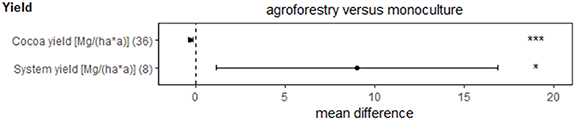
Figure 1. Mean difference of cocoa and total system yields in agroforestry systems compared with monocultures. The number of studies is shown in brackets; the horizontal bar shows the 95% confidence intervals; negative values indicate a higher mean value in monocultures; positive values indicate a higher mean value in cocoa agroforestry systems; levels of significance: *** p < 0.001, ** p < 0.01, * p < 0.05, n.s.: not significant.
Download figure:
Standard imageHigh-resolution image


Table 1. Mean values and standard deviations (SD) for (a) yield; (b) economic performance; (c) soil chemical properties; (d) soil physical properties; (e) pests and diseases; (f) microclimate; (g) stand structural parameters in cocoa agroforestry systems and cocoa monocultures. N indicates the number of studies; levels of significance: *** p < 0.001, ** p < 0.01, * p < 0.05, n.s.: not significant.
| | | | Cocoa agroforestry system | Cocoa monoculture | | | | | | | --------------------------- | ------------ | ------------------------- | ----------------- | ------ | ------- | -- | ------ | | | Group | Variable | Unit | Mean | SD | Mean | SD | N | | | Yield | | | | | | | | | | | Cocoa yield | Mg ha−1 | 0.6 | ± 0.4 | 0.9 | ± 0.7 | 36 | *** | | | | System yield | Mg ha−1 | 9.8 | ± 9.2 | 0.6 | ± 0.4 | 8 | * | | | Economic performance | | | | | | | | | | | Costs | USD ha−1 a−1 | 571.5 | ± 322.8 | 652.9 | ± 464.4 | 7 | n.s. | | | | System revenue | USD ha−1 a−1 | 1094.3 | ± 594.7 | 1299.7 | ± 905.9 | 8 | n.s. | | | | Net present value | USD ha−1 | 998.8 | ± 736.8 | 1108.9 | ± 729.7 | 4 | n.s. | | | Soil chemical properties | | | | | | | | | | | Soil C | % | 14.5 | ± 2.4 | 13.8 | ± 2.3 | 20 | n.s. | | | | Soil N | % | 1.8 | ± 0.7 | 1.7 | ± 0.6 | 22 | n.s. | | | | Soil available P | mg kg−1 | 13.7 | ± 14.2 | 17.2 | ± 16.9 | 9 | n.s. | | | | Soil available K | g kg−1 | 0.1 | ± 0.1 | 0.1 | ± 0.1 | 10 | n.s. | | | | Soil organic carbon | % | 1.7 | ± 0.5 | 1.7 | ± 0.5 | 8 | n.s. | | | | pH | | 6.3 | ± 0.4 | 6.4 | ± 0.5 | 6 | * | | | Soil physical properties | | | | | | | | | | | Mean weight diameter | mm | 1.0 | ± 0.4 | 0.9 | ± 0.2 | 10 | n.s. | | | | Bulk density | g cm3 | 1.3 | ± 0.3 | 1.4 | ± 0.2 | 4 | * | | | | Volumetric water content | % | 20.1 | ± 5.4 | 21.8 | ± 5.7 | 6 | ** | | | Fungal diseases | | | | | | | | | | | Frosty pod rot | % | 28.8 | ± 24.5 | 21.2 | ± 16 | 4 | n.s. | | | | Black pod | % | 3.4 | ± 2.2 | 3.0 | ± 2.0 | 5 | * | | | | Witches’ broom | % | 1.9 | ± 1.4 | 3.7 | ± 2.4 | 5 | * | | | Microclimate | | | | | | | | | | | Maximum temperature | °C | 32.4 | ± 2.5 | 34.7 | ± 3.3 | 8 | * | | | | Minimum temperature | °C | 18.6 | ± 3.1 | 17.9 | ± 3.4 | 8 | *** | | | | Mean temperature | °C | 24.7 | ± 1.8 | 25.0 | ± 1.8 | 8 | * | | | | Mean relative humidity | % | 81.5 | ± 16.5 | 80.5 | ± 15.6 | 3 | n.s. | | | | Vapor pressure deficit | kPa | 1.1 | ± 0.7 | 1.3 | ± 0.8 | 4 | n.s. | | | Stand structural parameters | | | | | | | | | | | Basal area cocoa trees | m2 ha−1 | 7.7 | ± 2.9 | 9.4 | ± 3.2 | 22 | *** | | | | Basal area shade trees | m2 ha−1 | 10.2 | ± 2.2 | 0.2 | ± 0.4 | 4 | *** | | | | Total C in cocoa trees | Mg ha−1 | 9.5 | ± 6.3 | 13.2 | ± 6.9 | 30 | *** | | | | Total C in shade trees | Mg ha−1 | 24.7 | ± 26.3 | 1.0 | ± 4.6 | 27 | *** | | | | Total C in system | Mg ha−1 | 37.0 | ± 28.9 | 14.2 | ± 9.0 | 30 | *** | |
Considering all crops harvested, production in cocoa agroforestry systems amounts to 9.8 ± 9.2 Mg ha−1 a−1, which is about ten times higher than production in cocoa monocultures (figure 1, table 1). The lower system yield obtained in cocoa monocultures compared to cocoa yield in monocultures (0.6 vs 0.9 Mg ha−1) is related to different studies included as well as the number of pair comparisons, i.e. we calculated the mean yield of only eight data pairs for system yield, while cocoa yield is calculated from 36 data pairs. Kuyah et al [45] obtained similar results for other types of agroforestry systems, pointing to their potential to produce food, which improves food security of farming families [5, 25]. Production diversity also reduces dependency on one single crop and, consequently, fluctuations in prices and demand [46]. The high variability of system yields reported might be explained by the wide range of crops that can be grown in cocoa agroforestry systems (SI appendix, table S1). Besides the production, the commercialization of fruits can be difficult due to reduced market access or local acceptance. Banana and plantain are common products in cocoa agroforestry systems [5, 47], since they are also used for protecting the cocoa trees from direct light during the establishment phase. They produce in high quantities and may be distributed locally since they are staple crops in many regions and commonly consumed. Tuber crops like turmeric and ginger need specialized markets or export options, and uncommon fruits like araza (Eugenia stipitata) cannot be transported or stored easily to reach their market [48].
3.2. Can cocoa agroforestry systems sustain farmers’ incomes?
Even though the total system production is higher in cocoa agroforestry systems, this is not reflected in higher revenues or net present values, neither is it in the costs (figure 2). Cocoa, a commodity produced mainly for export, normally reaches higher prices than its by-crops, which are mainly sold in local markets, or consumed on-farm and do not contribute to farmer’s income [49]. The economic performance of the production systems depends on the level of management of the plantation and on labor costs, with cocoa agroforestry systems tending to have higher labor demands [24]. In the case of cocoa agroforestry systems, it also depends on the planting design and selection of shade tree species [47]. Timber trees increase the net present value of cocoa agroforestry systems [47]. However, their value is not always considered a future benefit for farmers, due to insecure land and tree tenure and the risk of fires [42]. The wide range of management intensities in the production systems in the different studies is likely responsible for the variation in the mean differences of the economic variables analyzed between cocoa agroforestry systems and monocultures (SI appendix, figure s1 (stacks.iop.org/ERL/15/104085/mmedia)). The total costs in organically managed cocoa production systems included the certification costs [24], while another study included the costs for renting the land [26]. The net present value depends not only on the planting design, but also on the plantation age and the timeframe that was used for the calculation, e.g. a 20-year production cycle [50], or a 12-year net income flow [47].
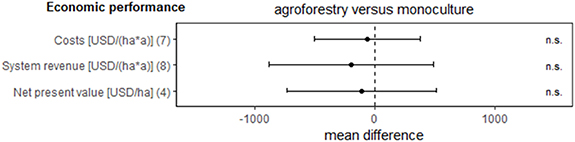
Figure 2. Mean difference in the economic performance of cocoa agroforestry systems compared with monocultures. The number of studies is shown in brackets; the horizontal bars show the 95% confidence intervals; negative values indicate a higher mean value in monocultures; positive values indicate a higher mean value in cocoa agroforestry systems; levels of significance: *** p < 0.001, ** p < 0.01, * p < 0.05, n.s.: not significant.
Download figure:
Standard imageHigh-resolution image


The lack of a clear effect of the type of production system on variables of the economic performance indicates that, despite their lower cocoa production, agroforestry systems can be economically as viable as monocultures.
3.3. Do cocoa agroforestry systems improve soil chemical and physical properties for cocoa production?
We found no significant differences in soil chemical properties between production systems, with the exception of higher soil pH values in monocultures (figure 3(a), table 1). Thus, our results do not indicate a positive impact of cocoa agroforestry on soil fertility. However, we observed substantial differences between studies. For instance, studies sampling around single shade trees found positive effects on soil chemical properties [51–53]. Positive effects on soil chemical parameters could likely be achieved if the biomass resulting from pruning the shade trees were distributed across the plantation [54]. Still, shade trees are not usually pruned and distributing the biomass can be highly labor-intensive. Tree selection can ultimately influence soil chemical properties [51, 53]. Better knowledge on shade tree properties is thus important for an optimal tree selection. Finally, contrasting results between studies may also be related to different soil type, plantation age and land-use history [55], which might affect the influence of agroforestry trees on the soil [56], e.g. Mohammed et al [57] described a slight increase in SOC with the age of the cocoa agroforestry system and a decline in monocultures.
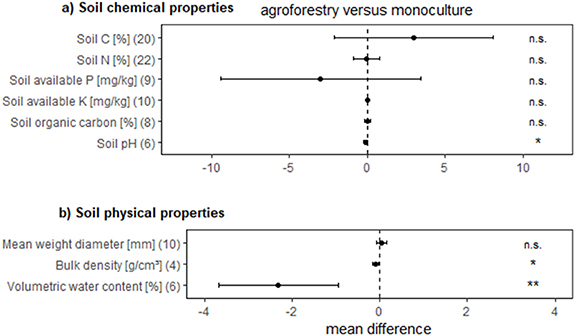
Figure 3. Mean difference in the (a) soil chemical properties and (b) soil physical properties of cocoa agroforestry systems compared with monocultures. The number of studies is shown in brackets; horizontal bars show the 95% confidence intervals; negative values indicate a higher mean value in monocultures; positive values indicate a higher mean value in cocoa agroforestry systems; levels of significance: *** p < 0.001, ** p < 0.01, * p < 0.05, n.s.: not significant.
Download figure:
Standard imageHigh-resolution image


Soils in cocoa agroforestry systems have a significantly lower volumetric water content than in monocultures (figure 3(b), table 1). This may result in competition for water between cocoa and shade trees. However, this potentially negative effect of shade trees will only become critical if shade trees are planted at very high densities [7], or in regions with an annual precipitation that is close to the limit for cocoa production [33, 58]. This needs to be further investigated and carefully considered in relation to future scenarios of decreasing or changing water availability patterns due to climate change [59]. Potential competition for water may be reduced by selecting shade tree species with rooting patterns complementary to that of cocoa trees [17, 60, 61]. However, the information available on this aspect, though crucial for providing recommendations on tree species selection and planting patterns, is still very limited.
3.4. Do cocoa agroforestry systems enhance the control of pests and diseases?
Pests and diseases, and particularly fungal diseases, are a major threat to cocoa production. The analysis of disease control in the different systems results in contrasting findings: frosty pod rot (Moniliophthora roreri) is not affected by the production system, while the incidences of black pod (Phytophthora spp.) and witches’ broom (Moniliophthora perniciosa) are respectively higher and lower in cocoa agroforestry systems than in cocoa monocultures (figure 4, table 1). These findings are in line with previous studies showing the complex effects of shade trees on the incidence of pests and diseases [7, 22, 62]. Influencing factors include: the management of the system (e.g. pruning, fertilization, weeding) [63]; the specific pest and disease management strategy (e.g. cultural, chemical or biological control) [62, 63]; the specific characteristics of the pest or disease considered [30]; and the particular microclimatic conditions, which highly depend on the structural complexity of the cocoa agroforestry system [18]. In cocoa agroforestry systems, reduced light availability and wind speed, buffered temperatures and increased relative humidity compared to monocultures [18] may stimulate sporulation of diseases such as black pod, but also favor the presence of antagonists, e.g. for witches’ broom [22, 64]. The broad variance of the incidence of frosty pod rot in our analysis is not only related to cocoa production systems, but also to general differences in the infestation rate. Up to 63% infected fruits were counted by Krauss and Soberanis [62] compared to a relatively low infestation rate around 10% by Armengot et al [63] which was explained by regular elimination of affected fruits before sporulation rather than application of fungicides. The single data pair comparison of a broader range of pests and diseases (including cocoa swollen shoot virus disease, leaf herbivory, vascular streak dieback), as well as of the total yield loss and total infestation, showed contrasting results, too. This resulted in no significant difference in the incidence of pests and diseases between cocoa agroforestry systems and cocoa monocultures according to the grand mean difference over all data pairs (SI appendix, figure S2).
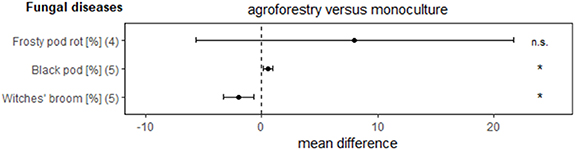
Figure 4. Mean difference in the incidence of three fungal diseases in cocoa agroforestry systems and monocultures. The number of studies is shown in brackets; horizontal bars show the 95% confidence intervals; negative values indicate a higher mean value in monocultures; positive values indicate a higher mean value in cocoa agroforestry systems; levels of significance: *** p < 0.001, ** p < 0.01, * p < 0.05, n.s.: not significant.
Download figure:
Standard imageHigh-resolution image


The results do not completely support the above-mentioned regulating effects of cocoa agroforestry systems. However, they show that cocoa agroforestry systems compared with cocoa monocultures are not prone to pests and diseases, contrary to widespread perceptions.
3.5. Do cocoa agroforestry systems support adaptation of cocoa plantations to climate change?
In cocoa agroforestry systems, solar radiation is reduced by the canopy of shade trees [18], which provides a more stable microclimate: the mean temperature remains lower and the daily maximum and minimum temperatures are buffered compared to what happens in monocultures (figure 5, table 1). Cocoa agroforestry systems, therefore, have the potential to reduce the impact of rising mean temperatures and temperature extremes predicted for producer countries [59, 65]. Consequently, they are more resilient to climate change and provide more comfortable working conditions (shade and lower temperatures) than full-sun monocultures [46, 66].
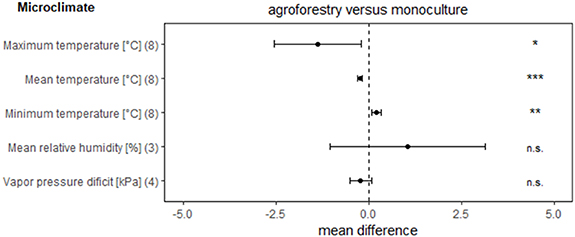
Figure 5. Mean difference in microclimatic variables between cocoa agroforestry systems and monocultures. The number of studies is shown in brackets; horizontal bars show the 95% confidence intervals; negative values indicate a higher mean value in monocultures; positive values indicate a higher mean value in cocoa agroforestry systems; levels of significance: *** p < 0.001, ** p < 0.01, * p < 0.05, n.s.: not significant.
Download figure:
Standard imageHigh-resolution image


The mean relative humidity of the air and the vapor pressure deficit do not differ between cocoa agroforestry systems and cocoa monocultures (figure 5). Some studies show that the difference in relative humidity is pronounced during the wet season, and smaller during the dry season [7]. In addition, canopy closure and stratification of cocoa agroforestry systems affect internal relative humidity [18]. Tall trees may allow more aeration below their canopy than dense tree crowns close to the cocoa canopy. Tree species selection and planting density are therefore important for shading intensity and microclimatic conditions. The actual radiation reaching cocoa agroforestry systems—which depends on location-specific factors like latitude, altitude, cloudiness, slope exposure and surrounding shading forests—needs to be considered for the selection of the shade trees [67]. It is important to highlight that microclimatic variables can be influenced and adapted to seasonal needs of cocoa tree plantations by managing shade intensity through regular shade tree pruning [18].
3.6. Do cocoa agroforestry systems contribute to climate change mitigation?
Cocoa trees tend to store more carbon when growing in monocultures, since they are bigger and often planted at higher densities than in agroforestry systems, as reflected in the higher basal area (figure 6, table 1). Shade trees are often planted at low densities, but, since they usually have larger stem diameters and grow high above the cocoa trees, they account for most of the basal area [18] and for 66% of the carbon stored in the system (figure 6, table 1). The total carbon (aboveground and root biomass) stored in an agroforestry system, including both the cocoa and the shade trees, is, on average, 2.5 times higher than in a monoculture (figure 6, table 1). Thus, cocoa agroforestry systems have greater potential for climate change mitigation than cocoa monocultures due to a higher carbon sequestration potential. Carbon payments are often mentioned as a potential incentive for farmers to plant trees. However, widely accessible systems directing these payments to cocoa producers are rarely found, and the payments tend to be too low to incentivize the planting of shade trees [68].
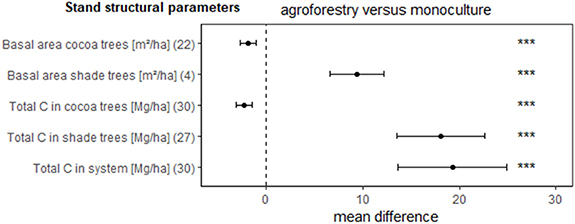
Figure 6. Mean difference in stand structural parameters between cocoa agroforestry systems and monocultures. The number of studies is shown in brackets; horizontal bars show the 95% confidence intervals; negative values indicate a higher mean value in monocultures; positive values indicate a higher mean value in cocoa agroforestry systems; levels of significance: *** p < 0.001, ** p < 0.01, * p < 0.05, n.s.: not significant; Total C: carbon stock of aboveground and root biomass.
Download figure:
Standard imageHigh-resolution image


3.7. Do cocoa agroforestry systems contribute to biodiversity conservation?
Only five articles directly compare the species richness of five animal groups [7, 46, 69–71] in cocoa agroforestry systems and monocultures. Therefore, we prefer to show the results for each taxon and study rather than only the mean difference. The mean difference in the grand mean over all animal taxa (RE Model) between cocoa agroforestry systems and cocoa monocultures shows a significantly higher number of species in agroforestry systems (figure 7(a)). This positive effect of shade trees on biodiversity is consistent with other studies that have investigated the value of cocoa agroforests for the conservation of biodiversity [19, 72–74]. The effect of shade on animal biodiversity depends amongst others on the taxa under consideration [73], but also on the management, diversity, and complexity of the particular cocoa agroforestry system [75]. Agroforestry systems have also been reported to provide habitat for functionally more diverse species communities because they are structurally more complex and diverse than monocultures [5, 20, 76] (SI appendix, table S1).
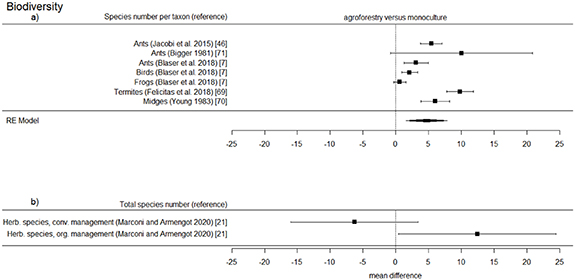
Figure 7. Comparison of (a) animal and (b) herbaceous species richness in cocoa agroforestry systems and monocultures shown by single studies and the mean difference between studies (RE Model). Horizontal bars show the 95% confidence intervals; negative values indicate a higher mean value in monocultures; positive values indicate a higher mean value in cocoa agroforestry systems.
Download figure:
Standard imageHigh-resolution image


The scarcity of available data on the diversity of herbaceous species in cocoa agroforestry systems and cocoa monocultures (two data pair analyses from only one publication [21]) prevents us from generalizing the results by calculating the grand mean difference (RE Model) (figure 7(b)). However, the data imply that the effect on herbaceous species richness might depend heavily on farm management practices, e.g. use of agrochemicals or cover crops, availability of light, and weeding interventions [20, 21].
This meta-analysis indicates that cocoa agroforestry systems have the potential to compete with cocoa monocultures in terms of economic performance, and to outperform them in crucial system services such as adaptation to climate change and carbon sequestration, as well as in total system yields. With only five articles on biodiversity conservation in cocoa agroforestry systems and cocoa monocultures, and six on the incidence of pests and diseases, we identified a knowledge gap for these two topics in cocoa production. Although this prevents us from generalizing the results, it is possible to infer that cocoa agroforestry systems tend to have a similar or even better performance than monocultures in most of the evaluated parameters.
Our results underline the need for promoting cocoa agroforestry systems to improve the sustainability of the cocoa sector. Despite all the above-mentioned benefits of cocoa agroforestry systems, the lower cocoa yield might still be one of the most relevant factors hindering a broader adoption of diversified production systems. In this sense, further research focused on increasing cocoa yields in agroforestry systems is crucial, e.g. breeding for shade tolerant varieties or adapted management practices to increase pollination rates. However, for promoting cocoa agroforestry systems, building and enabling access to new alternative markets and value chains for agroforestry products is also crucial, as is compensating farmers for cocoa yield reductions through fair prices for sustainable cocoa production or carbon storage. The promotion and support of cocoa agroforestry systems by the cocoa industry can therefore contribute to meeting its sustainability goals.
The high heterogeneity and wide range of climatic and edaphic conditions, management strategies, planting densities and shade tree species encountered in the literature included in this meta-analysis suggest that a global recommendation for shade levels or shade tree species would not be accurate. Rather, local and context-specific recommendations for cocoa agroforestry design and management considering socio-economic factors should be developed for the implementation of sustainable and feasible cocoa production systems. Knowledge gaps regarding, for instance, detailed species-specific information on shade trees need to be addressed. The role of different shade trees on soil nutrient dynamics, including competition and synergies for resources, needs to be elucidated. This needs to be context specific, considering different soil types and land-use histories. Finally, management strategies, pricing policies, cultural and social services, and livelihood aspects deserve further attention in future research.
We wish to thank the authors of the studies that are the basis of this meta-analysis. The study was funded by the Swiss Platform for Sustainable Cocoa. Laura Armengot was supported by the Syscom programme, financed by the Swiss Agency for Development and Cooperation (SDC), the Liechtenstein Development Service (LED), the Biovision Foundation for Ecological Development, and the Coop Sustainability Fund.
No new data were created or analysed in this study.