Renewable energy in emergent countries: lessons from energy transition in Morocco (original) (raw)
Background
Morocco’s energy strategy has been developed in response to climate change, specifically that caused by the activities of the energy sector. Indeed, it is based on the mobilization of Morocco’s own national resources, the rise of renewables in the energy mix, and the introduction of energy efficiency as a national priority. Its implementation will enable the establishment of a diversified energy mix and will be optimized around specific technology choices, both reliable and competitive.
This strategy, which has the major objectives of ensuring security of supply and widespread energy price-optimized access; mobilization of domestic energy resources, mainly the significant potential for renewable energy (RE) in the country; the promotion of energy efficiency [1]; and the integration of Morocco into the regional energy system in compliance with environmental preservation, places the development of RE at the top of its priorities [2].
Furthermore, Morocco has experienced considerable growth in electricity demand. Energy consumption has risen at an average annual rate of 6.5% from 2002 to 2015 [3, 4] due to economic growth, the rise in population, and the increase in per capita energy consumption. This increase in consumption was also due to consistent investments in electrification projects, which allowed the country to reach a 99.5% electricity access rate in 2015 (which is impressive growth considering that the rural electrification level was only at 18% in 1995) [5].
During the 21st session of the Conference of the Parties (COP21), Morocco announced a new goal to increase the capacity of renewables to 52% (20% solar, 20% wind, 12% hydro) by 2030 [6]. This will make Morocco the first African country to aim to reach more than 50% electricity generation from RE in a continent where access to any energy is a big issue [7]. These goals are attainable because the country has high potential in wind and solar resources and is an important player in the Euro-Mediterranean energy hub, including all regional projects facilitating synergy as Project MedGrid, of which the Morocco is a member [3].
This paper describes the organization of the Moroccan energy sector, which is based on a green strategy with RE. Potential impacts of this strategy are discussed on the basis of a regulatory framework. We also discuss opportunities and barriers for this green strategy in relation to the international context based on the findings from past and ongoing studies and conferences organized regarding the Moroccan energy experience. Finally, we suggest additional measures that integrate large-scale projects and regulation improvements that involve a real transition from a regulated market to a full free market and that takes account of the barriers related to existing independent power producers (IPP) facilities.
Energy context
The primary energy supply in Morocco has been rising steadily and reached 17,283 ktons of oil equivalent (“TOE”) in 2015 [8]. The country is clearly dependent on fossil fuels, as petroleum products account for 41% of the primary energy supply, crude oil for 31%, coal and peat for 17%, and gas for 4%. The primary energy supply has increased significantly in the past. Morocco is highly dependent on imports of energy sources; in 2015, the dependency was about 94.5%. Morocco experienced a significant increase in demand for primary energy as it has increased by 0.36 TOE per capita in 2002 to 0.56 TOE in 2015 [9].
In 2015, the total energy consumption was 18.4 million TOE out of which petroleum products stood for 60% of energy consumption and coal 22% [[10](/article/10.1186/s13705-017-0131-2#ref-CR10 "Brower M, Galán EM, Li JF, Green D, Hinrichs-Rahlwes R, Sawyer S, Sander M, Taylor R, Kopetz H, and Gsänger, “Renewables 2014 global status report,” REN21. 2014. http://www.ren21.net/Portals/0/documents/Resources/GSR/2014/GSR2014_KeyFindings_low%20res.pdf
. (last seen 21 Aug 2017)")\]. This trend was also observed on electricity, where the rate was 7% in 2013 with a total energy demand of 32 Twh in the end of 2015 reflecting an energy bill of US$12.3 billion \[[11](/article/10.1186/s13705-017-0131-2#ref-CR11 "Aherdan M (2016). Chiffres Clefs du Secteur Energie 2015, Ministère de l’Energie, des Mines, de l’Eau et de l’Environnement, Vol. 234, pp 34–36")\].Due to demographic and economic growth, electricity demand grew at an average annual rate of 6.6% in 2015, leading to an energy consumption of 34,413 GWh at the end of 2015 [11]. In 2015, the amount of electricity produced totaled 29,914.2 GWh. Renewable sources generated 13.4% of the energy, while 49% came from coal, 16.6% from natural gas, and 6% from oil [9].
Morocco has an overall vision towards sustainable development. After adopting a National Energy Strategy (NES) with corresponding targets in 2009 of reaching 42% installed RE capacity by 2020, Morocco renewed the strategy in 2015 with a 52% target for 2030 [12]. Thus, Morocco has prioritized the development of renewables in addition of other sources as natural gas.
Moroccan power system and planned evolution
Moroccan power system
The electricity sector is structured around a national utility, the National Agency for Electricity and Water/Electricity Branch (ONEE), which is placed under the administrative and technical control of the Ministry of Energy, Mines, Water, and the Environment. The ministry also supervises the following institutions:
- a.
MASEN - The Moroccan Agency for Solar Energy is a limited company with a Management and Supervisory Board [13]. MASEN ensures the development of integrated projects for producing electricity from solar energy, and has a minimum total capacity of 2000 MW. In 2016, MASEN’s scope was extended to wind and hydropower, and it became the Moroccan agency for sustainable energy. The outlook of the agency now includes the development of 3000 MW in 2020 and 6000 MW in 2030 from renewable sources [8] under the PPA schemes. Regrouping all renewables in one agency will help MASEN to optimize the cost of electricity, especially the concentrated solar power (CSP), which will still be a heavy cost for the public budget [14]. However, this will decrease the competitiveness of the national electricity company (ONEE) because the cost of hydro and wind is lower. After regrouping, the ONEE will purchase electricity at an average cost of the three sources total (solar, wind, and hydro). - b.
ADEREE - The National Agency for the Development of Renewable Energy and Energy Efficiency was established in 2010. ADEREE has replaced the Centre for Renewable Energy Development and aims to develop and promote RE and energy efficiency [15] In 2016, ADEREE was transformed into AMEE, the Moroccan agency for Energy Efficiency, with the goal of focusing only on energy efficiency [16]. This transformation is very important to the agency, as energy efficiency in Morocco is still in progress, and the work done before in this field was insufficient regarding the huge potential of reducing overall energy consumption in Morocco [17]. - c.
EIS - The Energy Investment Corporation was created in June 2009 to boost the development of RE projects [18] The company has a national interest capital of MAD 1 billion [19]. With the new update of Moroccan institutions and their roles, the new role of this company is still undefined, and it still works only in small and medium projects, such as street lighting (use of PV panel system). - d.
IRESEN - The Research Institute for Solar Energy and New Energy was established in February 2011. IRESEN aims to consolidate the needs of different stakeholders and to ensure the implementation and enhancement of various research projects.
Unfortunately, the distribution operators that are supervised by the Ministry of the Interior are often against the development of RE in their networks. This lack of coordination, cooperation, and synergistic collaboration between the various stakeholders, political groups, and ministries does not help when forming a common strategic vision for the promotion of RE.
Evolution of the energy sector
ONEE is the sole buyer and seller and the sole importer/exporter of bulk electricity. Since 1999, it has also operated on the Spanish electricity market, which is interconnected with Morocco’s. The dominant role of ONEE should, however, become weaker; in 2012, Morocco adopted a national regulatory framework for the electricity sector, which provides a free market for the exchange of electricity from renewable sources (Act 13–09). As the sole buyer, ONEE supplies the national market through its own plants (about 42%), through those of IPPs (about 40%), through imports (about 18%), and also through a number of private industrial producers (<1%). The current power mix is dominated by fossil energies, specifically about two-thirds of energy is generated by coal, oil, and gas, followed by imports from Spain (about 18%), hydropower (< 10%, depending on actual hydrology), and wind/solar. Demand is about 35 GWh/year and has increased by 6,5% per year since year 2000. Installed capacity exceeds 8000 MW [20].
Renewable energy investment framework in Morocco
Act No. 13–09 as amended and supplemented by Act No. 58–15 for the private development of projects
Act 13–09, on renewable energies, marked the new energy strategy by allowing private companies to produce electricity from renewable sources and to buy it from the market. This Act revolutionized the energy landscape by introducing major innovations through:
- The liberalization of the RE market;
- Allowing private green electricity developers access to the national grid (all voltage levels); and
- The possibility for private developers to carry out direct transmission lines for their own use when the capacity of the national electricity grid and interconnections is insufficient.
Act 13–09 also acts as the authorization system for the RE project if the capacity is greater than 2 MW or as a notification system if the capacity is less [[21](/article/10.1186/s13705-017-0131-2#ref-CR21 "Bryden J, Riahi L, Zissler R (2013). MENA: Renewables Status Report, REN 21. URL : http://www.ren21.net/Portals/0/documents/activities/Regional%20Reports/MENA_2013_lowres.pdf
              . Paris 2013.")\]. This Act is a first step towards the liberalization of the Moroccan Energy Market. Its focus on the RE market is important because the conventional market is still under the IPP scheme contract (20–30 years of power purchase agreements), which makes liberalization so difficult. However, in the future Morocco can proceed to liberalize this market if the renewable market liberalization is more successful \[[22](/article/10.1186/s13705-017-0131-2#ref-CR22 "Roller G, Lefevre M, Wirtz J, Schmidt-Sercander B, Eichhammer W, Ragwitz M, Mouline S (2007). Etude sur le cadre organisationnel, institutionnel et législatif pour la promotion des Énergies Renouvelables. Retrieved from
                http://www.giz.de/en/downloads/fr-marokkoerneuerbare-energien-2007.pdf

              . (Last visit 25 June 2017)")\]. This mitigation in the country is a case study for emergent countries where most are under IPP contract. The transition to a liberalized market will have to be reached though mixed schemes (Fig. [1](/article/10.1186/s13705-017-0131-2#Fig1)), which shows that the role of a mixed scheme is an important transition before achieving a full free market.
Fig. 1

The alternative text for this image may have been generated using AI.
Transition of the electricity market in emergent countries
In 2016, a new update of Act No. 13–09 was adopted, called Act No. 58–15, and implemented the following provisions:
- Increasing the threshold of installed capacity for small hydroelectric power plants from 12 to 30 MW;
- Allowing the trade of surplus green generation to ONEE, though the project owner cannot sell “more than 20% as an excess of the annual generation”; and
- Introducing the basis of the low-voltage electricity market.
The most added value of Act 58–15 is the liberalization of the low-voltage market. This market presents a huge potential for small scale projects (i.e., rooftop photovoltaic, biomass, solar pump). As such, complementary acts related to this Act should take into consideration the low income of the Moroccan people and propose financial mechanisms to boost the market. For example, a mixed system of Feed-in-tariff and Net Metering will be good choices [23].
Many of the laws that have been introduced to promote RE, such as the 13–09 law, are still presenting issues. For example, this law tends to facilitate only large-scale projects rather than helping the entry of smaller producers and stimulating the development of more community-based, bottom-up energy initiatives. The decree for RE connection to low-voltage energy has not been approved yet.
Tenders
Morocco is also developing its power mix through public–private partnerships. IPPs develop power projects and sell the power to ONEE or to large consumers through power purchase agreements that include generally a “take or pay” clause. The result is that power plants that are technically dispatchable are financially not dispatchable for ONEE as a balancing authority, whose dispatchable capacity is increasingly reduced [24].
ONEE and MASEN launched international tenders under the IPP scheme for the development, financing, design, engineering, procurement, construction, commissioning, and operation and maintenance of wind farms. The bidder signs a Power Purchase Agreement (PPA) with ONEE for a period of 20 years, under which ONEE will purchase the project’s electricity production [25].
The PPA contains commercial and legal terms and conditions that cover the following points, in particular:
- Development, financing, design, engineering, procurement, construction, authorization, realization, testing, commissioning, insurance, right of use, operation and maintenance by the Wind Farm Project Corporation and all ancillary facilities;
- Net energy sale by the project company and purchase by the ONEE;
- Other ONEE procurement and payment obligations;
- Deductions, penalties, and other damages arising from deviations from the terms of the PPA;
- Cases of force majeure; and
- Termination cases and rights in the event of termination.
This PPA allows (i) the purchase of electricity during the life of the plant, (ii) the issuance by the government of a letter of support guaranteeing payment to the project company and payment in case of early termination of the PPA, and (iii) the use of the project site for the duration of the PPA.
As shown in Table 1, the tender schemes helped the country to reduce the cost of electricity from 1.6 MAD per Kwh with NOOR 1 to 1.39 MAD per Kwh with NOOR 3, and also introduced CSP technology into the national grid, which will generate energy in peak hours when the electricity cost is higher, as has been done in some countries like Chile and Taiwan [26].
Table 1 Electricity cost from last international tenders in Morocco
Self-generation
As Morocco’s first experience with RE, the Act authorized industries to produce green electricity for their own consumption with a limit of 10 Mw (before 2008). A wind farm was realized under this Act with a capacity of 10.2 MW in 2005. In 2008, the newly revised Act raised the maximum allowed capacity to 50 MW. Even for big consumers, the limit was also 50 MW. However, without access to the grid, companies could only generate power on-site.
In 2015, the new Act (54.14) overcame the limitations of Act 16.08, now giving the right for large consumers to develop bigger capacities (a minimum of 300 MW) from renewables or conventional resources. It also gave the possibility of grid access, so big consumers could produce electricity on one site and consume it at another site.
As proved by the International Energy Agency in its report “Morocco 2014 - Energy Policies Beyond IEA Countries”, the above-mentioned reforms and investments had proven a considerable commitment to promote RE. However, many barriers obstructing further RE development in the country were still present, including:
- i)
Lack of accessible financial support for small scale projects; - ii)
Lack of coordination, cooperation, and synergetic collaboration between the various stakeholders, political groups and ministries (distribution operators are often against the development of RE in their electrical grid); - iii)
Continuing major technical issues related to the intermittent nature of renewable energies such as wind and solar. Technical complications occur when aiming to ensure large scale reliability of supply with high penetration of intermittent sources.
Energy tariff policy, end use energy prices (household and industry)
Electricity
Electricity prices in Morocco are, by regional standards, relatively high. The price of electricity for final consumers is fixed by decree from the government. Subsidies on electricity prices have been phased out in recent years, leading to a steady but moderate price increase as shown in Table 2.
Table 2 Electricity prices for private domestic use
More suited to rural customers’ consumption habits because of its dispersal and distance from villages, the “Nour” system is based on a prepaid meter. To obtain electricity, the customer can buy the desired quantities through refill cards (from an amount of 20 dhs with an average price of 1.2 MAD per KWh) [[27](/article/10.1186/s13705-017-0131-2#ref-CR27 "Chang KC, Lin WM, Leu TS, Chung KM (2016) Perspectives for solar thermal applications in Taiwan. Energy Policy 94:25–28 http://www.sciencedirect.com/science/article/pii/S0301421516301367?via%3Dihub
. (Last seen 21 Aug 2017)")\].The tariff structure is uniform regardless of the distributor [[28](/article/10.1186/s13705-017-0131-2#ref-CR28 "Almaghrb Bank (2O15). Annuel Repport of Moroccan National Bank. Rabat, Morocco. URL: http://www.bkam.ma/en/Publications-statisticsand-research/Institutional-publications/Annual-report-presented-to-his-majesty-the-king/Annual-report-2015
. (last seen 21.08.2017)")\]. However, it is relatively variable and complex because it differentiates uses that are defined as follows:- Private lighting (lights, mosques, timers, consulates, associations, parking).
- Patented, which applies to all natural or legal persons engaged in gainful employment and connected to low voltage; lighting for commercial and offices subject to a patent; cabinets, cafes, restaurants, private schools, etc.
- Domestic use (all premises used as dwellings).
- Driving forces (artisans, elevators, petite textile companies, wells, mills, special construction, i.e., for the purposes of work performed by contractors for parties, fairs, carnivals, etc.).
- Administrative lighting (local government buildings, local authorities, offices).
Since August 1, 2014, water rates and electricity have increased. They are now based on new consumption levels. The consumer pays according to the consumption band to which it pertains. There are now six sections defined for electricity instead of four, and all types of voltages are affected by the increase. The rate of electricity price per Kwh has increased by 2.9% for low voltage, 6.1% for medium voltage, and 4.7% for high and very high voltage [[29](/article/10.1186/s13705-017-0131-2#ref-CR29 "Dornan M, Shah KU (2016) Energy policy, aid, and the development of renewable energy resources in Small Island Developing States. Energy Policy 98:759–767 https://doi.org/10.1016/j.enpol.2016.05.035
")\].Oil price indexation system
Since the early 90s, oil prices showed significant increases accompanied by higher volatility. The crude oil price rose on average from US$18 a barrel during the 1990s to US$28 a barrel in 2000. This price surge prompted the government to suspend in 2000 the application of the oil price indexation system, which had been implemented since the sector’s liberalization in 1995, and to replace it with a fixed price mechanism in which the State bears the difference between cost prices and consumer prices. However, the continued rise in international prices, with an average price of US$97 a barrel in 2008 and US$104 a barrel between 2011 and 2013, placed a heavy burden on subsidy costs for petroleum products. Despite some one-off adjustments, mainly in June 2012, these costs increased from 7.9 billion dirhams in 2006 to 48.2 billion in 2012, before falling to 36.3 billion in 2013.
The reforms that have been underway for several years in favor of the private sector. In 2013, the reforms were strengthened by a fiscal reform and the continuation of the reform of the compensation fund, which represents a key step in reducing public spending. With the current price of oil (44–50 USD, 2016) the energy bill is reduced by 20% in comparison with 2013. Morocco has invested in consistent sectorial strategies to accompany the reforms undertaken since the early 2000s, which helped accelerate the economy’s structural transformation and promote new products. New industries, such as aeronautics and automobiles, are now drivers of growth and areas of innovation for the Moroccan economy. These areas can help Morocco overcome the difficulties encountered by certain traditional sectors such as textiles.
While subsidies for gasoline, diesel, and kerosene have almost been eliminated, the electricity prices in Morocco do not represent the real costs, which are below the average costs of production and transmission. This creates a significant financial burden on the national budget. In addition, considerable subsidies allow consumers to pay a mere third of the “real” price of butane gas, in particular.
All car fuels were phased out in 2014, and there was a partial increase of electricity tariffs as well. The latter, however, remain below generation costs, with households paying between 0.9 and 1.44 MAD per kWh depending on monthly consumption levels. This is well-received by consumers.
Renewable energy targets and realizations
The energy target aims to increase the share of renewable energy to 42%. As already mentioned, the New Energy Road map, recently announced during COP21, bolstered this target of 52% RE in 2030, of which 12% is hydro, 20% is solar, and 20% is wind generation, as shown in Fig. 2. This target makes Morocco an African leader of RE, just as Germany is for Europe [[30](/article/10.1186/s13705-017-0131-2#ref-CR30 "A.Azizi (2015). Actes du colloque international sur l’énergie.Fédération Nationale de l’Energie. Casablanca, MOROCCO. Url : http://www.fedenerg.ma/energie-strategie/
(last seen 21.08.2017)")\].Fig. 2
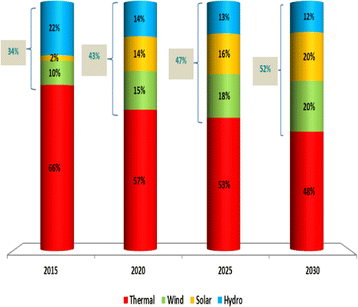
The alternative text for this image may have been generated using AI.
Moroccan Energy Mix 2020–2030 (Haut Commissariat au Plan, 2016)
The development of green projects will require an estimated investment over the next 15 years of more than US$40 billion, including ¾ for renewable energies. This development will be mobilized by private companies and national and international financial institutions.
Morocco has the necessary assets to achieve their set goals, particularly in developing RE, mainly wind and solar, and realize its integration among the Euro-Mediterranean markets. The country has a huge potential for RE. The wind potential alone is estimated at more than 25,000 MW, of which 6000 MW is forecast to be implemented by year 2030 in regions with an average 9 m/s of wind speed. With an annual sunshine averaging 3000 h, which is equivalent to an irradiation density of almost 5.3 KWh/m2 per day, Morocco is well suited for building large-scale solar energy power [[30](/article/10.1186/s13705-017-0131-2#ref-CR30 "A.Azizi (2015). Actes du colloque international sur l’énergie.Fédération Nationale de l’Energie. Casablanca, MOROCCO. Url : http://www.fedenerg.ma/energie-strategie/
               (last seen 21.08.2017)"), [31](/article/10.1186/s13705-017-0131-2#ref-CR31 "BMWi (Federal Ministry of Economics and Technology) and BMU (Federal Ministry for the Environment, Nature Conservation and Nuclear Safety) (2010) Energy concept for an environmentally sound, reliable and affordable energy supply. Available via:
                https://www.bmwi.de/Redaktion/EN/Publikationen/research-for-an-environmentally-sound-reliable-and-affordable-energy-supply.pdf?__blob=publicationFile&v=3

              . Accessed 21 Aug 2017")\].
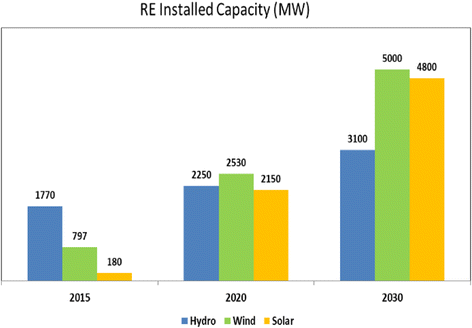
In the past, hydro-electric power has been a fundamental element of the Moroccan energy system, with the installed capacity reaching 1770 MW. Capacity is expected to grow to 3100 MW by 2030. However, because of limited hydro resources, the country has launched two programs to boost solar and wind energy projects:
- The Moroccan Solar Plan (Noor) aims to reach 2000 MW installed solar power capacity (PV and CSP) by 2020 and roughly 4800 MW by 2030 (additional 4560 MW from 2016 to 2030).
- The Moroccan Integrated Wind Program aims to achieve 2000 MW installed wind power capacity by 2020 and up to 5000 MW by 2030 (additional 4200 MW from 2016 to 2030).
With the export of green electricity to Europe, given the vicinity to Spain, Morocco can become an important player in the export of green electricity to a major regional market [32]. Even though exporting is not possible today because of the economic downturn in Europe and the excess of renewable generation in Spain, the future of the north African energy market will be Europe. In the aim to encourage renewable energy deployment, Morocco has approved three main pillars of action:
- (i)
Promulgate the actual regulations and acts to improve renewable energy transparency and competitiveness; - (ii)
Set up institutions with the ability to succeed, control, and promote green energy facilities; and - (iii)
Execute projects and major financial investments to construct the mandatory renewable energy projects and propose new schemes to boost large scale projects.
Wind targets and realizations
The first wind farms were commissioned in the 2000s on behalf of ONEE within a PPA with a private developer.
The installed base for renewables production features a wind farm in Tetouan (54 MW, commissioned in 2000), Lafarge’s wind farm at Tetouan (32 MW, commissioned in 2005, 2008, and 2009), Amogdoul’s wind farm at Essaouira (60 MW, commissioned in 2007), the Tangiers wind farm (140 MW, commissioned in 2009), the cement plant at Laâyoune (5 MW, commissioned in 2011), and the Tarfaya wind farm (300 MW). In addition, independent producers developed 620 MW for industrial clients (Akhfennir, 200 MW; Foum El Oued, 50 MW; El Haouma, 50 MW; JbelKhalladi, 120 MW, Aftissat 200 MW) [33].
Moreover, ONEE has launched an Integrated Wind Programme, which will total 1000 MW upon completion of six wind farms; the first 150 MW capacity is currently under development at Taza. The five other wind farms planned in this integrated program are:
- Midelt (Midelt), 150 MW to be delivered on 2018;
- Tanger II (Tangiers), 100 MW to be delivered on 2019 Tiskrad (Laâyoune), 300 MW to be delivered on 2019;
- JbelLahdid (Essaouira), 200 MW to be delivered in 2020; and
- Boujdour (Boujdour), 100 MW to be delivered in 2020.
Moreover, ONEE intends to increase the power of the Tetouan (Koudia El Baïda) wind farm to 130 MW or 150 MW.
As shown in Fig. 3, by 2020 the expected 2000 MW capacity should generate around 6600 GWh per year thanks to the exceptional quality of the wind resources on the Moroccan coasts. It expected to save 1.5 Mtoe and prevent the emission of 5.6 million tons of carbon dioxide annually. By realizing these projects, the installed wind capacity will be around 2530 MW in 2020 (largely exceeding the initial target of 2000 MW) and 5000 MW in 2030 [34].
Fig. 3
The alternative text for this image may have been generated using AI.
Projected RE installed capacity (2020–2030)
Solar target and realizations
Since 1995, Morocco has undertaken a Global Rural Electrification Programme (PERG) entrusted to ONEE. Over 16 years, 42,200 villages have thus been provided with electricity, i.e., 2 million households; of these, 51,000 individuals were equipped with (isolated) solar kits with a capacity of 70 kW (kW) or 200 kW – totaling around 10 MW of photovoltaic energy (PV).
In addition, a CSP power plant with a 20 MW capacity, commissioned in 2011 with the support of the World Bank’s Global Environment Facility, was incorporated in the 450 MW combined cycle gas power plant of Ain Beni Mathar [35, 36].
Moreover, the Solar Integrated Project was launched in 2009. The target of this project is to reach a total installed capacity of 2000 MW by 2020 with the development of large scale CSP and PV facilities in five different areas covering a total of 10,000 ha for a total final production of 4500 GWh (18% of current national electricity production) [37]. The investment costs for the project amount to US$9 billion, however the project would lead to savings of 1 million Toe (tonne of oil equivalent) and 3.7 million tonnes of CO2 emissions per year [38]. The first phase of the project will have a total capacity of 580 MW and will involve the construction of a CSP farm in the area. The initial construction has been in operation since December 2015 with a capacity of 160 MW [39]. The cost of this project is too high compared to other power plants, but the country looks to increase the added value of this project by the local content and industry integration. The experience is still in the beginning stages and the assessment is late.
The second project (NOORII), also a parabolic trough, with a capacity of 200 MW and 7 h of storage is to start construction during the third quarter 2015. The third project (NOOR III), which is a tower with a capacity of 150 MW and more than 7 h of storage, is expected to start construction at about the same time. MASEN is also developing a new program called NOOR PV I that consists of three PV power plants with an aggregate capacity of 170 MW and an annual output of 320 GWh [[40](/article/10.1186/s13705-017-0131-2#ref-CR40 "Bennouna A, El Hebil C (2016) Energy needs for Morocco 2030, as obtained from GDP-energy and GDP-energy intensity correlations. Energy Policy 88:45–55. http://www.sciencedirect.com/science/article/pii/S0301421515301312
. (seen 21.08.2017)")\].To further develop the strong domestic solar energy potential, ONEE launched a program to develop end-of-line, mid-sized (20 MW to 30 MW) solar PV plants, which will help strengthen the security of the electricity supply in the selected zones. This program, which aims for a total installed power of around 400 MW, is seen as a network management tool, since it is mainly intended to improve the quality of the customer service provided in surrounding regions, particularly during daytime hours. This program features the following projects:
- The NOOR ATLAS project is intended to meet the needs of the southern and eastern regions through the deployment of eight solar PV plants with a 200 MW capacity at Guemim, Tata, Tahla, Guenfouda, Ain Beni Mathar, Boudnib, and Boulmane.
- The NOOR Tafilalt project is intended to strengthen the Zagora Arfoud and Misour networks thanks to three solar PV plants with a 75 MW capacity.
- The addition of 100 MW is intended to strengthen the network in other Moroccan regions.
By realizing these projects, the solar installed capacity will be around 2150 MW in 2020 (exceeding the initial target of 2000 MW) and 4800 MW in 2030.
Morocco is initiating the second phase of its energy strategy, which aims to accelerate the achievement of the solar and wind programs. During this phase, new recent projects have been launched, including the roadmap for the development of PV covering the following areas:
- Development program of large and medium solar PV (PV Program Onee 400 MW, MASEN PV Program: 400 MW - PV Program THT-HT for private producers under Act 13–09).
- Development of PV solar power projects whose production is for consumers connected to medium voltage (market estimated at 1.5 GW in 2030).
- Development of large-scale use of PV in the residential and tertiary areas connected to low voltage. The potential is estimated at 4.5 GW (market is estimated to be 1.5 GW in 2030).
- Establishment of support in industrial integration and R&D programs dedicated to PV.
Also, new reform projects are being launched. This is the opening of the electricity market from renewable sources to the medium voltage (MV) and low voltage (LV) and the establishment of an independent authority of energy regulation to accompany the evolutions in the national energy sector, particularly in terms of opening the renewable source electricity market (scheduled for 2015).
Hydro target and realizations
By 2020, 520 MW will be installed on the major dams under construction. Moreover, under Act 13–09, seven hydraulic micro-plants with a total capacity of 54 MW are now under development by the private sector. Finally, retention basins have been built and drip irrigation developed with a view to separate irrigation needs from energy needs to better satisfy demand [41].
The increase in the share of variable renewable energies—such as wind and solar power—makes the use of Morocco’s flexible hydropower resources even more essential. Managing this variability will be made easier thanks to the Pumped Storage Plants Plant (PSPP) that already exists (Afourer, 464 MW, since 2004) and those in development (Abdelmoumen, 350 MWh, around 7 h of storage at full power). Two other PSPPs of 300 MW each are under development with an expected commissioning date between 2020 and 2030 [42].
By realizing these projects, the hydro installed capacity will be around 2250 MW (exceeding the initial target of 2000 MW) in 2020 and 3100 MW in 2030 [[43](/article/10.1186/s13705-017-0131-2#ref-CR43 "ONEE Morocco (2015). Monthly Activity Report of ONEE, ONEE.MA, December 2015 URL: http://www.one.org.ma/FR/pdf/Rapport%20d'activit%C3%A9s2015.rar
. last seen 21.08.2017.")\].Lessons learnt from Moroccan energy experience
PPA model
The PPA model adopted for the production of electricity since 1992 allows:
- the guarantee to purchase electricity during the lifetime of the plant;
- transfer of know-how to Moroccan technicians;
- the evolution of the electricity generation fleet; and
- the production of electricity at competitive prices.
This PPA model has undergone a remarkable evolution since the launch of the first PPA with Jorf Lasfar. This view of the limitations of the capacities of national investment, until today, has been most notably through the introduction of industrial integration criteria for integrated solar and wind programs and the choice of private operators, and the involvement of national partners in the process of developing these projects has ensured the sustainability of knowledge to make and transfer technology and to create national champions [[44](/article/10.1186/s13705-017-0131-2#ref-CR44 "International Renewable Energy Agency. (2012). Renewable Energy Technologies: Cost Analysis Series. Biomass for Power Generation (Vol. 1). Retrieved from Retrieved from https://www.irena.org/DocumentDownloads/Publications/RE_Technologies_Cost_Analysis-BIOMASS.pdf%5Cnwww.irena.org/Publications
")\].Liberalization and requested reforms
Liberalization refers to the abolition of the rights of monopolies, rights that accorded energy suppliers protection against competition. Liberalization constitutes a ground-breaking change for the whole energy sector. Consequently, this process of liberalization presents special challenges and risks, some of which may lead to serious mistakes if not handled appropriately [[45](/article/10.1186/s13705-017-0131-2#ref-CR45 "Devabhaktuni V, Alam M, Shekara Sreenadh Reddy Depuru S, Green RC, Nims D, Near C (2013) Solar energy: Trends and enabling technologies. Renew Sust Energ Rev 19:555–564. http://www.sciencedirect.com/science/article/pii/S1364032112006363
. ( seen 21 Aug 2017)"), [46](/article/10.1186/s13705-017-0131-2#ref-CR46 "Burgherr P, Hirschberg S (2014) Comparative risk assessment of severe accidents in the energy sector. Energy Policy 74(1):35–56")\].While contracted, the power purchase price of Ouarzazate Concentrated Solar Plant (NOOR1,2 &3) is much greater than the cost of electricity from other sources (1.62, 1.36, 1.42 MAD, respectively), and the government subsidy is required to bridge the affordability gap for CSP in order to prevent the costs from being transferred to energy consumers.
In Morocco, national electricity grid usage tariffs are still not regulated. Actually, there is no subsidy for delivery to the grid, but with the creation of a National Authority for the Regulation of Electricity, the principles of access to the grid will be laid down [[47](/article/10.1186/s13705-017-0131-2#ref-CR47 "Touami A. Pan-Arab Renewable Energy Strategy 2030, IRENA, 2014. Url: https://www.irena.org/DocumentDownloads/Publications/IRENA_Pan-Arab_Strategy_June%202014.pdf
(Last seen 21 Aug 2017)."), [48](/article/10.1186/s13705-017-0131-2#ref-CR48 "Gallego CD, Mack A (2010) Sustainability assessment of energy technologies via social indicators: results of a survey among European energy experts. Energy Policy 38(2):1030–1039")\].Despite sustained efforts to reform the electrical sector, the latter is still incomplete along with the operating rules for the wholesale market, including provisioning of the grid and systems services, which are unclear, non-transparent, and untested. In addition, while policy signals appear to be promising and ambitious, execution of these reform plans at the state level is vague and uncertain.
Discussion
Renewable Energy does not only provide an effective solution to meet CO2 reduction targets. Beyond climate change mitigation and adaptation, renewable energy can offer great advantages in terms of energy security and savings on energy imports as well as great opportunities to spend money within the national economy rather than on fuel imports. Our analysis of the energy sector shows some challenges and limitations that need to be overcome:
- The implementation of PPAs with fixed prices for a long time-span between a single purchaser “offtaker” (often a state-owned electricity utility) and a privately owned power producer causes distortion of free competition and limits the flexibility of the electricity system needed to manage renewable energy production hazards.
- Renewable energies in Morocco are currently expanding. Today, they represent almost 10% of the Moroccan electricity mix, making the intermittency of renewable generation more pressing. Until now, there have been no demand management measures to mitigate renewables’ intermittent supply, which is challenging. Their potential contribution to the electrical system flexibility should be studied.
- The mixed regulated market for conventional production and a liberalized market for renewable energy supply makes the operation of the electrical system more complex (in particular, real-time balancing is difficult when intermittent energy injection is unpredictable) and limits the size of the wholesale market. Additionally, the juxtaposition of the two markets is not accurate in terms of management, even in the case of very large markets.
- A clearly established system for the provision of grid and balancing services should take place for producers injecting renewable energy supply into the grid.
- The current grid access pricing is not establishing the costs for different energy producers in a clear and transparent way. In fact, where an obligation to grant access exists, the pricing of access has proven to be a crucial regulatory issue. Thus, it is necessary to work towards a harmonized charging system that fully meets the efficiency and cost recovery objectives.
- The grid code for high and extra high voltage setting out the technical parameters for access to the grid must be adjusted for the new structure of the energy sector for large renewable energy penetration. Furthermore, given the opening to competition of the electricity market for medium voltage for renewable sources, a grid code for medium voltage must be established for access by renewable energy producers.
- The role of the EIS as a unique electricity purchaser in the national electricity market does not allow a separation of the transport and electricity production activities. This separation is necessary for non-discriminatory access to the grid.
- The opening of the market for medium voltage customers must be conditioned by the prior realignment and restructuring of the multi-service distribution sector. Otherwise, the Moroccan government has introduced a liberalization of the distribution market, which will not offend the interests of dealers. The whole question is how dealers and private suppliers will share the electrical grid. The distributor’s system should be rethought.
- The regulation of the distribution activity will have to integrate the principles of opening the medium voltage market for renewable energy producers. It should be noted that a new regulatory scheme for production and transport activities is currently being studied. Otherwise, distribution activities will be carried out in a second stage.
- The decentralized production connection (of renewable or non-renewable type) has a significant impact on the medium voltage grid operation. This affects first the distribution grid manager, as he is responsible for maintaining a reasonable level of reliability, quality, and safety. The injection of energy into a medium grid thus brings additional constraints: reverse flows, voltage regulation, protection schemes, power quality, etc. Then, the grid manager has an increased need for observability via power grid tools.
Particularly, there is a lack of accessible financial support for small scale projects to help facilitate private consumers’ installation of renewable energy technologies. Most financing is directed to large scale projects.
Moreover, the economic viability is affected by high initial capital costs due to a lack of confident financial support and high-risk perceptions related to renewable energy. In Morocco, major financing for RE development still comes from the government and from international funds rather than from local private investors and regional banks.
Conclusions
This paper has examined the Moroccan energy sector as it relates to RE policy evaluation, namely the Act 13–09 related to renewable energies and the PPA/IPP schemes related to the regulated electricity market. As presented, Morocco is transitioning into green development, as the country is involved in important economic and social development. Due to some key issues that Morocco is facing (lake of water, high energy importation, and impact of climate change) and the weak economic progress and social development policies for boosting job creation and decreasing social and spatial gaps, Morocco has categorically made the green economy a strategic focus of its sustainable development policy [[49](/article/10.1186/s13705-017-0131-2#ref-CR49 "Benrahmoune I (2011). Etude pour la spécification des besoins en compétences dans le secteur des énergies renouvelables et les secteurs impactés par l’efficacité énergétique, Sfere-Co Efficience, Novembre 2011 URL: http://www.mem.gov.ma/SitePages/Discours/Allocution-Cluster21Avril14.pdf
. (last seen April 2017)")\].The country is dedicated to mobilizing all interested parties and building advanced public–private partnerships (PPP) to raise environment-compliant investments that are likely to create value and add sustainable jobs. Morocco has the required assets to achieve these goals, particularly for developing REs, mainly wind and solar, and to realize its integration among the Euro-Mediterranean markets.
Morocco has adopted an RE development model based on a public–private partnership in which the private sector brings its know-how to complete projects and make them operational. The above analysis shows that the importance of policies and regulatory frameworks cannot be overstated. Setting strong policy goals is hereby indispensable for offering investment confidence, to mobilize stakeholders, and develop the sharing of resources. Also, mechanisms and national/international micro-financing tools for small-scale renewable energy projects should be developed in order to allow adequate adaptation of the vulnerable local populations.
However, a well-functioning regional market will require implementing necessary reforms in order to meet global market standards, pursuing policies that promote the harmonization of national regulations and technical rules for operation of power systems, and removing subsidies or any other barriers that can impede competition and the smooth physical flow of power. The final goal is to have a market design that optimally combines economic logic and technical constraints.
References
- ADEREE (2015). The Energy Efficiency vision of the Kingdom. ADEREE, Rabat, p 123
Google Scholar - MEMEE (2016). Minister Speech during Photovoltaica Conference and Exhibition. MEMEE, Rabat
Google Scholar - International Energy Agency (2014). Energy Policies beyond IEA countries: Morocco. International Energy Agency, Paris
Google Scholar - Leidreter A, Boselli F (2015). 100% Renewable energy: boosting development in Morocco, World Future Council
- Vidican G (2013). Achieving Inclusive Competitiveness in the Emerging Solar Energy Sector in Morocco, DIE: German Development Institute, Bonn p. 45.
- MEMEE (2015). Speech of the Minister of Energy and Mines during COP21. MEMEE, Paris
Google Scholar - Clean Energy Council (2015). Clean Energy Australia Report 2015. Special Report. Clean Energy Council, Sydney, pp 31–35
Google Scholar - Climate Change Legislation in Morocco, The 2015 Global Climate Legislation Study. UNFCCC Climate Change Conference in Bonn, Germany. p. 44
- Schinke B, Klawitter J (2016). Energy and Development at a Glance: Country Fact Sheet Morocco, German Watch, Vol. 145, pp.132
- Brower M, Galán EM, Li JF, Green D, Hinrichs-Rahlwes R, Sawyer S, Sander M, Taylor R, Kopetz H, and Gsänger, “Renewables 2014 global status report,” REN21. 2014. http://www.ren21.net/Portals/0/documents/Resources/GSR/2014/GSR2014_KeyFindings_low%20res.pdf. (last seen 21 Aug 2017)
- Aherdan M (2016). Chiffres Clefs du Secteur Energie 2015, Ministère de l’Energie, des Mines, de l’Eau et de l’Environnement, Vol. 234, pp 34–36
- Döring J (2016) Project: Middle East North Africa Sustainable Electricity Trajectories (MENA-SELECT), German Watch Journal, Vol. 142, pp.12
- Official Gazette (2010). Act number 57-09 on the creation of the Moroccan Agency for Solar Energy, vol 5955. Official Gazette, Rabat, pp 23–26
Google Scholar - Study on innovative financing mechanisms for renewable energy projects in North Africa. https://www.uneca.org/publications/studyinnovative-financing-mechanisms-renewable-energy-projects-north-africa. Accessed 21 Aug 17
- Official Gazette (2016). Act number 37–16 on the update of the Moroccan Agency for sustainable development, vol 6342. Official Gazette, Rabat, pp 43–45
Google Scholar - Official Gazette (2010). Act number 16–09 on the update of CDER to ADEREE, vol 5943. Official Gazette, Rabat, pp 11–14
Google Scholar - Official Gazette (2016). Act number 39–16 on the update of ADEREE to AMEE, vol 6342. Official Gazette, Rabat, pp 41–42
Google Scholar - Mezzour S (2014). Morocco Challenges and Public Private Partnerships. University of Venice
- Official Gazette (2013). Finance Budget Act on the establishment of SIE, vol 4467. Official Gazette, Rabat, pp 100–104
Google Scholar - Benatmout A (2013). Etude Prospective De La Demande D’Energie a L’Horizon 2030. Ministere de l’énergie et des mines, pp 138
- Bryden J, Riahi L, Zissler R (2013). MENA: Renewables Status Report, REN 21. URL : http://www.ren21.net/Portals/0/documents/activities/Regional%20Reports/MENA_2013_lowres.pdf. Paris 2013.
- Roller G, Lefevre M, Wirtz J, Schmidt-Sercander B, Eichhammer W, Ragwitz M, Mouline S (2007). Etude sur le cadre organisationnel, institutionnel et législatif pour la promotion des Énergies Renouvelables. Retrieved from http://www.giz.de/en/downloads/fr-marokkoerneuerbare-energien-2007.pdf. (Last visit 25 June 2017)
- Official Gazette (2010). Act number 13–09 on renewable energy, vol 5532. Official Gazette, Rabat, pp 130–136
Google Scholar - Taoumi M, Liyan J (2015). FEMIP Evaluating Renewable Energy Manufacturing Potential in the Mediterranean Partner Countries, (IRENA publication May 2015).
- Laâbi T, Abaâch H (2015). Public-Private Partnerships in Morocco: Enabling environment for the realization of RE projects, Global Energy for the Mediterranean magazin (GEM), N° 13, Rabat Morocco.
- Haddouche A (2016) Renewable Energy and Wind Energy in Morocco, Powerpoint Presentation. MASEN Agency, Berlin
Google Scholar - Chang KC, Lin WM, Leu TS, Chung KM (2016) Perspectives for solar thermal applications in Taiwan. Energy Policy 94:25–28 http://www.sciencedirect.com/science/article/pii/S0301421516301367?via%3Dihub. (Last seen 21 Aug 2017)
- Almaghrb Bank (2O15). Annuel Repport of Moroccan National Bank. Rabat, Morocco. URL: http://www.bkam.ma/en/Publications-statisticsand-research/Institutional-publications/Annual-report-presented-to-his-majesty-the-king/Annual-report-2015. (last seen 21.08.2017)
- Dornan M, Shah KU (2016) Energy policy, aid, and the development of renewable energy resources in Small Island Developing States. Energy Policy 98:759–767 https://doi.org/10.1016/j.enpol.2016.05.035
Article Google Scholar - A.Azizi (2015). Actes du colloque international sur l’énergie.Fédération Nationale de l’Energie. Casablanca, MOROCCO. Url : http://www.fedenerg.ma/energie-strategie/ (last seen 21.08.2017)
- BMWi (Federal Ministry of Economics and Technology) and BMU (Federal Ministry for the Environment, Nature Conservation and Nuclear Safety) (2010) Energy concept for an environmentally sound, reliable and affordable energy supply. Available via: https://www.bmwi.de/Redaktion/EN/Publikationen/research-for-an-environmentally-sound-reliable-and-affordable-energy-supply.pdf?__blob=publicationFile&v=3. Accessed 21 Aug 2017
- LeCanut P, Picard L, Feuillard C (2015). Generation and Transmission Master Plan with RE integration on the Moroccan power, EDF reports, Vol. 35, pp 35
- Nfaoui, H (2004). aractéristiques du gisement éolien marocain et optimisation d’un système aérogénérateur/groupe électrogène pour l’électrification des villages isolés. Rabat, Faculté des Sciences. Accessed 13 May 2017
- Benkhadra A (2012) DESERTEC: Concentrated Solar Power. (p. 4). Desertec-UK, London
Google Scholar - Favennec JP, Adedjoumon C, Duhamel B, Girl J, Gilles H, and Tronche A (2009). “L’énergie en Afrique à l’horizon 2050”
Google Scholar - Amaraa A (2015). Ministry of energy and mines Speech during 21st Conference Of Parties in Paris. November 2015.
- Tekken V, Costa L, Kropp JP (2009) Assessing the Regional Impact of Climate Change on Economics Sectors in the Low-Lying Coastal zone of Mediterranean East of Morocco. J Coast Res
- Abengoa (2010) Activity Repport. Abengoa, Madrid
Google Scholar - Aherdan M (2013). Analyse des Indicateurs Energétiques, Ministère de l’Energie, des Mines, de l’Eau et de l’Environnement, DOP Publication, April Volume, pp 65
- Bennouna A, El Hebil C (2016) Energy needs for Morocco 2030, as obtained from GDP-energy and GDP-energy intensity correlations. Energy Policy 88:45–55. http://www.sciencedirect.com/science/article/pii/S0301421515301312. (seen 21.08.2017)
- MASEN. (2017). Repport about Moroccan Solar Project. Marrekch
- World Bank. (2016). Moroccan Solar complexe. Bonne
- ONEE Morocco (2015). Monthly Activity Report of ONEE, ONEE.MA, December 2015 URL: http://www.one.org.ma/FR/pdf/Rapport%20d'activit%C3%A9s2015.rar. last seen 21.08.2017.
- International Renewable Energy Agency. (2012). Renewable Energy Technologies: Cost Analysis Series. Biomass for Power Generation (Vol. 1). Retrieved from Retrieved from https://www.irena.org/DocumentDownloads/Publications/RE_Technologies_Cost_Analysis-BIOMASS.pdf%5Cnwww.irena.org/Publications
- Devabhaktuni V, Alam M, Shekara Sreenadh Reddy Depuru S, Green RC, Nims D, Near C (2013) Solar energy: Trends and enabling technologies. Renew Sust Energ Rev 19:555–564. http://www.sciencedirect.com/science/article/pii/S1364032112006363. ( seen 21 Aug 2017)
- Burgherr P, Hirschberg S (2014) Comparative risk assessment of severe accidents in the energy sector. Energy Policy 74(1):35–56
Google Scholar - Touami A. Pan-Arab Renewable Energy Strategy 2030, IRENA, 2014. Url: https://www.irena.org/DocumentDownloads/Publications/IRENA_Pan-Arab_Strategy_June%202014.pdf (Last seen 21 Aug 2017).
- Gallego CD, Mack A (2010) Sustainability assessment of energy technologies via social indicators: results of a survey among European energy experts. Energy Policy 38(2):1030–1039
Article Google Scholar - Benrahmoune I (2011). Etude pour la spécification des besoins en compétences dans le secteur des énergies renouvelables et les secteurs impactés par l’efficacité énergétique, Sfere-Co Efficience, Novembre 2011 URL: http://www.mem.gov.ma/SitePages/Discours/Allocution-Cluster21Avril14.pdf. (last seen April 2017)