Low Prognostic Implication of Fibroblast Growth Factor Family Activation in Triple-negative Breast Cancer Subsets (original) (raw)
Abstract
Background
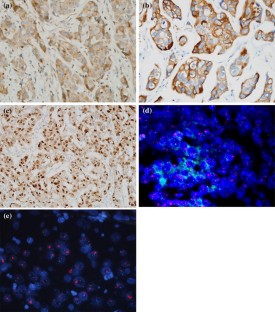
Despite a greater understanding of the molecular heterogeneity of breast cancer, current therapeutic strategies still cannot overcome the relatively poor prognosis of triple-negative breast cancer (TNBC). Deregulation of fibroblast growth factor (FGF) signaling has been found in breast cancer, and blocking this pathway has been suggested as a potential therapeutic target. We therefore evaluated the expression and copy number changes of FGF family members in TNBC.
Methods
We retrospectively evaluated 148 primary TNBC in 2009 for FGFR1, FGFR2, and FGF2 expression by immunohistochemistry. FGFR1 and FGFR2 gene copy numbers were analyzed by fluorescence in situ hybridization. The Cancer Genome Atlas (TCGA) data was used to study correlations between gene expression and amplification or methylation of FGFR1, FGFR2, and FGF2 in basal-like TNBC.
Results
FGFR1, FGFR2, and FGF2 expression were found in 16.2 % (24 of 148), 12.8 % (19 of 148), and 12.8 % (19 of 148) of TNBCs, respectively. FGFR1 gene amplification was observed in 4.1 % (6 of 145), and FGFR1 high polysomy was detected in 6.9 % (10 of 145) of the cases examined. FGFR2 gene amplification and high polysomy were identified in 4.7 % (6 of 129 cases) and 0.8 % (1 of 129 cases), respectively. FGF2 expression was found to be associated with basal-like TNBC. The expression of FGF family members and FGFR1 or FGFR2 gene amplification did not affect patient survival. TCGA data revealed that promoter methylation of the 3 genes was significantly associated with mRNA expression.
Conclusions
Even though the implications for patient outcomes are not significant, subsets of TNBCs harbor FGFR1 or FGFR2 gene amplification and FGFR1, FGFR2, or FGF2 protein overexpression.
Access this article
Subscribe and save
- Starting from 10 chapters or articles per month
- Access and download chapters and articles from more than 300k books and 2,500 journals
- Cancel anytime View plans
Buy Now
Price excludes VAT (USA)
Tax calculation will be finalised during checkout.
Instant access to the full article PDF.
Fig. 1
References
- Lehmann BD, Bauer JA, Chen X, Sanders ME, Chakravarthy AB, Shyr Y, et al. Identification of human triple-negative breast cancer subtypes and preclinical models for selection of targeted therapies. J Clin Invest. 2011;121:2750–67.
Article CAS PubMed Central PubMed Google Scholar - Ossovskaya V, Wang Y, Budoff A, Xu Q, Lituev A, Potapova O, et al. Exploring molecular pathways of triple-negative breast cancer. Genes Cancer. 2011;2:870–9.
Article CAS PubMed Central PubMed Google Scholar - Turner N, Lambros MB, Horlings HM, Pearson A, Sharpe R, Natrajan R, et al. Integrative molecular profiling of triple negative breast cancers identifies amplicon drivers and potential therapeutic targets. Oncogene. 2010;29:2013–23.
Article CAS PubMed Central PubMed Google Scholar - Brooks AN, Kilgour E, Smith PD. Molecular pathways: fibroblast growth factor signaling: a new therapeutic opportunity in cancer. Clin Cancer Res. 2012;18:1855–62.
Article CAS PubMed Google Scholar - Ahmad I, Iwata T, Leung HY. Mechanisms of FGFR-mediated carcinogenesis. Biochim Biophys Acta. 2012;1823:850–60.
Article CAS PubMed Google Scholar - Elbauomy Elsheikh S, Green AR, Lambros MB, Turner NC, Grainge MJ, Powe D, et al. FGFR1 amplification in breast carcinomas: a chromogenic in situ hybridisation analysis. Breast Cancer Res. 2007;9:R23.
Article PubMed Central PubMed Google Scholar - Hammond ME, Hayes DF, Dowsett M, Allred DC, Hagerty KL, Badve S, et al. American Society of Clinical Oncology/College Of American Pathologists guideline recommendations for immunohistochemical testing of estrogen and progesterone receptors in breast cancer. J Clin Oncol. 2010;28:2784–95.
Article PubMed Central PubMed Google Scholar - Koh YW, Lee HJ, Lee JW, Kang J, Gong G. Dual-color silver-enhanced in situ hybridization for assessing HER2 gene amplification in breast cancer. Mod Pathol. 2011;24:794–800.
Article CAS PubMed Google Scholar - Jang MH, Kim EJ, Choi Y, Lee HE, Kim YJ, Kim JH, et al. FGFR1 is amplified during the progression of in situ to invasive breast carcinoma. Breast Cancer Res. 2012;14:R115.
Article CAS PubMed Central PubMed Google Scholar - Cappuzzo F, Hirsch FR, Rossi E, et al. Epidermal growth factor receptor gene and protein and gefitinib sensitivity in non-small-cell lung cancer. J Natl Cancer Inst. 2005;97:643-55.
Article CAS PubMed Google Scholar - Stephens PJ, Tarpey PS, Davies H, Van Loo P, Greenman C, Wedge DC, et al. The landscape of cancer genes and mutational processes in breast cancer. Nature. 2012;486:400–4.
CAS PubMed Central PubMed Google Scholar - Nielsen TO, Hsu FD, Jensen K, Cheang M, Karaca G, Hu Z, et al. Immunohistochemical and clinical characterization of the basal-like subtype of invasive breast carcinoma. Clin Cancer Res. 2004;10:5367–74.
Article CAS PubMed Google Scholar - Cheang MC, Voduc D, Bajdik C, Leung S, McKinney S, Chia SK, et al. Basal-like breast cancer defined by five biomarkers has superior prognostic value than triple-negative phenotype. Clin Cancer Res. 2008;14:1368–76.
Article CAS PubMed Google Scholar - Beroukhim R, Getz G, Nghiemphu L, Barretina J, Hsueh T, Linhart D, et al. Assessing the significance of chromosomal aberrations in cancer: methodology and application to glioma. Proc Natl Acad Sci USA. 2007;104:20007–12.
Article CAS PubMed Central PubMed Google Scholar - Massabeau C, Sigal-Zafrani B, Belin L, Savignoni A, Richardson M, Kirova YM, et al. The fibroblast growth factor receptor 1 (FGFR1), a marker of response to chemoradiotherapy in breast cancer? Breast Cancer Res Treat. 2012;134:259–66.
Article CAS PubMed Google Scholar - Sun S, Jiang Y, Zhang G, Song H, Zhang X, Zhang Y, et al. Increased expression of fibroblastic growth factor receptor 2 is correlated with poor prognosis in patients with breast cancer. J Surg Oncol. 2012;105:773–9.
Article CAS PubMed Google Scholar - Gelsi-Boyer V, Orsetti B, Cervera N, Finetti P, Sircoulomb F, Rougé C, et al. Comprehensive profiling of 8p11-12 amplification in breast cancer. Mol Cancer Res. 2005;3:655–67.
Article CAS PubMed Google Scholar - Turner N, Pearson A, Sharpe R, Lambros M, Geyer F, Lopez-Garcia MA, et al. FGFR1 amplification drives endocrine therapy resistance and is a therapeutic target in breast cancer. Cancer Res. 2010;70:2085–94.
Article CAS PubMed Central PubMed Google Scholar - Sharpe R, Pearson A, Herrera-Abreu MT, Johnson D, Mackay A, Welti JC, et al. FGFR signaling promotes the growth of triple-negative and basal-like breast cancer cell lines both in vitro and in vivo. Clin Cancer Res. 2011;17:5275–86.
Article CAS PubMed Central PubMed Google Scholar - Jain VK, Turner NC. Challenges and opportunities in the targeting of fibroblast growth factor receptors in breast cancer. Breast Cancer Res. 2012;14:208.
Article PubMed Central PubMed Google Scholar - Michor F, Polyak K. The origins and implications of intratumor heterogeneity. Cancer Prev Res Phila. 2010;3:1361–4.
Article PubMed Central PubMed Google Scholar
Author information
Authors and Affiliations
- Department of Pathology, Asan Medical Center, University of Ulsan College of Medicine, Seoul, Korea
Hee Jin Lee MD, PhD, Joo Young Kim MD, Ji Young Park MD, PhD & Gyungyub Gong MD, PhD - Department of Pathology, Seoul National University Bundang Hospital, Seongnam, Gyeonggi, Korea
An Na Seo MD, PhD & So Yeon Park MD, PhD - Department of Pathology, Seoul National University College of Medicine, Seoul, Korea
So Yeon Park MD, PhD - Department of Surgery, Asan Medical Center, University of Ulsan College of Medicine, Seoul, Korea
Jong Han Yu MD, PhD - Department of Oncology, Asan Medical Center, University of Ulsan College of Medicine, Seoul, Korea
Jin-Hee Ahn MD, PhD
Authors
- Hee Jin Lee MD, PhD
- An Na Seo MD, PhD
- So Yeon Park MD, PhD
- Joo Young Kim MD
- Ji Young Park MD, PhD
- Jong Han Yu MD, PhD
- Jin-Hee Ahn MD, PhD
- Gyungyub Gong MD, PhD
Corresponding author
Correspondence toHee Jin Lee MD, PhD.
Additional information
Hee Jin Lee and An Na Seo are contributed equally to this work.
Rights and permissions
About this article
Cite this article
Lee, H.J., Seo, A.N., Park, S.Y. et al. Low Prognostic Implication of Fibroblast Growth Factor Family Activation in Triple-negative Breast Cancer Subsets.Ann Surg Oncol 21, 1561–1568 (2014). https://doi.org/10.1245/s10434-013-3456-x
- Received: 13 July 2013
- Published: 03 January 2014
- Issue date: May 2014
- DOI: https://doi.org/10.1245/s10434-013-3456-x