Prognostic Implication of Body Mass Index on Survival Outcomes in Surgically Treated Nonmetastatic Renal Cell Carcinoma: A Single-Institutional Retrospective Analysis of a Large Cohort (original) (raw)
Abstract
Purpose
Obesity is a well-known risk factor for renal cell carcinoma (RCC). However, the prognostic role of obesity in RCC has not been clearly established thus far. We aim to assess the effect of preoperative body mass index (BMI) on survival outcomes in nonmetastatic RCC patients.
Patients and Methods
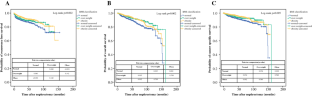
We retrospectively analyzed data on 2329 patients who underwent curative surgery for RCC between 2000 and 2014 in a single institution. Patients were divided into normal (< 23 kg/m2), overweight (23–24.9 kg/m2), and obese (≥ 25 kg/m2) groups depending on cutoffs for Asian population. Kaplan–Meier analysis with log-rank test was used to estimate and compare survival outcomes, including recurrence-free, overall, and cancer-specific survival, among each BMI group. The influence of BMI on each survival outcome was evaluated using multivariate Cox regression analyses.
Results
Obese patients presented favorable 5-year recurrent-free (90.7% vs 84.9%, p < 0.001), overall (91.8% vs 86.8%, p = 0.002), and cancer-specific (94.8% vs 89.4%, p = 0.002) survival rates than the normal group. Multivariate analyses revealed that increasing BMI was an independent predictor of favorable survival outcomes (all p values < 0.05). In particular, overweight (p = 0.009) and obese (p = 0.009) patients showed better cancer-specific survival compared with normal patients.
Conclusions
Our data suggest that overweight and obesity defined based on BMI are generally related to favorable survival outcomes after surgery for RCC. Additional basic research is required to find out the biological mechanisms explaining the correlation between BMI and survival outcomes.
Access this article
Subscribe and save
- Starting from 10 chapters or articles per month
- Access and download chapters and articles from more than 300k books and 2,500 journals
- Cancel anytime View plans
Buy Now
Price excludes VAT (USA)
Tax calculation will be finalised during checkout.
Instant access to the full article PDF.
Fig. 1
References
- Ljungberg B, Bensalah K, Canfield S, et al. EAU guidelines on renal cell carcinoma: 2014 update. Eur Urol. 2015;67:913–24.
Article Google Scholar - Motzer RJ, Jonasch E, Agarwal N, et al. Kidney cancer, version 2.2017, NCCN clinical practice guidelines in oncology. J Natl Compr Cancer Netw. 2017;15:804–34.
Article Google Scholar - Kontak JA, Campbell SC. Prognostic factors in renal cell carcinoma. Urol Clin N Am. 2003;30:467–80.
Article Google Scholar - Scelo G, Larose TL. Epidemiology and risk factors for kidney cancer. J Clin Oncol. 2018;7:245–57.
Google Scholar - Calle EE, Rodriguez C, Walker-Thurmond K, Thun MJ. Overweight, obesity, and mortality from cancer in a prospectively studied cohort of U.S. adults. N Eng J Med. 2003;348:1625–38.
Article Google Scholar - Calle EE, Kaaks R. Overweight, obesity and cancer: epidemiological evidence and proposed mechanisms. Nat Rev Cancer. 2004;4:579–91.
Article CAS Google Scholar - Pischon T, Lahmann PH, Boeing H, et al. Body size and risk of renal cell carcinoma in the European Prospective Investigation into Cancer and Nutrition (EPIC). Int J Cancer. 2006;118:728–38.
Article CAS Google Scholar - Adams KF, Leitzmann MF, Albanes D, et al. Body size and renal cell cancer incidence in a large US cohort study. Am J Epidemiol. 2008;168:268–77.
Article Google Scholar - McGuire BB, Fitzpatrick JM. BMI and the risk of renal cell carcinoma. Curr Opin Urol. 2011;21:356–61.
Article Google Scholar - Renehan AG, Tyson M, Egger M, Heller RF, Zwahlen M. Body-mass index and incidence of cancer: a systematic review and meta-analysis of prospective observational studies. Lancet. 2008;371:569–78.
Article Google Scholar - Hursting SD, Dunlap SM. Obesity, metabolic dysregulation, and cancer: a growing concern and an inflammatory (and microenvironmental) issue. Ann NY Acad Sci. 2012;1271:82–7.
Article CAS Google Scholar - Kundu JK, Surh Y-J. Emerging avenues linking inflammation and cancer. Free Radic Biol Med. 2012;52:2013–37.
Article CAS Google Scholar - Gilbert CA, Slingerland JM. Cytokines, obesity, and cancer: new insights on mechanisms linking obesity to cancer risk and progression. Annu Rev Med. 2013;64:45–57.
Article CAS Google Scholar - Jeon HG, Jeong IG, Lee JH, et al. Prognostic value of body mass index in Korean patients with renal cell carcinoma. J Urol. 2010;183: 448–54.
Article Google Scholar - Sung HH, Jeon SS, Park SY, et al. Impact of body mass index in Korean patients with renal cell carcinoma. Cancer Causes Control. 2012;23:505–11.
Article Google Scholar - Lee HW, Jeong BC, Seo SI, et al. Prognostic significance of visceral obesity in patients with advanced renal cell carcinoma undergoing nephrectomy. Int J Urol. 2015;22:455–61.
Article Google Scholar - Lee WK, Hong SK, Lee S, et al. Prognostic value of body mass index according to histologic subtype in nonmetastatic renal cell carcinoma: a large cohort analysis. Clin Genitourin Cancer. 2015;13:461–8.
Article Google Scholar - Kamat AM, Shock RP, Naya Y, Rosser CJ, Slaton JW, Pisters LL. Prognostic value of body mass index in patients undergoing nephrectomy for localized renal tumors. Urology. 2004;63:46–50.
Article Google Scholar - Parker AS, Lohse CM, Cheville JC, Thiel DD, Leibovich BC, Blute ML. Greater body mass index is associated with better pathologic features and improved outcome among patients treated surgically for clear cell renal cell carcinoma. Urology. 2006;68:741–6.
Article Google Scholar - Steffens S, Ringe KI, Schroeer K, et al Does overweight influence the prognosis of renal cell carcinoma? Results of a multicenter study. Int J Urol. 2013;20:585–92.
Article Google Scholar - Kaneko G, Miyajima A, Yuge K, et al. Visceral obesity is associated with better recurrence-free survival after curative surgery for Japanese patients with localized clear cell renal cell carcinoma. Jpn J Clin Oncol. 2015;45:210–6.
Article Google Scholar - Schips L, Lipsky K, Zigeuner R, et al. Does overweight impact on the prognosis of patients with renal cell carcinoma? A single center experience of 683 patients. J Surg Oncol. 2004;88:57–61.
Article Google Scholar - Donat SM, Salzhauer EW, Mitra N, Yanke BV, Snyder ME, Russo P. Impact of body mass index on survival of patients with surgically treated renal cell carcinoma. J Urol. 2006;75:46–52.
Article Google Scholar - Zheng W, McLerran DF, Rolland B, et al. Association between body-mass index and risk of death in more than 1 million Asians. N Engl J Med. 2011;364:719–29.
Article CAS Google Scholar - Stafford HS, Saltzstein SL, Shimasaki S, Sanders C, Downs TM, Sadler GR. Racial/ethnic and gender disparities in renal cell carcinoma incidence and survival. J Urol. 2008;179:1704–8.
Article Google Scholar - Consultation WE. Appropriate body-mass index for Asian populations and its implications for policy and intervention strategies. Lancet. 2004;363:157–63.
Article Google Scholar - Oh SW. Obesity and metabolic syndrome in Korea. Diabetes Metab J. 2011;35:561–6.
Article Google Scholar - Johansson M, Carreras-Torres R. The influence of obesity-related factors in the etiology of renal cell carcinoma—a Mendelian randomization study. PLoS Med. 2019;16:e1002724.
Article Google Scholar - Donin NM, Pantuck A, Klopfer P, et al. Body mass index and survival in a prospective randomized trial of localized high-risk renal cell carcinoma. Cancer Epidemiol Biomark Prev. 2016;25:1326–32.
Article CAS Google Scholar - Ito R, Narita S, Huang M, et al. The impact of obesity and adiponectin signaling in patients with renal cell carcinoma: a potential mechanism for the “obesity paradox”. PLoS One 2017;12:e0171615.
Article Google Scholar
Acknowledgements
This work was supported by a National Research Foundation of Korea (NRF) Grant (Grant No. 2018R1C1B5086339) funded by the Korea Government (MSIP). The funding source had no role in the study design, data collection, data analysis, data interpretation, or the writing of this report. The corresponding author had full access to all data and final responsibility to submit the paper for publication.
Author information
Authors and Affiliations
- Department of Urology, Seoul National University College of Medicine, Seoul, Korea
Dong Young Seon MD, Cheol Kwak MD, PhD, Hyeon Hoe Kim MD, PhD & Ja Hyeon Ku MD, PhD - Department of Urology, Dongguk University Ilsan Medical Center, Dongguk University College of Medicine, Goyang-si, Gyeonggi-do, Korea
Hyung Suk Kim MD, PhD
Authors
- Dong Young Seon MD
- Cheol Kwak MD, PhD
- Hyeon Hoe Kim MD, PhD
- Ja Hyeon Ku MD, PhD
- Hyung Suk Kim MD, PhD
Contributions
Conception and design: HSK, JHK, CK, and HHK. Data acquisition: DYS and HSK. Data analysis and interpretation: DYS and HSK. Manuscript drafting: DYS and HSK. Critical revision of the manuscript for scientific and factual content: HSK, JHK, CK, and HHK. Statistical analysis: DYS and HSK. Supervision: HSK, JHK, CK, and HHK.
Corresponding author
Correspondence toHyung Suk Kim MD, PhD.
Ethics declarations
Disclosures
No conflicts of interest were declared by all authors.
Additional information
Publisher's Note
Springer Nature remains neutral with regard to jurisdictional claims in published maps and institutional affiliations.
Rights and permissions
About this article
Cite this article
Seon, D.Y., Kwak, C., Kim, H.H. et al. Prognostic Implication of Body Mass Index on Survival Outcomes in Surgically Treated Nonmetastatic Renal Cell Carcinoma: A Single-Institutional Retrospective Analysis of a Large Cohort.Ann Surg Oncol 27, 2459–2467 (2020). https://doi.org/10.1245/s10434-020-08417-6
- Received: 14 August 2019
- Published: 03 April 2020
- Version of record: 03 April 2020
- Issue date: July 2020
- DOI: https://doi.org/10.1245/s10434-020-08417-6