JRM Vol.26 p.513 (2014) | Fuji Technology Press: academic journal publisher (original) (raw)
single-rb.php
JRM Vol.26 No.4 pp. 513-514
(2014)
Development Report:
Views over last 60 days: 1,348
Babyloid
Department of Mechanical and Systems Engineering, Chukyo University, 101-2 Yagoto Honmachi, Showa-ku, Nagoya 466-8666, Japan
Received:
October 29, 2014
Accepted:
May 19, 2014
Published:
August 20, 2014

Keywords:
human-robot interaction, robot assisted therapy, doll therapy, welfare care
Abstract
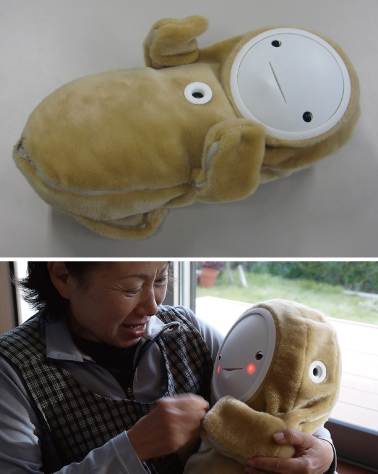
Babyloid
Babyloid is a robot whose purpose is to relieve the psychological distress in elderly patients and patients needing long-term care by having them take care of it. Unlike general robots, which seek to be able to do all tasks in the manner of human beings, Babyloid was designed so that it cannot do anything. However, it tries to satisfy its self-sufficiency by expressing psychological and physiological states through crying, showing bad mood, etc.
Cite this article as:
M. Kanoh, “Babyloid,” J. Robot. Mechatron., Vol.26 No.4, pp. 513-514, 2014.
Data files:
References
- [1] M. Kanoh and T. Shimizu, “Developing A Robot Babyloid That Cannot Do Anything,” J. of RSJ, Vol.29, No.3, pp. 76-83, 2011 (in Japanese).
- [2] K. Wada and T. Shibata, “Living With Seal Robots – Its Sociopsychological and Physiological Influences on the Elderly at a Care House,” IEEE Trans. Robotics, Vol.23, No.5, pp. 972-980, 2007.
*This site is desgined based on HTML5 and CSS3 for modern browsers, e.g. Chrome, Firefox, Safari, Edge, Opera.
Last updated on Apr. 10, 2026