A gigantic feathered dinosaur from the Lower Cretaceous of China (original) (raw)
- Letter
- Published: 04 April 2012
- Kebai Wang3,
- Ke Zhang4,
- Qingyu Ma1,
- Lida Xing5,
- Corwin Sullivan1,
- Dongyu Hu2,
- Shuqing Cheng3 &
- …
- Shuo Wang1,6
Nature volume 484, pages 92–95 (2012) Cite this article
- 8973 Accesses
- 135 Citations
- 493 Altmetric
- Metrics details
Subjects
Abstract
Numerous feathered dinosaur specimens have recently been recovered from the Middle–Upper Jurassic and Lower Cretaceous deposits of northeastern China, but most of them represent small animals1. Here we report the discovery of a gigantic new basal tyrannosauroid, Yutyrannus huali gen. et sp. nov., based on three nearly complete skeletons representing two distinct ontogenetic stages from the Lower Cretaceous Yixian Formation of Liaoning Province, China. Y. huali shares some features, particularly of the cranium, with derived tyrannosauroids2,3, but is similar to other basal tyrannosauroids4,5,6,7,8,9,10,11,12 in possessing a three-fingered manus and a typical theropod pes. Morphometric analysis suggests that Y. huali differed from tyrannosaurids in its growth strategy13,14. Most significantly, Y. huali bears long filamentous feathers, thus providing direct evidence for the presence of extensively feathered gigantic dinosaurs and offering new insights into early feather evolution.
This is a preview of subscription content, access via your institution
Access options
Subscribe to this journal
Receive 51 print issues and online access
$199.00 per year
only $3.90 per issue
Buy this article
- Purchase on SpringerLink
- Instant access to the full article PDF.
USD 39.95
Prices may be subject to local taxes which are calculated during checkout
Additional access options:
Figure 1: Yutyrannus huali (ZCDM V5000 and ZCDM V5001).
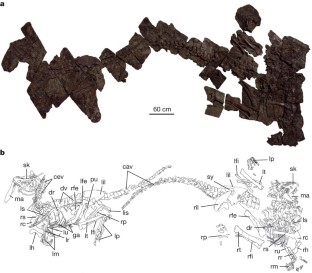
The alternative text for this image may have been generated using AI.
Figure 2: Selected elements of Y. huali (ZCDM V5000, ZCDM V5001 and ELDM V1001).
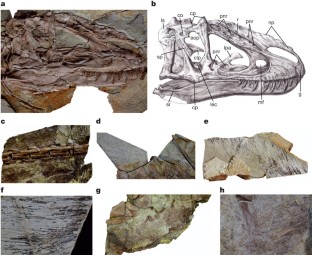
The alternative text for this image may have been generated using AI.
Figure 3: A simplified cladogram showing the systematic position of Y. huali among the Tyrannosauroidea.
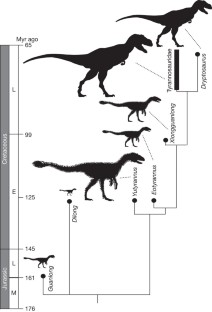
The alternative text for this image may have been generated using AI.
References
- Xu, X. & Guo, Y. The origin and early evolution of feathers: insights from recent paleontological and neontological data. Vert. PalAsiatica 47, 311–329 (2009)
Google Scholar - Holtz, T. R. in The Dinosauria 2nd edn (eds Weishampel, D.B., Dodson, P. & Osmólska, H. ) 111–136 (Univ. California Press, Berkeley, 2004)
Book Google Scholar - Currie, P. J. Cranial anatomy of tyrannosaurid dinosaurs from the Late Cretaceous of Alberta, Canada. Acta Palaeontol. Pol. 48, 191–226 (2003)
Google Scholar - Rauhut, O. W. M., Milner, A. C. & Moore-Fay, S. Cranial osteology and phylogenetic position of the theropod dinosaur Proceratosaurus bradleyi (Woodward, 1910) from the Middle Jurassic of England. Zool. J. Linn. Soc. 158, 155–195 (2010)
Article Google Scholar - Rauhut, O. W. M. A tyrannosauroid dinosaur from the Upper Jurassic of Portugal. Palaeontology 46, 903–910 (2003)
Article Google Scholar - Xu, X. et al. Basal tyrannosauroids from China and evidence for protofeathers in tyrannosauroids. Nature 431, 680–684 (2004)
Article ADS CAS Google Scholar - Xu, X. et al. A basal tyrannosauroid dinosaur from the Late Jurassic of China. Nature 439, 715–718 (2006)
Article ADS CAS Google Scholar - Ji, Q., Ji, S. A. & Zhang, L. J. First known large tyrannosauroid theropod from the Early Cretaceous Jehol Biota in northeastern China. Geol. Bull. China 28, 1369–1374 (2009)
MathSciNet Google Scholar - Li, D. Q., Norell, M. A., Gao, K.-Q., Smith, N. D. & Makovicky, P. J. A longisrostrine tyrannosauroid from the Early Cretaceous of China. Proc. R. Soc. Lond. B 277, 183–190 (2010)
Article Google Scholar - Averianov, A. O., Krasnolutskii, S. A. & Ivantsov, S. V. A new basal coelurosaur (Dinosauria: Theropoda) from the Middle Jurassic of Siberia. Proc. Zool. Inst. RAS 314, 42–57 (2010)
Google Scholar - Benson, R. B. J. New information on Stokesosaurus, a tyrannosauroid (Dinosauria: Theropoda) from North America and the United Kingdom. J. Vertebr. Paleontol. 28, 732–750 (2008)
Article Google Scholar - Hutt, S., Naish, D., Martill, D. M., Barker, M. J. & Newbery, P. A preliminary account of a new tyrannosauroid theropod from the Wessex Formation (Early Cretaceous) of southern England. Cretac. Res. 22, 227–242 (2001)
Article Google Scholar - Erickson, G. M. et al. Gigantism and comparative life-history parameters of tyrannosaurid dinosaurs. Nature 430, 772–775 (2004)
Article ADS CAS Google Scholar - Currie, P. J. Allometric growth in tyrannosaurids (Dinosauria: Theropoda) from the Upper Cretaceous of North America and Asia. Can. J. Earth Sci. 40, 651–665 (2003)
Article ADS Google Scholar - Brusatte, S. et al. Tyrannosaur paleobiology: new research on ancient exemplar organisms. Science 329, 1481–1485 (2010)
Article ADS CAS Google Scholar - Sereno, P. C. et al. Tyrannosaurid skeletal design first evolved at small body size. Science 326, 418–422 (2009)
Article ADS CAS Google Scholar - Fowler, D. W., Woodward, H. N., Freedman, E. A., Larson, P. L. & Horner, J. R. Reanalysis of ‘_Raptorex kriegsteini_’: a juvenile tyrannosaurid dinosaur from Mongolia. PLoS ONE 6, e21376 (2011)
Article ADS CAS Google Scholar - Swisher, C. C. et al. Further Support for a Cretaceous age for the feathered-dinosaur beds of Liaoning, China: New 40Ar/39Ar dating of the Yixian and Tuchengzi Formations. Chin. Sci. Bull. 47, 135–138 (2002)
Google Scholar - Christiansen, P. & Fariña, R. A. Mass prediction in theropod dinosaurs. Hist. Biol. 16, 85–92 (2004)
Article Google Scholar - Ortega, F., Escaso, F. & Sanz, J. L. A bizarre, humped Carcharodontosauria (Theropoda) from the Lower Cretaceous of Spain. Nature 467, 203–206 (2010)
Article ADS CAS Google Scholar - Brochu, C. A. Osteology of Tyrannosaurus rex: insights from a nearly complete skeleton and high-resolution computed tomographic analysis of the skull. J. Vertebr. Paleontol. Mem. 7, 1–138 (2003)
Article Google Scholar - Brusatte, S. L., Carr, T. D., Erickson, B. R., Bever, G. S. & Norell, M. A. A long-snouted, multihorned tyrannosaurid from the late Cretaceous of Mongolia. Proc. Natl Acad. Sci. USA 106, 17261–17266 (2009)
Article ADS CAS Google Scholar - Xu, X., Tang, Q.-W., Wang, J.-M., Zhao, X.-J. & Tan, L. A gigantic bird-like dinosaur from the late Cretaceous of China. Nature 447, 844–847 (2007)
Article ADS CAS Google Scholar - Xu, X., Tang, Z.-L. & Wang, X.-L. A therizinosauroid dinosaur with integumentary structures from China. Nature 399, 350–354 (1999)
Article ADS CAS Google Scholar - Paul, G. S. in Tyrannosaurus rex, the Tyrant King (eds Carpenter, K. & Larson, P.E. ) 354–368 (Indiana Univ. Press, 2008)
Google Scholar - Currie, P. J., Badamgarav, D. & Koppelhus, E. B. The first Late Cretaceous footprints from the Nemegt Locality in the Gobi of Mongolia. Ichnos 10, 1–13 (2003)
Article Google Scholar - Amiot, R. et al. Oxygen isotopes of east Asian dinosaurs reveal exceptionally cold Early Cretaceous Climates. Proc. Natl Acad. Sci. USA 108, 5179–5183 (2011)
Article ADS CAS Google Scholar - Fiorillo, A. R. & Gangloff, R. A. Theropod teeth from the Prince Creek Formation (Cretaceous) of northern Alaska, with speculations on Arctic dinosaur paleoecology. J. Vertebr. Paleontol. 20, 675–682 (2000)
Article Google Scholar - Spicer, R. A. & Herman, A. B. The Late Cretaceous environment of the Arctic: a quantitative reassessment based on plant fossils. Paleogeogr. Palaeoclimatol. Palaeoecol. 295, 423–442 (2010)
Article ADS Google Scholar - Deng, T. et al. Out of Tibet: Pliocene woolly rhino suggests high-plateau origin of ice age megaherbivores. Science 333, 1285–1288 (2011)
Article ADS CAS Google Scholar
Acknowledgements
We thank L. Zhang for discussions, R. Li, H. Zang and X. Ding for illustrations, and H. Wang, L. Xiang and R. Cao for preparing the specimens. We thank the Zhucheng Municipal Government and Erlianhaote Municipal Government for support. This study was supported by grants from the National Natural Science Foundation of China and Special Funds For Major State Basic Research Projects of China.
Author information
Authors and Affiliations
- Institute of Vertebrate Paleontology and Paleoanthropology, Key Laboratory of Evolutionary Systematics of Vertebrates, Chinese Academy of Sciences, 142 Xiwai Street, Beijing 100044, China,
Xing Xu, Qingyu Ma, Corwin Sullivan & Shuo Wang - Liaoning Paleontological Museum, Shenyang Normal University, 253 North Huanghe Street, Shenyang 110034, China,
Xing Xu & Dongyu Hu - Zhucheng Dinosaur Museum, Zhucheng, Shandong, 262200, China
Kebai Wang & Shuqing Cheng - School of the Earth Sciences and Resources, China University of Geosciences, 28 Xueyuan Road, Beijing 100083, China,
Ke Zhang - Department of Biological Sciences, University of Alberta, 11145 Saskatchewan Drive, Edmonton, Alberta T6G 2E9, Canada,
Lida Xing - Graduate University of Chinese Academy of Sciences, 19 Yuquan Road, Beijing 100049, China,
Shuo Wang
Authors
- Xing Xu
- Kebai Wang
- Ke Zhang
- Qingyu Ma
- Lida Xing
- Corwin Sullivan
- Dongyu Hu
- Shuqing Cheng
- Shuo Wang
Contributions
X.X. designed the project. X.X., K.W., K.Z., Q.M., L.X., C.S., D.H., S.C. and S.W. performed the research. X.X., C.S. and Q.M. wrote the manuscript.
Corresponding author
Correspondence toXing Xu.
Ethics declarations
Competing interests
The authors declare no competing financial interests.
Supplementary information
PowerPoint slides
Rights and permissions
About this article
Cite this article
Xu, X., Wang, K., Zhang, K. et al. A gigantic feathered dinosaur from the Lower Cretaceous of China.Nature 484, 92–95 (2012). https://doi.org/10.1038/nature10906
- Received: 26 November 2011
- Accepted: 27 January 2012
- Published: 04 April 2012
- Issue date: 05 April 2012
- DOI: https://doi.org/10.1038/nature10906
This article is cited by
Comments
Commenting on this article is now closed.
- Charles Weber 5 April 2012, 22:57
Dear Dr. Xu,
Two legged dinosaurs are portrayed in museums and television with their bodies held horizontally and their legs vertical, as they are in your article. This is not at all possible because their center of gravity is above their hip bone (or forward of the hip when the body is horizontal). If they had attempted to walk horizontally with their legs vertical they would have toppled forward. Almost certainly they walked almost erect often with the tail held aloft in order to prevent tripping by thrusting it back and to prevent an assailant from jumping on their back. To see a discussion of this see http://charles_w.tripod.com... . If you see any errors in it, please let me know. You may also see an explanation why vertebrate size, extent of bone, and teeth declined during the Cretaceous on the savannas in http://www.angelfire.com/nc... as caused by a phosphorus famine produced by Amitermitinae plant smothering termites.
Sincerely, Charles Weber
Editorial Summary
T. rex's giant feathered friends
Tyrannosaurus rex and its gigantic cousins lived at the close of the Cretaceous period, around 70 million years ago. Earlier relatives were thought to have been much smaller than T. rex, but recent finds from the early Cretaceous of China have had body lengths of up to 10 metres. Three 125-million-year-old specimens of a new tyrannosauroid species from China add a twist to this story: not only were the creatures large (the adult may have weighed around 1,400 kg), but they were also feathered. This basal tyrannosauroid is the largest feathered creature known, living or extinct, and raises interesting questions about dinosaur development and metabolism.