Rapid accretion and early core formation on asteroids and the terrestrial planets from Hf–W chronometry (original) (raw)
- Letter
- Published: 29 August 2002
Nature volume 418, pages 952–955 (2002)Cite this article
- 5552 Accesses
- 682 Citations
- 135 Altmetric
- Metrics details
Abstract
The timescales and mechanisms for the formation and chemical differentiation of the planets can be quantified using the radioactive decay of short-lived isotopes1,2,3,4,5,6,7,8,9,10. Of these, the 182Hf-to-182W decay is ideally suited for dating core formation in planetary bodies1,2,3,4,5. In an earlier study, the W isotope composition1 of the Earth's mantle was used to infer that core formation was late1 (≥60 million years after the beginning of the Solar System) and that accretion was a protracted process11,12. The correct interpretation of Hf–W data depends, however, on accurate knowledge of the initial abundance of 182Hf in the Solar System and the W isotope composition of chondritic meteorites. Here we report Hf–W data for carbonaceous and H chondrite meteorites that lead to timescales of accretion and core formation significantly different from those calculated previously1,3,5,11,12. The revised ages for Vesta, Mars and Earth indicate rapid accretion, and show that the timescale for core formation decreases with decreasing size of the planet. We conclude that core formation in the terrestrial planets and the formation of the Moon must have occurred during the first ∼30 million years of the life of the Solar System.
This is a preview of subscription content, access via your institution
Access options
Subscribe to this journal
Receive 51 print issues and online access
$199.00 per year
only $3.90 per issue
Buy this article
- Purchase on SpringerLink
- Instant access to the full article PDF.
USD 39.95
Prices may be subject to local taxes which are calculated during checkout
Additional access options:
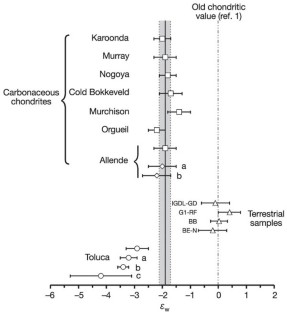
Figure 1: _ɛ_w values of carbonaceous chondrites compared with those of the Toluca iron meteorite and terrestrial samples analysed in this study.
The alternative text for this image may have been generated using AI.
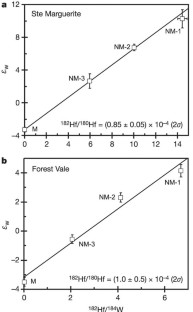
Figure 2: _ɛ_w versus 180Hf/184W for different fractions of the H chondrites Ste Marguerite (a) and Forest Vale (b).
The alternative text for this image may have been generated using AI.
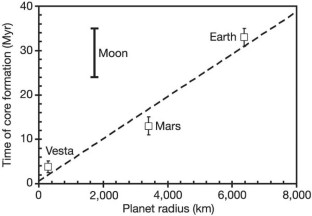
Figure 3: Time of core formation in Myr after CAI condensation for Vesta, Mars, Earth and Moon versus planet radius as deduced from Hf–W systematics.
The alternative text for this image may have been generated using AI.
References
- Lee, D. C. & Halliday, A. N. Hafnium-tungsten chronometry and the timing of terrestrial core formation. Nature 378, 771–774 (1995)
Article ADS CAS Google Scholar - Harper, C. L. & Jacobsen, S. B. Evidence for 182Hf in the early solar system and constraints on the timescale of terrestrial accretion and core formation. Geochim. Cosmochim. Acta 60, 1131–1153 (1996)
Article ADS CAS Google Scholar - Lee, D. C. & Halliday, A. N. Core formation on Mars and differentiated asteroids. Nature 388, 854–857 (1997)
Article ADS CAS Google Scholar - Horan, M. F., Smoliar, M. I. & Walker, R. J. 182W and 187Re-187Os systematics of iron meteorites: Chronology for melting, differentiation, and crystallization in asteroids. Geochim. Cosmochim. Acta 62, 545–554 (1998)
Article ADS CAS Google Scholar - Quitté, G., Birck, J. L. & Allègre, C. J. 182Hf/180Hf systematics in eucrites: the puzzle of iron segregation in the early solar system. Earth Planet. Sci. Lett. 184, 83–94 (2000)
Article ADS Google Scholar - Lugmair, G. W. & Shukolyukov, A. Early solar system timescales according to 53Mn-53Cr systematics. Geochim. Cosmochim. Acta 62, 2863–2886 (1998)
Article ADS CAS Google Scholar - Shukolyukov, A. & Lugmair, G. W. 60Fe in eucrites. Earth Planet. Sci. Lett. 119, 159–166 (1993)
Article ADS CAS Google Scholar - Srinivasan, G., Goswami, J. & Bhandari, N. 26Al in eucrite Piplia Kalan: plausible heat source and formation chronology. Science 284, 1348–1350 (1999)
Article ADS CAS Google Scholar - Chen, J. H. & Wasserburg, G. J. The isotopic composition of Ag in meteorites and the presence of 107Pd in protoplanets. Geochim. Cosmochim. Acta 54, 1729–1743 (1990)
Article ADS CAS Google Scholar - Carlson, R. W. & Hauri, E. H. Extending the 107Pd-107Ag chronometer to low Pd/Ag meteorites with multicollector plasma-ionization mass spectrometry. Geochim. Cosmochim. Acta 65, 1839–1848 (2001)
Article ADS CAS Google Scholar - Halliday, A. N. & Lee, D. C. Tungsten isotopes and the early development of the earth and the moon. Geochim. Cosmochim. Acta 63, 4157–4179 (1999)
Article ADS CAS Google Scholar - Shearer, C. K. & Newsom, H. E. W-Hf isotope abundances and the early origin and evolution of the Earth-Moon system. Geochim. Cosmochim. Acta 64, 3599–3613 (2000)
Article ADS CAS Google Scholar - Lee, D. C. & Halliday, A. N. Accretion of primitive planetesimals: Hf-W isotopic evidence from enstatite chondrites. Science 288, 1629–1631 (2000)
Article ADS CAS Google Scholar - Göpel, C., Manhès, G. & Allègre, C. J. U-Pb systematics of phosphates from equilibrated ordinary chondrites. Earth Planet. Sci. Lett. 121, 153–171 (1994)
Article ADS Google Scholar - Allègre, C. J., Manhès, G. & Göpel, C. The age of the Earth. Geochim. Cosmochim. Acta 59, 1445–1456 (1995)
Article ADS Google Scholar - Yin, Q. et al. New Hf-W data that are consistent with Mn-Cr chronology: implications for early solar system evolution. Lunar Planet. Sci. XXXIII, 1700 (2002)
ADS Google Scholar - Ireland, T. R., Kirby, H., Bukovanska, M. & Wlotzka, F. Hf-W systematics of meteoritic zircons, revisited. Lunar Planet. Sci. XXXI, 1540 (2000)
ADS Google Scholar - Lee, D. C. & Halliday, A. N. Hf-W internal isochrons for ordinary chondrites and the initial 182Hf/180Hf of the solar system. Chem. Geol. 169, 35–43 (2000)
Article ADS CAS Google Scholar - Lee, D. C. & Halliday, A. N. Cosmogenic tungsten and the origin and earliest differentiation of the Moon. Earth Planet. Sci. Lett. 198, 267–274 (2002)
Article ADS CAS Google Scholar - Binzel, R. P. & Xu, S. Chips off of asteroid 4 Vesta: evidence for the parent body of basaltic achondrite meteorites. Science 260, 186–191 (1993)
Article ADS CAS Google Scholar - Palme, H. & Rammensee, W. The significance of W in planetary differentiation processes: Evidence from new data on eucrites. Lunar Planet. Sci. XXII, 949–964 (1981)
ADS Google Scholar - Palme, H. & Beer, H. in Landolt-Börnstein Group VI, Astronomy and Astrophysics Vol. 3a_, Instruments; Methods; Solar System_ (ed. Voigt, H. H.) 196–221 (Springer, Berlin, 1993)
Google Scholar - Kong, P., Ebihara, M. & Palme, H. Siderophile elements in Martian meteorites and implications for core formation in Mars. Geochim. Cosmochim. Acta 63, 1865–1875 (1999)
Article ADS CAS Google Scholar - Newsom, H. E. et al. The depletion of tungsten in the bulk silicate earth: Constraints on core formation. Geochim. Cosmochim. Acta 60, 1155–1169 (1996)
Article ADS CAS Google Scholar - McDonough, W. F. & Sun, S.-S. The composition of the Earth. Chem. Geol. 120, 223–253 (1995)
Article ADS CAS Google Scholar - Wetherill, G. W. Formation of the Earth. Annu. Rev. Earth Planet. Sci. 18, 205–256 (1990)
Article ADS Google Scholar - Canup, R. M. & Agnor, C. in Origin of Earth and Moon (eds Canup, R. M. & Righter, K.) 1839–1848 (Cambridge Univ. Press, Cambridge, 2001)
Google Scholar - Chambers, J. E. Making more terrestrial planets. Icarus 152, 205–224 (2001)
Article ADS Google Scholar - Münker, C., Weyer, S., Scherer, E. & Mezger, K. Separation of high field strength elements (Nb, Ta, Zr, Hf) and Lu from rock samples for MC-ICPMS measurements. Geochem. Geophys. Geosyst. 2, 2001GC000183 (2001)
- Schoenberg, R., Kamber, B. S., Collerson, K. D. & Eugster, O. New W-isotope evidence for rapid terrestrial accretion and very early core formation. Geochim. Cosmochim. Acta (in the press)
Acknowledgements
We thank the Muséum National d'Histoire Naturelle (Paris) for providing the meteorites Ste Marguerite and Forest Vale, the MPI Mainz for the carbonaceous chondrites, E. Scherer for discussions, and M. Drake, A. Halliday and D. Papanastassiou for comments and suggestions. This work was supported by the Deutsche Forschungsgemeinschaft as part of the research priority programme ‘Mars and the terrestrial planets’.
Author information
Authors and Affiliations
- Institut für Mineralogie, Universität Münster, Corrensstrasse 24, D-48149, Münster, Germany
T. Kleine, C. Münker & K. Mezger - Institut für Mineralogie und Geochemie, Universität zu Köln, Zülpicherstrasse 49b, D-50674, Köln, Germany
H. Palme
Authors
- T. Kleine
- C. Münker
- K. Mezger
- H. Palme
Corresponding author
Correspondence toT. Kleine.
Ethics declarations
Competing interests
The authors declare that they have no competing financial interests.
Rights and permissions
About this article
Cite this article
Kleine, T., Münker, C., Mezger, K. et al. Rapid accretion and early core formation on asteroids and the terrestrial planets from Hf–W chronometry.Nature 418, 952–955 (2002). https://doi.org/10.1038/nature00982
- Received: 30 May 2002
- Accepted: 17 July 2002
- Issue date: 29 August 2002
- DOI: https://doi.org/10.1038/nature00982
This article is cited by
Earth’s mantle composition revealed by mantle plumes
- Dominique Weis
- Karen S. Harpp
- Nicole M. B. Williamson
Nature Reviews Earth & Environment (2023)
Volcanism in the Solar System
- Long Xiao
- Jun Huang
- Yuqi Qian
Science China Earth Sciences (2023)
Controls on Pt/Pd ratios in Bushveld magmas and cumulates: a review complemented by new W isotope data
- Wolfgang D. Maier
- Andrea Mundl-Petermeier
Mineralium Deposita (2023)
The Geochemical Legacy of Low-Temperature, Percolation-Driven Core Formation in Planetesimals
- Geoffrey David Bromiley
Earth, Moon, and Planets (2023)
- Geoffrey David Bromiley
Bulk and in-situ chemical analysis of meteorite Berduc, an L6 chondrite
- Amit Basu Sarbadhikari
- Garima Arora
- Ramakant R Mahajan
Journal of Earth System Science (2023)