Red tides and marine mammal mortalities (original) (raw)
- Brief Communication
- Published: 08 June 2005
Brevetoxicosis
- Jerome P. Naar2,
- Jay P. Abbott1,
- Daniel G. Baden2,
- Nélio B. Barros3,
- Gregory D. Bossart4,
- Marie-Yasmine D. Bottein5,
- Daniel G. Hammond1,
- Elsa M. Haubold1,
- Cynthia A. Heil1,
- Michael S. Henry3,
- Henry M. Jacocks2,
- Tod A. Leighfield5,
- Richard H. Pierce3,
- Thomas D. Pitchford1,
- Sentiel A. Rommel1,
- Paula S. Scott1,
- Karen A. Steidinger1,
- Earnest W. Truby1,
- Frances M. Van Dolah5 &
- …
- Jan H. Landsberg1
Nature volume 435, pages 755–756 (2005)Cite this article
- 5630 Accesses
- 381 Citations
- 16 Altmetric
- Metrics details
Unexpected brevetoxin vectors may account for deaths long after or remote from an algal bloom.
Abstract
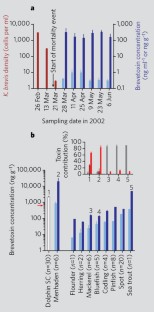
Potent marine neurotoxins known as brevetoxins are produced by the ‘red tide’ dinoflagellate Karenia brevis. They kill large numbers of fish and cause illness in humans who ingest toxic filter-feeding shellfish or inhale toxic aerosols1. The toxins are also suspected of having been involved in events in which many manatees and dolphins died, but this has usually not been verified owing to limited confirmation of toxin exposure, unexplained intoxication mechanisms and complicating pathologies2,3,4. Here we show that fish and seagrass can accumulate high concentrations of brevetoxins and that these have acted as toxin vectors during recent deaths of dolphins and manatees, respectively. Our results challenge claims that the deleterious effects of a brevetoxin on fish (ichthyotoxicity) preclude its accumulation in live fish, and they reveal a new vector mechanism for brevetoxin spread through food webs that poses a threat to upper trophic levels.
This is a preview of subscription content, access via your institution
Access options
Subscribe to this journal
Receive 51 print issues and online access
$199.00 per year
only $3.90 per issue
Buy this article
- Purchase on SpringerLink
- Instant access to the full article PDF.
USD 39.95
Prices may be subject to local taxes which are calculated during checkout
Additional access options:
Figure 1: Brevetoxin concentrations in seagrass and fish during mass-mortality events.
References
- Steidinger, K. A. in Algal Toxins in Seafood and Drinking Water (ed. Falconer, I.) 1–28 (Academic, London, 1993).
Book Google Scholar - Geraci, J. R. Clinical Investigation of the 1987–1988 Mass Mortality of Bottlenose Dolphins along the US Central and South Atlantic Coast. Report to the National Marine Fisheries Service and US Navy, Office of Naval Research and Marine Mammal Commission (Ontario Veterinary College, Guelph, Ontario, 1989).
Google Scholar - O'Shea, T. J., Bonde, R. K., Buergelt, C. D. & Odell, D. K. Mar. Mamm. Sci. 7, 165–179 (1991).
Article Google Scholar - Van Dolah, F. M., Doucette, G. J., Gulland, F. M. D., Rowles, T. L. & Bossart, G. D. in Toxicology of Marine Mammals (eds Vos, J. G., Bossart, G. D., Fournier, M. & O'Shea, T. J.) 247–269 (Taylor & Francis, New York, 2003).
Google Scholar - Bossart, G. D., Baden, D. G., Ewing, R. Y., Roberts, B. & Wright, S. D. Toxicol. Pathol. 26, 276–282 (1998).
Article CAS PubMed Google Scholar - Working Group on Marine Mammal Unusual Mortality Events The Bottlenose Dolphin (Tursiops truncatus): Unusual Mortality Event along the Panhandle of Florida March–April 2004 (National Marine Fisheries Service, 2004).
- Baden, D. G. & Mende, T. J. Toxicon 20, 457–461 (1982).
Article CAS PubMed Google Scholar - Pierce, R. H., Henry, M. S., Blum, P. & Payne, S. in Harmful Algal Blooms 2000 (eds Hallegraeff, G. M. et al.) 421–424 (Intergovernmental Oceanic Commission, Paris, 2001).
Google Scholar - Ross, P. S. Hum. Ecol. Risk Ass. 6, 29–46 (2000).
Article CAS Google Scholar
Author information
Authors and Affiliations
- Florida Fish and Wildlife Conservation Commission, Fish and Wildlife Research Institute, St Petersburg, 33701, Florida, USA
Leanne J. Flewelling, Jay P. Abbott, Daniel G. Hammond, Elsa M. Haubold, Cynthia A. Heil, Thomas D. Pitchford, Sentiel A. Rommel, Paula S. Scott, Karen A. Steidinger, Earnest W. Truby & Jan H. Landsberg - Center for Marine Science, University of North Carolina, Wilmington, 28409, North Carolina, USA
Jerome P. Naar, Daniel G. Baden & Henry M. Jacocks - Mote Marine Laboratory, Sarasota, 34236, Florida, USA
Nélio B. Barros, Michael S. Henry & Richard H. Pierce - Harbor Branch Oceanographic Institution, Fort Pierce, 34946, Florida, USA
Gregory D. Bossart - NOAA, NOS, Center for Coastal Environmental Health and Biomolecular Research, Charleston, 29412, South Carolina, USA
Marie-Yasmine D. Bottein, Tod A. Leighfield & Frances M. Van Dolah
Authors
- Leanne J. Flewelling
- Jerome P. Naar
- Jay P. Abbott
- Daniel G. Baden
- Nélio B. Barros
- Gregory D. Bossart
- Marie-Yasmine D. Bottein
- Daniel G. Hammond
- Elsa M. Haubold
- Cynthia A. Heil
- Michael S. Henry
- Henry M. Jacocks
- Tod A. Leighfield
- Richard H. Pierce
- Thomas D. Pitchford
- Sentiel A. Rommel
- Paula S. Scott
- Karen A. Steidinger
- Earnest W. Truby
- Frances M. Van Dolah
- Jan H. Landsberg
Corresponding author
Correspondence toJerome P. Naar.
Ethics declarations
Competing interests
The authors declare no competing financial interests.
Supplementary information
Rights and permissions
About this article
Cite this article
Flewelling, L., Naar, J., Abbott, J. et al. Red tides and marine mammal mortalities.Nature 435, 755–756 (2005). https://doi.org/10.1038/nature435755a
- Published: 08 June 2005
- Issue date: 09 June 2005
- DOI: https://doi.org/10.1038/nature435755a