Neural repetition suppression reflects fulfilled perceptual expectations (original) (raw)
- Brief Communication
- Published: 01 August 2008
Nature Neuroscience volume 11, pages 1004–1006 (2008)Cite this article
- 8283 Accesses
- 676 Citations
- 1 Altmetric
- Metrics details
Abstract
Stimulus-evoked neural activity is attenuated on stimulus repetition (repetition suppression), a phenomenon that is attributed to largely automatic processes in sensory neurons. By manipulating the likelihood of stimulus repetition, we found that repetition suppression in the human brain was reduced when stimulus repetitions were improbable (and thus, unexpected). Our data suggest that repetition suppression reflects a relative reduction in top-down perceptual 'prediction error' when processing an expected, compared with an unexpected, stimulus.
This is a preview of subscription content, access via your institution
Access options
Subscribe to this journal
Receive 12 print issues and online access
$259.00 per year
only $21.58 per issue
Buy this article
- Purchase on SpringerLink
- Instant access to the full article PDF.
USD 39.95
Prices may be subject to local taxes which are calculated during checkout
Additional access options:
Figure 1: Main experiment: protocol and results.
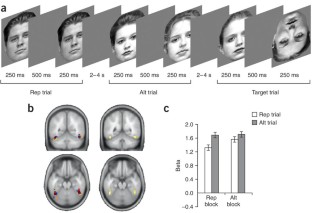
The alternative text for this image may have been generated using AI.
Figure 2: Control experiment protocol and results.
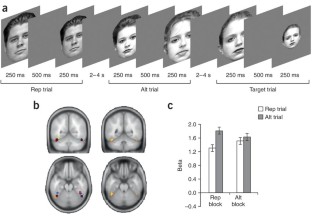
The alternative text for this image may have been generated using AI.
References
- Grill-Spector, K., Henson, R. & Martin, A. Trends Cogn. Sci. 10, 14–23 (2006).
Article Google Scholar - Henson, R.N. Prog. Neurobiol. 70, 53–81 (2003).
Article CAS Google Scholar - Miller, E.K., Li, L. & Desimone, R. Science 254, 1377–1379 (1991).
Article CAS Google Scholar - Wiggs, C.L. & Martin, A. Curr. Opin. Neurobiol. 8, 227–233 (1998).
Article CAS Google Scholar - Grill-Spector, K. & Malach, R. Acta Psychol. (Amst.) 107, 293–321 (2001).
Article CAS Google Scholar - Kourtzi, Z. & Kanwisher, N. Science 293, 1506–1509 (2001).
Article CAS Google Scholar - Desimone, R. Proc. Natl. Acad. Sci. USA 93, 13494–13499 (1996).
Article CAS Google Scholar - Friston, K. Phil. Trans. R. Soc. Lond. B 360, 815–836 (2005).
Article Google Scholar - Henson, R., Shallice, T. & Dolan, R. Science 287, 1269–1272 (2000).
Article CAS Google Scholar - Kanwisher, N., McDermott, J. & Chun, M.M. J. Neurosci. 17, 4302–4311 (1997).
Article CAS Google Scholar - Murray, S.O. & Wojciulik, E. Nat. Neurosci. 7, 70–74 (2004).
Article CAS Google Scholar - Friston, K., Kilner, J. & Harrison, L. J. Physiol. (Paris) 100, 70–87 (2006).
Article Google Scholar - Bar, M. & Aminoff, E. Neuron 38, 347–358 (2003).
Article CAS Google Scholar - Kersten, D., Mamassian, P. & Yuille, A. Annu. Rev. Psychol. 55, 271–304 (2004).
Article Google Scholar - Summerfield, C. & Koechlin, E. Neuron published online, doi: 10.1016/j.neuron.2008.05.21 (2008).
Acknowledgements
We are grateful to E. Koechlin and S. Kouider for helpful comments on an earlier version of this manuscript. This work was supported in part by a grant from the US National Institute of Neurological Disorders and Stroke (NS30863, M.-M.M.).
Author information
Authors and Affiliations
- INSERM U742, Université Pierre et Marie Currie, 9 Quai St., Bernard, Paris, 75005, France
Christopher Summerfield - Département d'Études Cognitives, Ecole Normale Supérieure, 29 Rue d'Ulm, Paris, 75005, France
Christopher Summerfield - Cognitive Neurology and Alzheimer's Disease Center, Feinberg School of Medicine, Northwestern University, 320 East Superior Street, Searle 11, Chicago, 60611, Illinois, USA
Emily H Trittschuh, Jim M Monti, M-Marsel Mesulam & Tobias Egner
Authors
- Christopher Summerfield
- Emily H Trittschuh
- Jim M Monti
- M-Marsel Mesulam
- Tobias Egner
Contributions
C.S., T.E., E.H.T. and M.-M.M. conceived of the experiment, C.S. and T.E. designed the experiment, T.E., E.H.T. and J.M.M. collected the data, T.E. analyzed the data and C.S. and T.E. wrote the paper.
Corresponding author
Correspondence toTobias Egner.
Supplementary information
Rights and permissions
About this article
Cite this article
Summerfield, C., Trittschuh, E., Monti, J. et al. Neural repetition suppression reflects fulfilled perceptual expectations.Nat Neurosci 11, 1004–1006 (2008). https://doi.org/10.1038/nn.2163
- Received: 02 June 2008
- Accepted: 16 June 2008
- Published: 01 August 2008
- Issue date: September 2008
- DOI: https://doi.org/10.1038/nn.2163