Spherical cap (original) (raw)
From Wikipedia, the free encyclopedia
Section of a sphere

An example of a spherical cap in blue (and another in red)
In geometry, a spherical cap or spherical dome is a portion of a sphere or of a ball cut off by a plane. It is also a spherical segment of one base, i.e., bounded by a single plane. If the plane passes through the center of the sphere (forming a great circle), so that the height of the cap is equal to the radius of the sphere, the spherical cap is called a hemisphere.
Volume and surface area
[edit]
The volume of the spherical cap and the area of the curved surface may be calculated using combinations of
These variables are inter-related through the formulas a = r sin θ {\displaystyle a=r\sin \theta } 



| | Using r {\displaystyle r} 


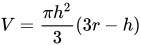
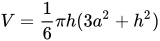







If ϕ {\displaystyle \phi } 


Deriving the surface area intuitively from the spherical sector volume
[edit]
Note that aside from the calculus based argument below, the area of the spherical cap may be derived from the volume V s e c {\displaystyle V_{sec}} 
A = 3 r V s e c = 3 r 2 π r 2 h 3 = 2 π r h . {\displaystyle A={\frac {3}{r}}V_{sec}={\frac {3}{r}}{\frac {2\pi r^{2}h}{3}}=2\pi rh\,.}

The intuitive argument is based upon summing the total sector volume from that of infinitesimal triangular pyramids. Utilizing the pyramid (or cone) volume formula of V = 1 3 b h ′ {\displaystyle V={\frac {1}{3}}bh'} 


V s e c = ∑ V = ∑ 1 3 b h ′ = ∑ 1 3 b r = r 3 ∑ b = r 3 A {\displaystyle V_{sec}=\sum {V}=\sum {\frac {1}{3}}bh'=\sum {\frac {1}{3}}br={\frac {r}{3}}\sum b={\frac {r}{3}}A}

Deriving the volume and surface area using calculus
[edit]

Rotating the green area creates a spherical cap with height h {\displaystyle h}
The volume and area formulas may be derived by examining the rotation of the function
f ( x ) = r 2 − ( x − r ) 2 = 2 r x − x 2 {\displaystyle f(x)={\sqrt {r^{2}-(x-r)^{2}}}={\sqrt {2rx-x^{2}}}}

for x ∈ [ 0 , h ] {\displaystyle x\in [0,h]} ![{\displaystyle x\in [0,h]}](https://wikimedia.org/api/rest_v1/media/math/render/svg/faa4170632cff53413f645f2ec2a07393d87fc32)
A = 2 π ∫ 0 h f ( x ) 1 + f ′ ( x ) 2 d x {\displaystyle A=2\pi \int _{0}^{h}f(x){\sqrt {1+f'(x)^{2}}}\,dx}
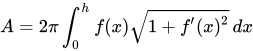
The derivative of f {\displaystyle f} 
f ′ ( x ) = r − x 2 r x − x 2 {\displaystyle f'(x)={\frac {r-x}{\sqrt {2rx-x^{2}}}}}
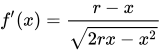
and hence
1 + f ′ ( x ) 2 = r 2 2 r x − x 2 {\displaystyle 1+f'(x)^{2}={\frac {r^{2}}{2rx-x^{2}}}}
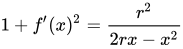
The formula for the area is therefore
A = 2 π ∫ 0 h 2 r x − x 2 r 2 2 r x − x 2 d x = 2 π ∫ 0 h r d x = 2 π r [ x ] 0 h = 2 π r h {\displaystyle A=2\pi \int _{0}^{h}{\sqrt {2rx-x^{2}}}{\sqrt {\frac {r^{2}}{2rx-x^{2}}}}\,dx=2\pi \int _{0}^{h}r\,dx=2\pi r\left[x\right]_{0}^{h}=2\pi rh}
![{\displaystyle A=2\pi \int _{0}^{h}{\sqrt {2rx-x^{2}}}{\sqrt {\frac {r^{2}}{2rx-x^{2}}}}\,dx=2\pi \int _{0}^{h}r\,dx=2\pi r\left[x\right]_{0}^{h}=2\pi rh}](https://wikimedia.org/api/rest_v1/media/math/render/svg/2ff09f518992736b25f811864b4fb9d3cf9f1660)
The volume is
V = π ∫ 0 h f ( x ) 2 d x = π ∫ 0 h ( 2 r x − x 2 ) d x = π [ r x 2 − 1 3 x 3 ] 0 h = π h 2 3 ( 3 r − h ) {\displaystyle V=\pi \int _{0}^{h}f(x)^{2}\,dx=\pi \int _{0}^{h}(2rx-x^{2})\,dx=\pi \left[rx^{2}-{\frac {1}{3}}x^{3}\right]_{0}^{h}={\frac {\pi h^{2}}{3}}(3r-h)}
![{\displaystyle V=\pi \int _{0}^{h}f(x)^{2}\,dx=\pi \int _{0}^{h}(2rx-x^{2})\,dx=\pi \left[rx^{2}-{\frac {1}{3}}x^{3}\right]_{0}^{h}={\frac {\pi h^{2}}{3}}(3r-h)}](https://wikimedia.org/api/rest_v1/media/math/render/svg/702ef6a354662216272326cd0d7d96284ec9f62f)
The moments of inertia of a spherical cap (where the z-axis is the symmetrical axis) about the principal axes (center) of the sphere are:
J z z , cap = m h ( 3 h 2 − 15 h R + 20 R 2 ) 10 ( 3 R − h ) {\displaystyle J_{zz,{\text{cap}}}={\frac {mh\left(3h^{2}-15hR+20R^{2}\right)}{10\left(3R-h\right)}}}

J x x , cap = J y y , cap = m ( − 9 h 3 + 45 h 2 R − 80 h R 2 + 60 R 3 ) 20 ( 3 R − h ) {\displaystyle J_{xx,{\text{cap}}}=J_{yy,{\text{cap}}}={\frac {m\left(-9h^{3}+45h^{2}R-80hR^{2}+60R^{3}\right)}{20\left(3R-h\right)}}}

where m and h are, respectively, the mass and height of the spherical cap and R is the radius of the entire sphere.
Volumes of union and intersection of two intersecting spheres
[edit]
The volume of the union of two intersecting spheres of radii r 1 {\displaystyle r_{1}} 

V = V ( 1 ) − V ( 2 ) , {\displaystyle V=V^{(1)}-V^{(2)}\,,}

where
V ( 1 ) = 4 π 3 r 1 3 + 4 π 3 r 2 3 {\displaystyle V^{(1)}={\frac {4\pi }{3}}r_{1}^{3}+{\frac {4\pi }{3}}r_{2}^{3}}
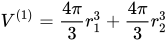
is the sum of the volumes of the two isolated spheres, and
V ( 2 ) = π h 1 2 3 ( 3 r 1 − h 1 ) + π h 2 2 3 ( 3 r 2 − h 2 ) {\displaystyle V^{(2)}={\frac {\pi h_{1}^{2}}{3}}(3r_{1}-h_{1})+{\frac {\pi h_{2}^{2}}{3}}(3r_{2}-h_{2})}

the sum of the volumes of the two spherical caps forming their intersection. If d ≤ r 1 + r 2 {\displaystyle d\leq r_{1}+r_{2}} 


V ( 2 ) = π 12 d ( r 1 + r 2 − d ) 2 ( d 2 + 2 d ( r 1 + r 2 ) − 3 ( r 1 − r 2 ) 2 ) . {\displaystyle V^{(2)}={\frac {\pi }{12d}}(r_{1}+r_{2}-d)^{2}\left(d^{2}+2d(r_{1}+r_{2})-3(r_{1}-r_{2})^{2}\right)\,.}

Volume of a spherical cap with a curved base
[edit]
The volume of a spherical cap with a curved base can be calculated by considering two spheres with radii r 1 {\displaystyle r_{1}} 


V = π h 2 3 ( 3 r 1 − h ) − π [ ( r 2 − r 1 ) − ( d − h ) ] 2 3 [ 3 r 2 − ( ( r 2 − r 1 ) − ( d − h ) ) ] , V = π h 2 3 ( 3 r 1 − h ) − π 3 ( d − h ) 3 ( r 2 − r 1 d − h − 1 ) 2 [ 2 r 2 + r 1 d − h + 1 ] . {\displaystyle {\begin{aligned}V&={\frac {\pi h^{2}}{3}}(3r_{1}-h)-{\frac {\pi [(r_{2}-r_{1})-(d-h)]^{2}}{3}}[3r_{2}-((r_{2}-r_{1})-(d-h))]\,,\\V&={\frac {\pi h^{2}}{3}}(3r_{1}-h)-{\frac {\pi }{3}}(d-h)^{3}\left({\frac {r_{2}-r_{1}}{d-h}}-1\right)^{2}\left[{\frac {2r_{2}+r_{1}}{d-h}}+1\right]\,.\end{aligned}}} ![{\displaystyle {\begin{aligned}V&={\frac {\pi h^{2}}{3}}(3r_{1}-h)-{\frac {\pi [(r_{2}-r_{1})-(d-h)]^{2}}{3}}[3r_{2}-((r_{2}-r_{1})-(d-h))]\,,\\V&={\frac {\pi h^{2}}{3}}(3r_{1}-h)-{\frac {\pi }{3}}(d-h)^{3}\left({\frac {r_{2}-r_{1}}{d-h}}-1\right)^{2}\left[{\frac {2r_{2}+r_{1}}{d-h}}+1\right]\,.\end{aligned}}}](https://wikimedia.org/api/rest_v1/media/math/render/svg/cbb934cd64cee113d0a6304522287d1d7798ebb9)
This formula is valid only for configurations that satisfy 0 < d < r 2 {\displaystyle 0<d<r_{2}} 



Areas of intersecting spheres
[edit]
Consider two intersecting spheres of radii r 1 {\displaystyle r_{1}}
| r 1 − r 2 | ≤ d ≤ r 1 + r 2 {\displaystyle |r_{1}-r_{2}|\leq d\leq r_{1}+r_{2}}

From the law of cosines, the polar angle of the spherical cap on the sphere of radius r 1 {\displaystyle r_{1}}
cos θ = r 1 2 − r 2 2 + d 2 2 r 1 d {\displaystyle \cos \theta ={\frac {r_{1}^{2}-r_{2}^{2}+d^{2}}{2r_{1}d}}}
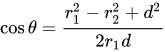
Using this, the surface area of the spherical cap on the sphere of radius r 1 {\displaystyle r_{1}}
A 1 = 2 π r 1 2 ( 1 + r 2 2 − r 1 2 − d 2 2 r 1 d ) {\displaystyle A_{1}=2\pi r_{1}^{2}\left(1+{\frac {r_{2}^{2}-r_{1}^{2}-d^{2}}{2r_{1}d}}\right)}
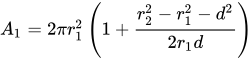
Surface area bounded by parallel disks
[edit]
The curved surface area of the spherical segment bounded by two parallel disks is the difference of surface areas of their respective spherical caps. For a sphere of radius r {\displaystyle r}
A = 2 π r | h 1 − h 2 | , {\displaystyle A=2\pi r|h_{1}-h_{2}|\,,}

or, using geographic coordinates with latitudes ϕ 1 {\displaystyle \phi _{1}} 

A = 2 π r 2 | sin ϕ 1 − sin ϕ 2 | , {\displaystyle A=2\pi r^{2}|\sin \phi _{1}-\sin \phi _{2}|\,,}

For example, assuming the Earth is a sphere of radius 6371 km, the surface area of the arctic (north of the Arctic Circle, at latitude 66.56° as of August 2016[7]) is 2_π_ ⋅ 63712 |sin 90° − sin 66.56°| = 21.04 million km2 (8.12 million mi2), or 0.5 ⋅ |sin 90° − sin 66.56°| = 4.125% of the total surface area of the Earth.
This formula can also be used to demonstrate that half the surface area of the Earth lies between latitudes 30° South and 30° North in a spherical zone which encompasses all of the tropics.
Sections of other solids
[edit]
The spheroidal dome is obtained by sectioning off a portion of a spheroid so that the resulting dome is circularly symmetric (having an axis of rotation), and likewise the ellipsoidal dome is derived from the ellipsoid.
Generally, the n {\displaystyle n} 
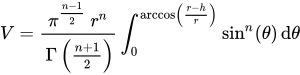

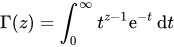
The formula for V {\displaystyle V} 
![{\textstyle C_{n}=\pi ^{n/2}/\Gamma [1+{\frac {n}{2}}]}](https://wikimedia.org/api/rest_v1/media/math/render/svg/260dd7aa1c23ad93d6327dd3fb86ab3061eb0e6d)


![{\displaystyle V=C_{n}\,r^{n}\left({\frac {1}{2}}\,-\,{\frac {r-h}{r}}\,{\frac {\Gamma [1+{\frac {n}{2}}]}{{\sqrt {\pi }}\,\Gamma [{\frac {n+1}{2}}]}}{\,\,}_{2}F_{1}\left({\tfrac {1}{2}},{\tfrac {1-n}{2}};{\tfrac {3}{2}};\left({\tfrac {r-h}{r}}\right)^{2}\right)\right)={\frac {1}{2}}C_{n}\,r^{n}I_{(2rh-h^{2})/r^{2}}\left({\frac {n+1}{2}},{\frac {1}{2}}\right),}](https://wikimedia.org/api/rest_v1/media/math/render/svg/bbe150e64fae505ba0251ebc28876df5c05cffb3)
and the area formula A {\displaystyle A} 
![{\textstyle A_{n}={2\pi ^{n/2}/\Gamma [{\frac {n}{2}}]}}](https://wikimedia.org/api/rest_v1/media/math/render/svg/73164042e20ebe0aadd4dcd9726a9aa08c3f55d0)


A. Chudnov[9] derived the following formulas: A = A n r n − 1 p n − 2 ( q ) , V = C n r n p n ( q ) , {\displaystyle A=A_{n}r^{n-1}p_{n-2}(q),\,V=C_{n}r^{n}p_{n}(q),} 

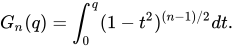
For odd n = 2 k + 1 {\displaystyle n=2k+1} 
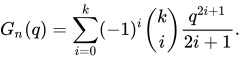
If n → ∞ {\displaystyle n\to \infty } 
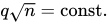


A more quantitative bound is A / ( A n r n − 1 ) = n Θ ( 1 ) ⋅ [ ( 2 − h / r ) h / r ] n / 2 {\displaystyle A/(A_{n}r^{n-1})=n^{\Theta (1)}\cdot [(2-h/r)h/r]^{n/2}} ![{\displaystyle A/(A_{n}r^{n-1})=n^{\Theta (1)}\cdot [(2-h/r)h/r]^{n/2}}](https://wikimedia.org/api/rest_v1/media/math/render/svg/f039863d79eac71ac66a07840d5231e2660d5329)


- Circular segment — the analogous 2D object
- Solid angle — contains formula for n-sphere caps
- Spherical segment
- Spherical sector
- Spherical wedge
- ^ a b Polyanin, Andrei D; Manzhirov, Alexander V. (2006), Handbook of Mathematics for Engineers and Scientists, CRC Press, p. 69, ISBN 9781584885023.
- ^ Shekhtman, Zor. "Unizor - Geometry3D - Spherical Sectors". YouTube. Zor Shekhtman. Archived from the original on 2021-12-22. Retrieved 31 Dec 2018.
- ^ Connolly, Michael L. (1985). "Computation of molecular volume". Journal of the American Chemical Society. 107 (5): 1118–1124. doi:10.1021/ja00291a006.
- ^ Pavani, R.; Ranghino, G. (1982). "A method to compute the volume of a molecule". Computers & Chemistry. 6 (3): 133–135. doi:10.1016/0097-8485(82)80006-5.
- ^ Bondi, A. (1964). "Van der Waals volumes and radii". The Journal of Physical Chemistry. 68 (3): 441–451. doi:10.1021/j100785a001.
- ^ Scott E. Donaldson, Stanley G. Siegel (2001). Successful Software Development. ISBN 9780130868268. Retrieved 29 August 2016.
- ^ "Obliquity of the Ecliptic (Eps Mean)". Neoprogrammics.com. Retrieved 2014-05-13.
- ^ Li, S. (2011). "Concise Formulas for the Area and Volume of a Hyperspherical Cap". Asian Journal of Mathematics and Statistics: 66–70. doi:10.3923/ajms.2011.66.70.
- ^ Chudnov, Alexander M. (1986). "On minimax signal generation and reception algorithms (engl. transl.)". Problems of Information Transmission. 22 (4): 49–54.
- ^ Chudnov, Alexander M (1991). "Game-theoretical problems of synthesis of signal generation and reception algorithms (engl. transl.)". Problems of Information Transmission. 27 (3): 57–65.
- ^ Becker, Anja; Ducas, Léo; Gama, Nicolas; Laarhoven, Thijs (10 January 2016). Krauthgamer, Robert (ed.). New directions in nearest neighbor searching with applications to lattice sieving. Twenty-seventh Annual ACM-SIAM Symposium on Discrete Algorithms (SODA '16), Arlington, Virginia. Philadelphia: Society for Industrial and Applied Mathematics. pp. 10–24. ISBN 978-1-61197-433-1.
- Richmond, Timothy J. (1984). "Solvent accessible surface area and excluded volume in proteins: Analytical equation for overlapping spheres and implications for the hydrophobic effect". Journal of Molecular Biology. 178 (1): 63–89. doi:10.1016/0022-2836(84)90231-6. PMID 6548264.
- Lustig, Rolf (1986). "Geometry of four hard fused spheres in an arbitrary spatial configuration". Molecular Physics. 59 (2): 195–207. Bibcode:1986MolPh..59..195L. doi:10.1080/00268978600102011.
- Gibson, K. D.; Scheraga, Harold A. (1987). "Volume of the intersection of three spheres of unequal size: a simplified formula". The Journal of Physical Chemistry. 91 (15): 4121–4122. doi:10.1021/j100299a035.
- Gibson, K. D.; Scheraga, Harold A. (1987). "Exact calculation of the volume and surface area of fused hard-sphere molecules with unequal atomic radii". Molecular Physics. 62 (5): 1247–1265. Bibcode:1987MolPh..62.1247G. doi:10.1080/00268978700102951.
- Petitjean, Michel (1994). "On the analytical calculation of van der Waals surfaces and volumes: some numerical aspects". Journal of Computational Chemistry. 15 (5): 507–523. doi:10.1002/jcc.540150504.
- Grant, J. A.; Pickup, B. T. (1995). "A Gaussian description of molecular shape". The Journal of Physical Chemistry. 99 (11): 3503–3510. doi:10.1021/j100011a016.
- Busa, Jan; Dzurina, Jozef; Hayryan, Edik; Hayryan, Shura (2005). "ARVO: A fortran package for computing the solvent accessible surface area and the excluded volume of overlapping spheres via analytic equations". Computer Physics Communications. 165 (1): 59–96. Bibcode:2005CoPhC.165...59B. doi:10.1016/j.cpc.2004.08.002.
- Strobl, Severin; Formella, Arno; Pöschel, Thorsten (2016). "Exact calculation of the overlap volume of spheres and mesh elements". J. Comput. Phys. 311: 158–172. doi:10.1016/j.jcp.2016.02.003. Provides formulas for intersection sphere caps.
- Weisstein, Eric W. "Spherical cap". MathWorld. Derivation and some additional formulas.
- Online calculator for spherical cap volume and area.
- Summary of spherical formulas.