O (original) (raw)

From Wikipedia, the free encyclopedia
Fifteenth letter of the Latin alphabet
Not to be confused with the number 0.
| O | |
|---|---|
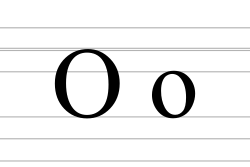
| O o | |
 |
|
| Usage | |
| Writing system | Latin script |
| Type | Alphabetic |
| Language of origin | Latin language |
| Sound values | [o][o̞][ɔ][əʊ][əʉ][oʊ][ɐʊ][ɐʉ][ɒʊ][uː][ʉː][ʌ][ɒ][ɑ][ø][a][ʕ][w][◌ʷ][ʊ][ɵ][ə][ɐ] |
| In Unicode | U+004F, U+006F |
| Alphabetical position | 15 |
| History | |
| Development |     Ο ο𐌏O o Ο ο𐌏O o |
| Time period | c. 700 BCE to present |
| Descendants | ÖⱺØŒƆƠỎꝊ∅º℅ |
| Sisters | ᴥƸʿОЮӨעعܥࠏዐࡘჺՈ ոՕ օᱳᱜ ᱣ |
| Other | |
| Associated graphs | o(x) |
| Writing direction | Left-to-right |
| This article contains phonetic transcriptions in the International Phonetic Alphabet (IPA). For an introductory guide on IPA symbols, see Help:IPA. For the distinction between [ ], / / and ⟨ ⟩, see IPA § Brackets and transcription delimiters. |
O (minuscule: o) is the fifteenth letter and the fourth vowel letter of the Latin alphabet, used in the modern English alphabet, the alphabets of other western European languages and others worldwide. Its name in English is o (pronounced ), plural oes.[1]
In English, the name of the letter is the "long O" sound, pronounced . In most other languages, its name matches the letter's pronunciation in open syllables.

Pronunciation of the name of the letter ⟨o⟩ in European languages
| Egyptian | PhoenicianAyin | Western GreekOmicron | EtruscanO | LatinO |
|---|---|---|---|---|
 |
 |
 |
 |
 |
Its graphic form has remained fairly constant from Phoenician times until today. The name of the Phoenician letter was ʿeyn, meaning "eye", and its shape originates simply as a drawing of a human eye (possibly inspired by the corresponding Egyptian hieroglyph, cf. Proto-Sinaitic script). Its original sound value was that of a consonant, probably [ʕ], the sound represented by the cognate Arabic letter ع ʿayn.[2]
The use of this Phoenician letter for a vowel sound is due to the early Greek alphabets, which adopted the letter "omicron" to represent the vowel /o/. The letter was adopted with the value in the Old Italic alphabets, including the early Latin alphabet. In Greek, a variation of the form later came to differentiate this long sound (omega, meaning "large O") from the short o (Omicron, meaning "small o"). The Greek omicron gave rise to the corresponding Cyrillic letter O.[2]

Late Renaissance or early Baroque design of an O, from 1627
Use in writing systems
[edit]
Pronunciation of ⟨o⟩ by language
| Orthography | Phonemes |
|---|---|
| Catalan | /ɔ/, /o/, /u/, /w/ |
| Standard Chinese (Pinyin) | /ə/, /u/ |
| Czech | /ɔ/ |
| Danish | /ɔ/, /o/, /oː/ |
| Dutch | /ɔ/, /oː/, /ə/ |
| English | /ɒ/, /oʊ/, /ə/, /ɔː/, /aɪə/ |
| French | /o/, /ɔ/ |
| German | /ɔ/, /oː/, /o/ |
| Irish | /ɔ/, /ə/ |
| Italian | /o/, /ɔ/ |
| Malagasy | /u/ |
| Malay | /ɔ/ |
| Norwegian | /ɔ/, /ʊ/, /oː/, /uː/ |
| Occitan | /u/ |
| Polish | /ɔ/ |
| Portuguese | /ɔ/, /o/, /u/, /w/ |
| Spanish | /o/ |
| Slovak | /ɔ/ |
| Swedish | /ɔ/, /oː/, /uː/ |
| Turkish | /o/ |
The letter ⟨o⟩ is the fourth most common letter in the English alphabet.[3] Like the other English vowel letters, it has associated "long" and "short" pronunciations. The "long" ⟨o⟩ as in boat is actually most often a diphthong (realized dialectically anywhere from [o] to [əʊ]). In English, there is also a "short" ⟨o⟩ as in fox, , which sounds slightly different in different dialects. In most dialects of British English, it is either an open-mid back rounded vowel [ɔ] or an open back rounded vowel [ɒ]; in American English, it is most commonly an unrounded back [ɑ] to a central vowel [a].[4]
Common digraphs include ⟨oo⟩, which represents either , or ; ⟨oi⟩ or ⟨oy⟩, which typically represents the diphthong , and ⟨ao⟩, ⟨oe⟩, and ⟨ou⟩ which represent a variety of pronunciations depending on context and etymology.[4]
In other contexts, especially before a letter with a minim, ⟨o⟩ may represent the sound , as in 'son' or 'love'. It can also represent the semivowel , as in choir or quinoa.[5]
"O" in isolation is a word, also spelled "oh" and pronounced /oʊ/. Before a noun, usually capitalized, it indicates a noun of address, as in the titles "O Canada" or "O Captain! My Captain!" or in certain verses of the Bible.[6]
⟨o⟩ is commonly associated with the open-mid back rounded vowel [ɔ], mid back rounded vowel [o̞] or close-mid back rounded vowel [o] in many languages. Other languages use ⟨o⟩ for various values, usually back vowels which are at least partly open. Derived letters such as ⟨ö⟩ and ⟨ø⟩ have been created for the alphabets of some languages to distinguish values that were not present in Latin and Greek, particularly rounded front vowels.[7]
In the International Phonetic Alphabet, ⟨o⟩ represents the close-mid back rounded vowel.[8]
- Oxygen, symbol O, a chemical element
Descendants and related characters in the Latin alphabet
[edit]
- Œ œ : Latin OE ligature
- O with diacritics: Ø ø Ǿ ǿ Ö ö Ȫ ȫ Ó ó Ò ò Ô ô Ố ố Ồ ồ Ổ ổ Ỗ ỗ Ộ ộ Ǒ ǒ Ő ő Ŏ ŏ Ȏ ȏ Ȯ ȯ Ȱ ȱ Ọ ọ Ɵ ɵ ᶱ[9] Ơ ơ Ớ ớ Ờ ờ Ỡ ỡ Ợ ợ Ở ở Ỏ ỏ Ō ō Ṓ ṓ Ṑ ṑ Õ õ Ȭ ȭ Ṍ ṍ Ṏ ṏ Ǫ ǫ Ȍ ȍ O̩ o̩ Ó̩ ó̩ Ò̩ ò̩ Ǭ ǭ O͍ o͍
- Ꝍ ꝍ : O with loop was used in some medieval Nordic orthographies[10]
- Ꟁ ꟁ : Old Polish O[11]
- ⱺ : Small o with low ring inside is used in the Swedish Dialect Alphabet[12]
- IPA-specific symbols related to O: ɔ
- IPA superscript letters:[13] 𐞢 𐞣
- Uralic Phonetic Alphabet-specific symbols related to O:[14]
- U+1D0F ᴏ LATIN LETTER SMALL CAPITAL O
- U+1D3C ᴼ MODIFIER LETTER CAPITAL O
- U+1D52 ᵒ MODIFIER LETTER SMALL O
- U+1D11 ᴑ LATIN SMALL LETTER SIDEWAYS O
- U+1D13 ᴓ LATIN SMALL LETTER SIDEWAYS O WITH STROKE
- U+1D16 ᴖ LATIN SMALL LETTER TOP HALF O
- U+1D17 ᴗ LATIN SMALL LETTER BOTTOM HALF O
- U+1D54 ᵔ MODIFIER LETTER SMALL TOP HALF O
- U+1D55 ᵕ MODIFIER LETTER SMALL BOTTOM HALF O
- Teuthonista phonetic transcription-specific symbols related to O:[15]
- U+AB3D ꬽ LATIN SMALL LETTER BLACKLETTER O
- U+AB3E ꬾ LATIN SMALL LETTER BLACKLETTER O WITH STROKE
- U+AB3F ꬿ LATIN SMALL LETTER OPEN O WITH STROKE
- U+AB43 ꭃ LATIN SMALL LETTER TURNED O OPEN-O
- U+AB44 ꭄ LATIN SMALL LETTER TURNED O OPEN-O WITH STROKE
- o : Subscript small o is used in Indo-European studies[16]
- 𝼛 : Latin small letter o with retroflex hook is used in phonetic transcription[17][18]
Derived signs, symbols and abbreviations
[edit]
- Ꝋ ꝋ : Forms of O were used for medieval scribal abbreviations[10]
- ∅ : empty set symbol[19]
- º : Masculine ordinal indicator
- Calligraphic O (𝒪, 𝓸): Mathematical Alphanumeric Symbols[20]
Ancestors and siblings in other alphabets
[edit]
- 𐤏 : Semitic letter Ayin, from which the following symbols originally derive:
- Ω ω : Greek letter Omega
- Ο ο : Greek letter Omicron
* Ⲟ ⲟ : Coptic letter O, which derives from Greek omicron
* О о : Cyrillic letter O, which also derives from Omicron
* 𐌏 : Old Italic O, which derives from Greek Omicron, and is the ancestor of modern Latin O
* Օ օ : Armenian letter O[_citation needed_]
Other representations
[edit]
- U+004F O LATIN CAPITAL LETTER O
- U+006F o LATIN SMALL LETTER O
- U+FF2F O FULLWIDTH LATIN CAPITAL LETTER O
- U+FF4F o FULLWIDTH LATIN SMALL LETTER O
- O mark
- Open O (Ɔ ɔ)
- 0 (zero). The capital letter O may be mistaken or misused for the number 0, as they appear quite identical in some typefaces. Early typewriters did not have a 'zero' key.
- ^ "O" Oxford English Dictionary, 2nd edition (1989);Chambers-Happap, "oes" op. cit. Oes is the plural of the name of the letter. The plural of the letter itself is rendered _O_s, O's, _o_s, o's.
- ^ a b "Evolution of Alphabets". webspace.ship.edu. Retrieved January 3, 2024.
- ^ "Frequency Table". www.math.cornell.edu.
- ^ a b "International Phonetic Alphabet for American English - IPA Chart". easypronunciation.com. Retrieved January 3, 2024.
- ^ Millward, C.M (December 1, 1988). History of the English Language. Thomson Learning. pp. |pages=137-138. ISBN 0030594316.
- ^ "Quick search: "o lord"". Retrieved December 5, 2013.
- ^ "Latin Script". Retrieved March 13, 2026.
- ^ "IPA Chart with Sounds – International Phonetic Alphabet Sounds". www.internationalphoneticalphabet.org. Retrieved October 22, 2023.
- ^ Constable, Peter (April 19, 2004). "L2/04-132 Proposal to add additional phonetic characters to the UCS" (PDF).
- ^ a b Everson, Michael; Baker, Peter; Emiliano, António; Grammel, Florian; Haugen, Odd Einar; Luft, Diana; Pedro, Susana; Schumacher, Gerd; Stötzner, Andreas (January 30, 2006). "L2/06-027: Proposal to add Medievalist characters to the UCS" (PDF).
- ^ Bunčić, Daniel (January 12, 2021). "L2/21-039: Proposal to include the letter 'Old Polish O'" (PDF).
- ^ Lemonen, Therese; Ruppel, Klaas; Kolehmainen, Erkki I.; Sandström, Caroline (January 26, 2006). "L2/06-036: Proposal to encode characters for Ordbok över Finlands svenska folkmål in the UCS" (PDF).
- ^ Miller, Kirk; Ashby, Michael (November 8, 2020). "L2/20-252R: Unicode request for IPA modifier-letters (a), pulmonic" (PDF).
- ^ Everson, Michael; et al. (March 20, 2002). "L2/02-141: Uralic Phonetic Alphabet characters for the UCS" (PDF).
- ^ Everson, Michael; Dicklberger, Alois; Pentzlin, Karl; Wandl-Vogt, Eveline (June 2, 2011). "L2/11-202: Revised proposal to encode "Teuthonista" phonetic characters in the UCS" (PDF).
- ^ Anderson, Deborah; Everson, Michael (June 7, 2004). "L2/04-191: Proposal to encode six Indo-Europeanist phonetic characters in the UCS" (PDF).
- ^ Miller, Kirk (July 11, 2020). "L2/20-125R: Unicode request for expected IPA retroflex letters and similar letters with hooks" (PDF).
- ^ Anderson, Deborah (December 7, 2020). "L2/21-021: Reference doc numbers for L2/20-266R "Consolidated code chart of proposed phonetic characters" and IPA etc. code point and name changes" (PDF).
- ^ "Earliest Uses of Symbols of Set Theory and Logic". jeff560.tripod.com.
- ^ "Script (or Calligraphic)". www.w3.org. Retrieved January 3, 2024.

Look up O or o in Wiktionary, the free dictionary.
 Media related to O at Wikimedia Commons