Growing tomatoes in home gardens (original) (raw)
- Home
- Yard and garden
- Growing tomatoes
A quick guide to tomatoes
- Start tomatoes from seeds indoors, five to six weeks before planting outside.
- When buying plants, choose sturdy plants up to a foot tall.
- Transplant outdoors after all danger of frost has passed and the soil has warmed.
- Stake or cage plants at the time of planting.
- Pick all the fruit and bring it indoors before the first frost at the end of summer.
Sun-loving tomatoes

Tomatoes (Solanum lycopersicum, Lycopersicon lycopersicum) are the most popular homegrown vegetable.
Like other plants in the potato family (which includes eggplants, peppers, and tobacco), tomatoes are heat-loving plants that require a long, frost-free season and full sun. The long, hot, sunny days of Minnesota summers are great for growing tomatoes.
You can start your own seeds indoors or buy plants by mail or from a garden center.
Soil pH and fertility
|
Have your soil tested to determine pH.
A pH of 5.5 to 7 is ideal.
- Apply phosphorus (P) and potassium (K) according to soil test recommendations. Many Minnesota soils have enough phosphorus.
- Unless your soil test report specifically recommends additional phosphorus, use a low- or no-phosphorus fertilizer.
- Too much nitrogen fertilization will lead to plants that are bushy, leafy, and slow to bear fruit.
- Do not use any fertilizer containing a weed killer ("Weed and Feed"), as it may kill your vegetable plants.
When the first fruits start to enlarge, apply fertilizer alongside the row of plants.
- Use the fertilizer at a rate of ½ cup of 46-0-0, or 1 cup of 27-3-3, or 3-½ cups 10-3-1 for every 100 feet of row.
- Spread the fertilizer in a six-inch wide band, and scratch it into the surface of the soil.
Improve your soil by adding composted manure or other compost in spring or fall. Do not use fresh manure as it may contain harmful bacteria and increase weed problems.
- You may not need additional fertilizer applications, depending on how much organic matter you apply.
You can use black plastic mulch to increase the soil temperature, protect plant roots and help keep soil moisture.
When buying plants, choose sturdy plants up to a foot tall.
They should have stems at least the diameter of a pencil with leaves closely spaced up the stem.
Do not buy plants with spots on their leaves, as you will likely bring disease into your garden.
If you buy plants from a mail-order catalog, you may need to keep them indoors until it is time to set them out. Treat the plants as if you had started them yourself.
Bush-type (determinate)
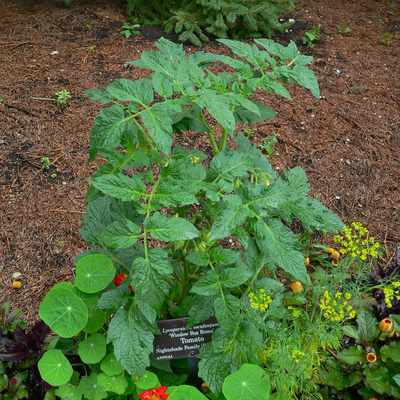
Bush-type Roma tomato plant
- Bush-type plants do not need pruning, staking or trellising.
- Their top or terminal growing point ends with flowers and fruit.
- Typically, they reach 24 to 30 inches in height.
- The plants stop growing and produce a set number of fruits that all ripen within a four- to six-week period.
- If you want to have a large harvest for canning, plant a few bush-type plants and pick many fruits at once.
- If your garden plot is small or you plan to grow tomatoes in containers, bush-type plants may be the only option.
Vining (indeterminate)
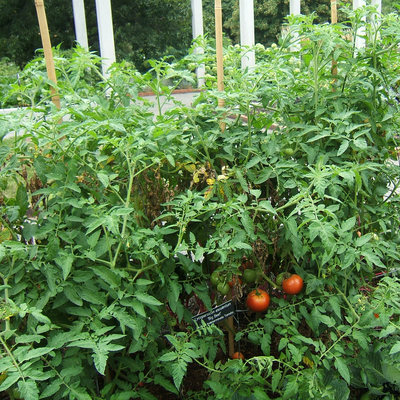
Vining Big Beef tomato plant
- Most tomato varieties are vining.
- Vining plants need support such as cages, stakes or trellises.
- Their top or terminal growing point grows continually with the leaves.
- Flowers and fruit grow on the side branches along the stem.
- They grow to three to five feet long, sometimes more.
- Vining tomato plants will continue to produce flowers and ripen fruit until the weather becomes too cold.
Resistant varieties
- If you have previously identified disease issues in the garden, choosing a resistant or tolerant variety is a good way of preventing or slowing the disease in the future.
- A resistant variety will not become diseased.
- A tolerant variety will become diseased, but the spread of disease will be slower and the infection will be less serious.
- Seed catalogs use codes to note which varieties of tomatoes are resistant or tolerant to different diseases.
- Some garden centers and big box stores include this information in their signage.
- For a full list of varieties, see the Cornell University Disease Resistant Vegetable Varieties page.
Start tomatoes from seeds indoors, five to six weeks before planting outside. In most of Minnesota, this is mid-April. Plants started earlier are difficult to manage and do not necessarily lead to better or earlier harvests.
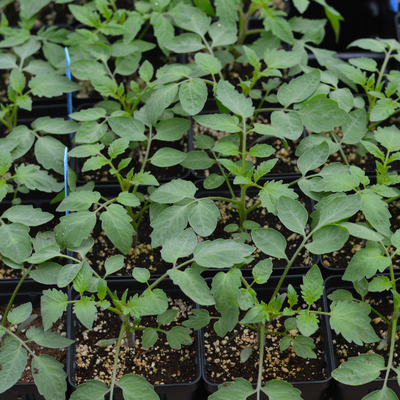
Young tomato plants growing indoors
- Plant seeds one-fourth inch deep in flats containing sterile, soilless germination mix.
- For best germination, use a heating mat to keep the flat at 75°F to 85°F until seedlings emerge. Carefully monitor potting mix moisture, as heating mats will dry the mix out faster.
- After emergence, a soil temperature of 70°F is ideal. Warm soil is better than cool.
- Provide bright overhead light for the seedlings.
- Thin or transplant seedlings after true leaves appear so that seedlings are two inches apart, and continue to grow under bright light. Without bright light directly overhead, the stems of the little plants will elongate and lean over.
- Reduce watering when plants are about 5 inches tall and 6 to 8 weeks old.
- Place plants outside where they will receive wind protection and a couple of hours of sunlight.
- Gradually expose them to more sunlight over the next week or two, bringing them indoors if night temperatures approach freezing.
Location
- Choose a location in your garden where you have not grown tomatoes, potatoes, peppers, eggplants and tomatillos for the past three or four years.
- Crop rotation and sanitation are very important.
- Allow two to three feet in all directions between vining plants. You can set bush-type plants closer together.
Climate
- Transplant outdoors after all danger of frost has passed and the soil has warmed.
- Check out this map for average frost-free dates in Minnesota.
- Transplant in late afternoon or on a cool, cloudy, calm day.
Treatment
- Water plants well before transplanting.
- It is best to install plant supports —stakes, cages, spirals, or trellises— at the time of planting.
- If the plants were growing in a community pack or container, cut the soil between the plants with a knife so each plant can separate easily with a root ball attached.
- When transplanting seedlings in peat pots, make sure you do not expose the top edge of the peat pot above the soil surface. The peat pot will act like a wick and rapidly draw the moisture from the root ball, stressing the plant.
- With a hand shovel, make a hole large enough for the root ball of the transplant.
- Firm the soil around the roots and water the transplants.
For a stronger, more vigorous plant, plant tomatoes so that some of the stem is below the soil line and new roots will emerge from the buried part of the stem. Rather than digging a hole, dig a trench three to four inches deep. Remove the lowest leaves from each seedling, and lay the plant down in the trench, burying the stem up to just below the lowest remaining leaves.
How to keep your tomato plants healthy and productive
|
Consistent soil moisture levels will help produce the best quality fruit. When soil moisture levels fluctuate during fruit growth, blossom-end rot can develop.
Avoid overhead sprinkling. Wet leaves are more disease prone, and soil splashed up onto the leaves can contain disease spores.
Always soak the soil thoroughly when watering.
Light watering can cause shallow root development, increase the crop's exposure to hot weather and drought stress, and reduce fruit quality.
One inch of rainfall or irrigation per week is ideal.
An inch of water will wet a sandy soil to a depth of ten inches, a heavy clay soil to six inches.
Very sandy soils may require watering more often.
Use a trowel to see how far down the soil is wet. If it is only an inch or two, keep the water running.
Frequent, shallow cultivation with a garden hoe or trowel will kill weeds before they become a problem.
Cultivate just deeply enough to cut the weeds off below the surface of the soil.
Mulch with herbicide-free grass clippings, weed-free straw or other organic material to a depth of three to four inches to help prevent weed growth, decreasing the need for frequent cultivation.

Harvest fruit when they have reached a usable size and color. Some tomatoes will drop when ripe. Others cling to the plant and you should cut them off in clusters. You may choose to pick the fruit of varieties that drop before it is completely ripe. Most types will come off the plant easily when ripe or close to ripe.
When frost threatens at the end of summer, pick all the fruit and bring it indoors. Tomatoes picked truly green will probably never ripen to a good flavor, but those picked when the green color is decreasing and starting to turn white or pink should not disappoint.
Fruit that is mature green, fully developed in size, but not color, will often ripen satisfactorily. Some gardeners look for a star, or streak of white, on the bottom of the tomato. If the fruit is so truly unripe that the bottom is as green as the rest, it will not be worth ripening indoors.
Store unripe fruits at room temperature, one layer deep, spaced apart without touching each other. Light is not necessary. Warm temperatures are more important than light in ripening the fruit. Fruit will ripen over the next few weeks. Check them often and eat them as they ripen.
Preservation
- Tomatoes are one of the easiest foods to can at home. Ripe tomatoes canned whole or in chunks, tomato juice, tomato sauce, and tomato-based salsas are common recipes.
- You can also try drying tomatoes.
- You can also prepare tomato sauce and freeze it.
- See our resources on canning tomatoes.
Managing pests, diseases and disorders
Many things can affect tomato leaves, flowers and fruit. Changes in physical appearance and plant health can be caused by the environment, plant diseases, insects and wildlife. In order to address what you’re seeing, it is important to make a correct diagnosis.
You can find additional help identifying common pest problems by using the online diagnostic tools or by sending a sample to the UMN Plant Disease Diagnostic Clinic. You can share pictures and get input on the Ask a Master Gardener form.
There will always be some level of disease and insect feeding in Minnesota tomatoes. It is possible to have a satisfactory crop of tomatoes even though the plants and fruit show some disease and pest problems.
|
- Cutworms can cut young tomato plants off at the base.
- Flea beetles are small, quick-moving insects whose feeding leads to many small holes in leaves.
- Colorado potato beetle larvae and adults feed on leaves.
- Aphids can colonize tomato plants in large numbers. You may notice leaf curling, discoloration, and sticky leaves.
- If you have aphids, you may see natural enemies nearby feeding on them.
- If tomato fruits are already damaged, you may see sap beetles feeding in the fruit.
- Tomato hornworm are large caterpillars that feed on leaves and fruit.
Minnesota’s climate means that we will see tomato diseases every year. Many of these diseases can be prevented using cultural practices, such as adequate plant spacing, pruning, rotation, and watering at the base of the plant.
- Early blight is a common tomato disease, and causes leaf spotting and occasional fruit rot.
- Septoria leaf spot is another common disease, which causes numerous, small spots on leaves.
- Tomato viruses cause off-coloring and weird patterns in tomato leaves and fruit, as well as distortion of all plant parts.
- Bacterial spot can cause spots on leaves and fruit.
- While gardeners often worry about late blight, it is a disease we don’t see in Minnesota every year.
Click on an image to enlarge.
- Blossom end rot causes the ends of tomato fruit to not develop, leading to the “blossom end” becoming scabbed over or moldy.
- Growth cracks occur on fruit when they grow too quickly, and most often occur during times of heavy rains and warm temperatures.
- Catfacing is when fruit becomes scarred and has many potential causes.
- Leaf roll is a non-damaging plant disorder, which causes tomato leaves to roll in on themselves.
- Sunscald occurs when tomato fruits get too much sun, causing white spots and then moldy areas in exposed areas.
- When the topside of tomato fruit never ripens and remains hard and yellow, it is caused by a mysterious disorder called yellow shoulders.
Authors: Cindy Tong, Extension horticulturist; Marissa Schuh, integrated pest management Extension educator; and Jill MacKenzie
Reviewed in 2024