4.2T3 Training Materials: Exercise "Livestock Production" (original) (raw)
Exercise: "Livestock Production"
There are several tables and columns in the FABLE Calculator designed to help users troubleshoot possible errors or inconsistencies. In the worksheet calc_livestock, there are two tables for this purpose, chk_herd and Chk_animproducts. We will revise in the section of crop production the checks there are for agricultural products, which is similar to those of Chk_animproducts. Therefore, this exercise will focus on Table 2.D chk_herd.
In the Open calculator, the default levels of some columns for cattle herd in table 2.D are as follows:
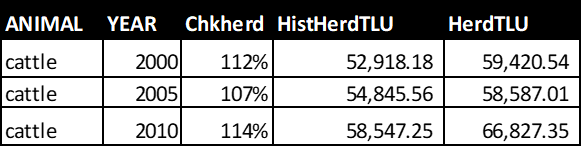
The comparison shown above is between historical values in herd, which for the year 2010 are 58,547.25 TLU, vs the calculated values of herd in the FABLE model, which for the same year amount to 66,827.35. There is clearly a mismatch between historical values and the ones calculated in the model, an overestimation of approximately 14%.
How would you go about trying to fix the calculated number, so that it matches 100% (or close) the historical values? There could be various points in the model where something could be off, and it is not easy to find out which of these could be changed. Tracing formulas and understanding the causality links involved is usually what would be required in this case. Let us do so!
- chk_herd[HerdTLU] is obtaining its values from calc_livestocknb[RealHerd], by a simple recalling of the numbers.
- calc_livestocknb[RealHerd] is a measure of herd size which depends on production values and productivity. Production vales related to cattle would be milk and cattle for beef, both of which seem to be adequately close to historical values in production and consumption, as one can filter in Chk_animproducts:
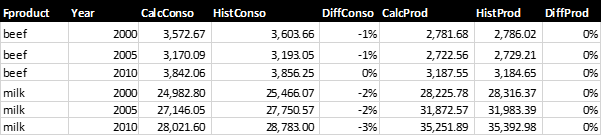
Therefore, one can start to suspect that productivity may be too high in the model. Tracing productivity, the values imported to the table calc_livestocknb, column “pdtyanim2000” come from data_live[yield], which themselves are obtained from Herrero, Havlik et al. (2013). It would be pertinent here to revise whether the productivity values obtained in this table are adequate for the country you represent.