The Ancient Greek Who Invented the World's First Steam Turbine - GreekReporter.com (original) (raw)
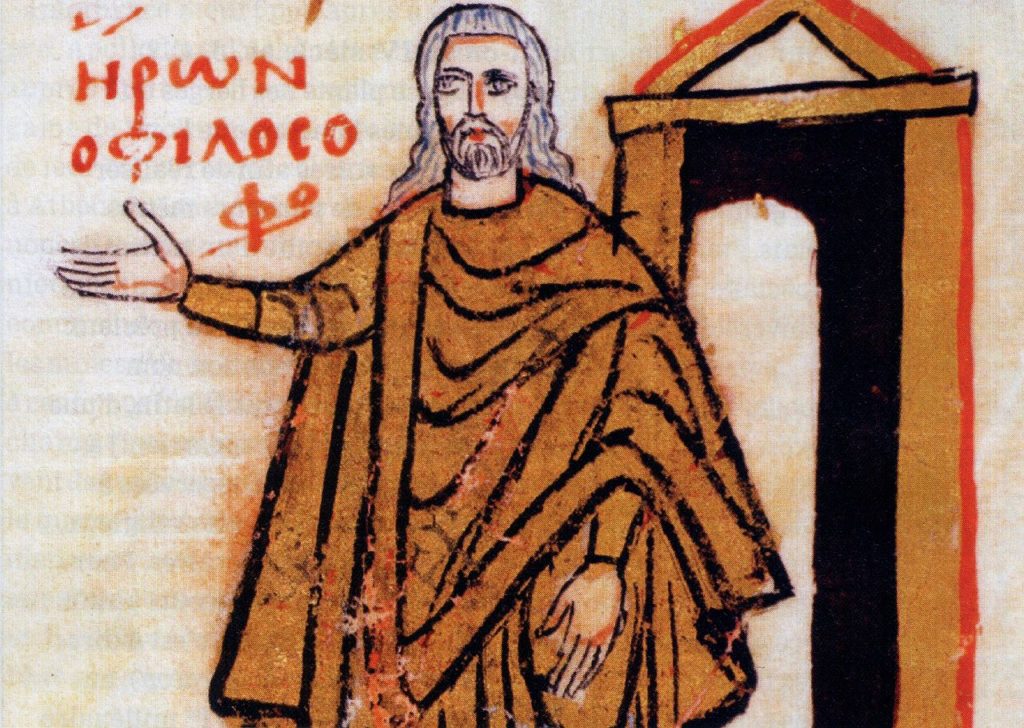
Heron of Alexandria. Codex of Saint Gregory Nazianzenos. Greek manuscript of the ninth century. Public Domain
Heron of Alexandria was an ancient Greek inventor of mechanical devices, mathematician, engineer, and geometer whose inventions include the first steam turbine.
Heron lived during Hellenistic times in Alexandria, Egypt, which was part of the Roman Empire at the time. He became famous for documenting the first steam turbine, the aeolipile.
Heron, or Hero of Alexandria, transitioned away from pure reasoning, number relationships, and abstract mathematical laws to empirical experiments. He invented numerous mechanisms for temples and theaters, designed pneumatic devices, surveying instruments, and also advanced or improved inventions by others, for example the hydraulis, originally invented by Ctesibius.
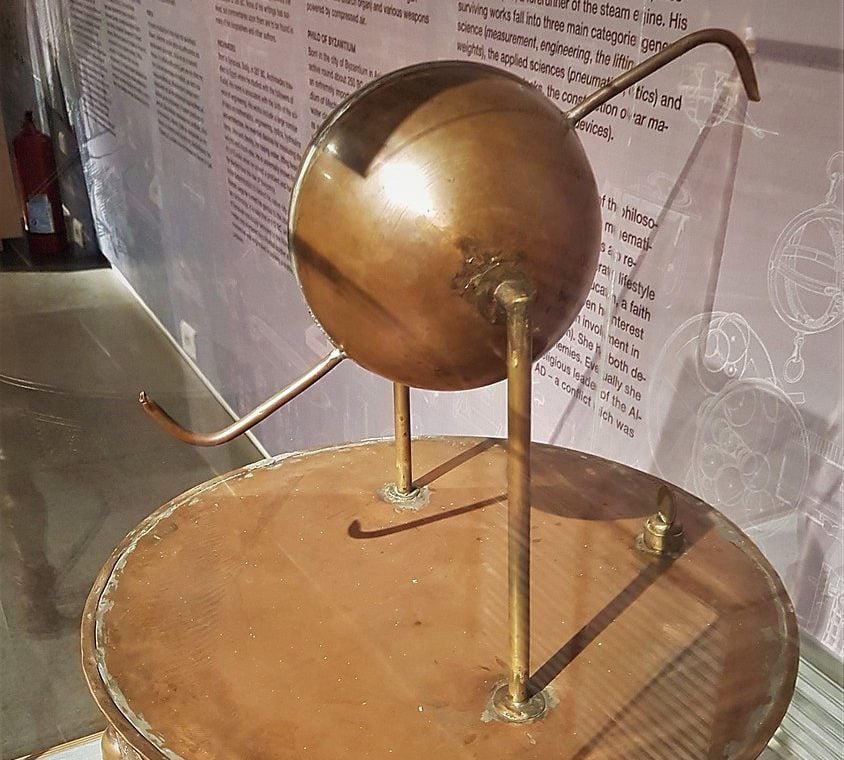
Heron of Alexandria was a brilliant ancient inventor who was ahead of his time and created a prototype of a steam engine. Credit: Gts-tg / CC-BY-SA-4.0 / Wikimedia Commons
It is uncertain whether he was born in Alexandria in the first century BC or the first century AD. Researchers have relied on references to him—and references made by Heron himself—to best determine the time period during which he lived. The fact that his name was quite common and the references could have been about other individuals did not make this an easy task.
Nevertheless, the majority of experts place the ancient Greek inventor’s birth date around 10 AD and his death in 85 AD.
From Heron’s manuscripts, researchers have deduced he taught at the Museum in Alexandria. His writings resemble lecture notes from his courses on mathematics, physics, pneumatics, and mechanics. Some of his writings are definitely textbooks while others are probably drafts of lecture notes not yet worked into final form for a student textbook.
Ancient Greek Inventions of Heron of Alexandria
The ancient Greek inventor developed many machines and mechanical devices with practical uses, proving it was possible to take theory and put it into practice.
- The aeolipile was a device which showed how to unlock the power of steam. It consisted of a copper stand resting upon a boiler, with two pipes rising perpendicularly from the surface. These acted as an axis for a pivoting sphere with two oppositely bent nozzles protruding from its surface. As the water in the boiler gave off steam, this made its way into the sphere and was ejected from the nozzles at high speed, causing the sphere to rotate.
- Heron’s Fountain was an instrument that used air pressure to produce a jet of water. It was a hydraulic machine that uses the flow of water from high gravitational potential energy to low gravitational potential energy, thus causing a fountain to form due to increasing pressure on the inside of the system.
- The dioptra was a surveying device that consisted of a circular table fixed to a sturdy stand, and this was calibrated and inscribed with angles. The surveyor leveled the device using small water levels for accuracy and used the disc to measure the angle between two distant objects with the aid of a rotating bar fitted with sights. Using triangulation, the surveyor could also measure the distance between two objects. The rotating disc could be tilted, allowing surveyors and astronomers to make vertical measurements.
- The automaton was a primitive, programmable robot used to entertain audiences at the theater. It was a cart with rope wrapped around two independent axles and a falling weight to provide power. Using pegs projecting from the axle, Heron could vary how the rope was wound around the axle, allowing the robot to change direction and move along a pre-programmed course.
- An apparatus called a temple door opener used heat and pneumatics to open a set of temple doors. The priest lit a fire on the altar, heating the air within, so as to cause it to expand. This expansion in volume forced water out of the sphere and into the bucket, which moved downwards under the extra weight. The bucket was connected to a rope coiled around a spindle and, as the bucket moved downwards, this spindle revolved, causing the doors to open. Once the fire died out, the air contracted and, to avoid leaving a vacuum, the water siphoned from the bucket back into the sphere. The bucket would then rise with the aid of a counterweight. As a result, the doors swung shut.
- The wind-powered organ relied on one of the simplest sources of free energy, the wind, to create a wind-powered organ. Heron’s organ included a small windwheel, which powered a piston and forced air through the organ pipes, creating sounds and tweets ‘like the sound of a flute.’ This device is believed to be the first example of wind powering a machine.
- Heron’s dispenser of holy water is referred to as the world’s first vending machine. A worshipper inserted a coin through a slot, and this fell onto a tray connected to a lever. The weight of the coin opened up a valve that allowed water to flow out. Eventually, the coin slid off the tray and, with the aid of a counterweight, the lever snapped back into place, ready for the next worshipper.
- The syringe, Heron’s lasting contribution to science, was a device used to control the delivery of air or fluid with precision. The device, similar to modern syringes, relied on suction to keep air or liquid in place. When the plunger was depressed, this forced the liquid out at a controllable rate. In a much smaller size, this is the ancestor of modern syringes.
Heron of Alexandria invented a steam apparatus that would automatically open and close temple doors. Credit: Wikipedia
Heron’s Books That Have Survived
According to Evangelos Papadopoulos, a professor at the Department of Mechanical Engineering at the National Technical University of Athens, the ancient Greek inventor’s most well-known books related to engineering are:
• Pneumatica (Pneumatics), the study of mechanical devices worked by air, steam, or water pressure by using strings and ropes—in Greek.
• Automatopoietica (Gr. Περί αυτoµατoπoιητικής, i.e. about making automatic devices), a description of automated machines using mechanical or pneumatical means, most for temples—in Greek.
• Belopoeica (from the Greek βέλος, meaning arrow, and πoιώ, meaning to make), designs and constructions of machines of war—in Greek.
• Mechanics, which covers mechanisms and simple machines and has survived in Arabic, with a few fragments in Greek preserved by Pappus.
• Barulkos (Gr. Bαρoύλκoς from βαρύς, meaning heavy and έλκω, meaning to pull) discusses methods of lifting heavy weights. Perhaps this is the same as mechanics.
• Dioptra, which describes a theodolite-like instrument used in surveying and methods to measure length—in Greek and Arabic.
• Catoptrica (Catoptrics) on light propagation and reflection and on the use of mirrors. Heron believed that vision results from light rays emitted by the eyes—in Greek.
• Cheirobalistra (On Catapults) about catapults—in Greek.
On Mathematics and Geometry
Heron has also made significant contributions to mathematics and geometry. Although some of the books are of disputed authorship, his works in these fields include:
• Metrica, describes how to calculate surfaces and volumes of diverse objects—in Arabic.
• Geometrica (Geometria), a collection of equations based on the first chapter of _Metrica_—in Greek.
• Stereometrica (i. and ii.), examples of three-dimensional calculations based on the second chapter of _Metrica_—in Greek.
• Geodaesia, surveying analysis—in Greek.
• Mensurae, tools which can be used to conduct measurements based on
Stereometrica and Metrica (disputed authorship)—in Greek.
• Definitiones (Definitions), containing definitions of terms for geometry—in Greek (disputed authorship).
Heron invented several more more devices, such as a primitive fire engine, or a rapid-fire crossbow weapon. Yet, as with other geniuses, the ancient Greek inventor had his later detractors, who doubted the originality—or even the existence—of some of the machines he claimed to have invented.
However, it is the surviving body of his written work that places him among the greatest inventors and engineering and mathematical geniuses of all time.