GraphQL Server with Golang | Backend Tutorial (original) (raw)
Go is an open-source programming language supported by Google. Learn more at the official website.
The following guide covers common backend application tasks, such as creating a GraphQL server with Go gqlgen and integrating a Go REST API into a unified GraphQL schema. We also go over how to integrate your Go app with Hasura.
New to GraphQL? Check out the Introduction to GraphQL tutorial to learn the core concepts quickly.
- You will learn how to create a GraphQL server with Golang and gqlgen
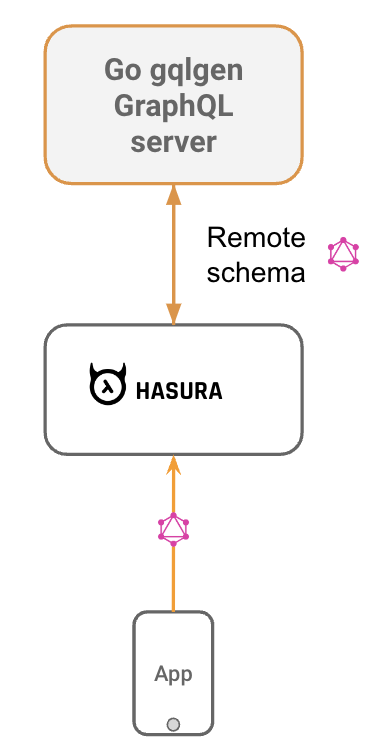
- If you have an existing GraphQL API with Golang, you can integrate it with Hasura as a Remote Schema to get a unified GraphQL API.
- If you have an existing REST API with Golang, you can transform that declaratively to GraphQL without writing any code using Hasura REST Connectors.
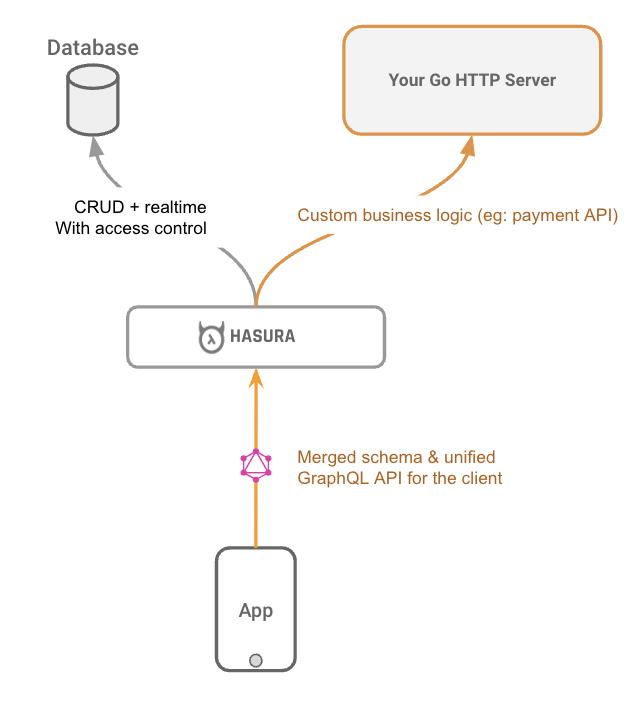
- You can also re-use or custom write REST endpoints with Golang and map the endpoint to a GraphQL schema in Hasura.
New to Hasura? The Hasura GraphQL Engine makes your data instantly accessible over a real-time GraphQL API so that you can build and ship modern, performant apps and APIs 10x faster. Hasura connects to your databases, REST and GraphQL endpoints, and third-party APIs to provide a unified, connected, real-time, secured GraphQL API for all your data. Check out the Hasura documentation.
Create a Go GraphQL Server with gqlgen
We can make a custom GraphQL server in Go using gqlgen
- Run the gqlgen quickstart, skipping the first step.
- In the
graph/schema.resolvers.goTodos resolver return a placeholder test value.
func (r *queryResolver) Todos(ctx context.Context) ([]*model.Todo, error) {
return []*model.Todo{
{
ID: "test",
Text: "test",
Done: false,
User: &model.User{
ID: "",
Name: "",
},
},
}, nil
} - Delete
server.goand inmain.goadd the generated GraphQL handler
import (
"log"

"net/http"
"github.com/hasura/learn-graphql/tutorials/backend/backend-stack/source-code/action"
"github.com/hasura/learn-graphql/tutorials/backend/backend-stack/source-code/event"
"github.com/99designs/gqlgen/graphql/handler"
"github.com/hasura/learn-graphql/tutorials/backend/backend-stack/source-code/graph"
"github.com/hasura/learn-graphql/tutorials/backend/backend-stack/source-code/graph/generated"
)
func main() {
mux := http.NewServeMux()
srv := handler.NewDefaultServer(generated.NewExecutableSchema(generated.Config{Resolvers: &graph.Resolver{}}))
mux.HandleFunc("/graphql", srv.ServeHTTP)
mux.HandleFunc("/action", action.LoginHandler)
mux.HandleFunc("/event", event.NewUserHandler)
err := http.ListenAndServe(":3000", mux)
log.Fatal(err)
}
Golang GraphQL API Federation using Hasura Remote Schema
We can connect our custom GraphQL server to Hasura using remote schemas to unify the GraphQL endpoint as a single endpoint.
- In the Hasura Console Remote Schema tab, add your Go server
<Go server URL>/graphql - In the API Explorer tab, try querying the sample todos.
query {
todos {
id
text
done
}
}
Convert a Go REST API Endpoint to GraphQL
In this section, we will write a REST Endpoint in Golang and see how to transform that to GraphQL. We will create a login POST endpoint that takes a username and password and returns an access code.
In our main.go, we use the standard library to create an HTTP server:
package main
import (
"log"
"net/http")
func main() {
mux := http.NewServeMux()

mux.HandleFunc("/action", action.LoginHandler)

err := http.ListenAndServe(":3000", mux)

log.Fatal(err)
}
In action/action.go, we make the handler:
package action
import (
"encoding/json"

"io/ioutil"

"net/http"
)
type LoginResponse struct {
AccessToken string}
type Mutation struct {
Login *LoginResponse}
type loginArgs struct {
Username string

Password string
}
type ActionPayload struct {
SessionVariables map[string]interface{} `json:"session_variables"`

Input            loginArgs              `json:"input"`
}
type GraphQLError struct {
Message string `json:"message"`}
func LoginHandler(w http.ResponseWriter, r *http.Request) {
w.Header().Set("Content-Type", "application/json")

reqBody, err := ioutil.ReadAll(r.Body)

if err != nil {

    http.Error(w, "invalid payload", http.StatusBadRequest)

    return

}

var actionPayload ActionPayload

err = json.Unmarshal(reqBody, &actionPayload)

if err != nil {

    http.Error(w, "invalid payload", http.StatusBadRequest)

    return

}

result, err := login(actionPayload.Input)

if err != nil {

    errorObject := GraphQLError{

        Message: err.Error(),

    }

    errorBody, _ := json.Marshal(errorObject)

    w.WriteHeader(http.StatusBadRequest)

    w.Write(errorBody)

    return

}

data, _ := json.Marshal(result)

w.Write(data)
}
func login(args loginArgs) (response LoginResponse, err error) {
response = LoginResponse{

    AccessToken: "<sample value>",

}

return response, nil
}
Add Go REST Endpoint to GraphQL schema using Hasura Actions
When writing a backend we usually have to write around 80% of our code doing boilerplate CRUD operations. Hasura helps us by autogenerating this part.
When we need to write custom business logic we can integrate our Go REST endpoint using Hasura Actions, giving us the best of both worlds.
In the Actions tab on the Hasura Console we will set up a custom login function that calls the REST endpoint we created:
type Mutation {
login(username: String!, password: String!): LoginResponse
}
New types definition:
type LoginResponse {
AccessToken: String!
}
Create the action, click the Codegen tab, and select go-serve-mux.
Combine the two generated Go files into main.go then run go run main.go.
In the Hasura API explorer tab you should now be able to test it
mutation {
login(password: "password", username: "username") {
AccessToken}
}
Result:
{
"data": {
"login": {

  "AccessToken": "<sample value>"

}
}
}
Run async scheduled events using a Go REST API and Hasura GraphQL
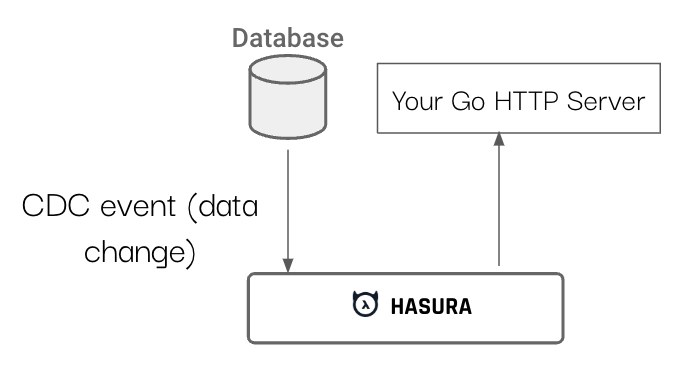
Databases like Postgres can run triggers when data changes, with Hasura event triggers we can easily call an HTTP endpoint whenever we have one of these events.
Let's send a webhook when a new user is created and print out their name.
- In the Hasura Console add a
usertable with aTextcolumnnameand the frequently usedUUIDcolumn id. - In the event trigger tab, on the
usertable, check the insert and via console trigger operations. - The event trigger payload schema can be found in the docs. We make a struct type in Go to represent this
type EventTriggerPayload[Old interface{}, New interface{}] struct {
Event struct {
SessionVariables struct {
XHasuraRole stringjson:"x-hasura-role"
}json:"session_variables"
Op stringjson:"op"
Data struct {
Old *Oldjson:"old"
New *Newjson:"new"
}json:"data"
TraceContext struct {
TraceID stringjson:"trace_id"
SpanID stringjson:"span_id"
}json:"trace_context"
}json:"event"
CreatedAt time.Timejson:"created_at"
ID stringjson:"id"
DeliveryInfo struct {
MaxRetries intjson:"max_retries"
CurrentRetry intjson:"current_retry"
}json:"delivery_info"
Trigger struct {
Name stringjson:"name"
}json:"trigger"
Table struct {
Schema stringjson:"schema"
Name stringjson:"name"
}json:"table"
} - Now we make an HTTP handler that handles the event
func NewUserHandler(w http.ResponseWriter, r *http.Request) {
var u EventTriggerPayload[interface{}, struct {
Id string
Name string
}]
err := json.NewDecoder(r.Body).Decode(&u)
if err != nil {
http.Error(w, err.Error(), http.StatusBadRequest)
return
}
fmt.Println("Hello", u.Event.Data.New.Name)
w.WriteHeader(200)
}
mux.HandleFunc("/event", event.NewUserHandler)
When you add a user in Hasura your Go server should receive the event.
Example: Querying GraphQL with Golang Client genqlient
To query a GraphQL endpoint from Go we use Khan Academy's genqlient to generate a type-safe GraphQL client.
- Download your Hasura schema
npx --yes graphqurl /v1/graphql --introspect > schema.graphql - Add your queries to
genqlient.graphql
query GetUsers {
user {
id
name
}
} - Create
genqlient.yaml
schema: schema.graphql
operations:
- genqlient.graphql
generated: generated/generated.go
use_struct_references: true
bindings:
DateTime:
type: time.Time
uuid:
type: string
Int:
type: int32
- Install and run
genqlient
go get github.com/Khan/genqlient
go run github.com/Khan/genqlient - To test if your setup is working, add a user, then query all users in the event trigger handler we created earlier
ctx := context.Background()
client := graphql.NewClient("/v1/graphql", http.DefaultClient)
resp, _ := generated.GetUsers(ctx, client)
for _, value := range resp.GetUser() {
fmt.Printf("%#v", value)
}
Summary
When developing backend applications, we may need to write custom business logic. When we use Hasura, it autogenerates most of our API but gives us escape hatches for this custom logic. We've gone over a few ways you can use the power of Go.
See the server source code on Github.
If you use Hasura and are ready to go to production, check out Hasura Cloud for a fully managed Hasura deployment.