Marie Curie and the Science of Radioactivity (original) (raw)
Making repeated separations of the various substances in the pitchblende, Marie and Pierre used the Curie electrometer to identify the most radioactive fractions. They thus discovered that two fractions, one containing mostly bismuth and the other containing mostly barium, were strongly radioactive. In July 1898 the Curies published their conclusion: the bismuth fraction contained a new element. Chemically it acted almost exactly like bismuth, but since it was radioactive, it had to be something new. They named it "polonium" in honor of the country of Marie's birth. A second publication, in December 1898, explained their discovery in the barium fraction of another new element, which they named "radium" from the Latin word for ray. The Curies were close to reaching one of the highest goals that a scientist of the time could hope to achieve--placing new elements in the Periodic Table. While the chemical properties of the two new elements were completely dissimilar, they both had strong radioactivity.
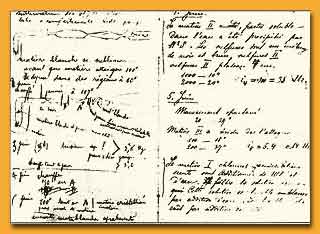 |
A page from the Curies' lab notebook of 1898. On the left, in Pierre's hand, a sublimation procedure. On the right, in Marie's hand, chemical processing. (Photo ACJC) Another picture Read the Discovery Paper in which the Curies announced the existence of Radium... |
|---|

 O CONVINCE THE SCIENTIFIC COMMUNITY of the existence of polonium and radium, and to complete the identification and establish the nature of the new elements, Marie set out to isolate them from the bismuth and barium with which they were mixed. Since the Municipal School storeroom would be inadequate to the task, the Curies moved their lab to an abandoned shed across the school courtyard. The shed, formerly a medical school dissecting room, was poorly outfitted and ventilated. It was not weathertight. She succeeded in separating the radium from the barium only with tremendous difficulty -- which would become central in the romantic legend of her life. She had to treat very large quantities of pitchblende, a ton of which the Curies received as a donation from the Austrian government. (The Austrians hoped she would find a use for a mineral their mines yielded as a waste byproduct.)
Luckily some help was available for the tedious labor of treating the pitchblende. They were able to collaborate with the Central Chemical Products Company, the firm that marketed Pierre's scientific instruments. Their colleague André Debierne cleverly adapted their standard lab techniques into larger-scale industrial processes. These processes isolated from the pitchblende materials with high concentrations of radium and polonium, which the Curies studied in detail in what she called the “miserable old shed.” In exchange for supplying chemical products and paying staff wages, the Central Chemical Products Company took a share of the radium salts extracted on its premises. The firm would later make a handsome profit by marketing these radium salts for medical and other uses.
Despite the industrial assistance the Curies received, it took Marie over three years to isolate one tenth of a gram of pure radium chloride. For reasons that would not be fully understood until the concept of radioactive decay was developed, Marie never succeeded in isolating polonium, which has a half-life of only 138 days.