Ritu Ratra - Profile on Academia.edu (original) (raw)
Papers by Ritu Ratra

International Journal of Power Electronics and Drive Systems, Oct 1, 2023
Nowadays, enormous amounts of data are produced every second. These data also contain private inf... more Nowadays, enormous amounts of data are produced every second. These data also contain private information from sources including media platforms, the banking sector, finance, healthcare, and criminal histories. Data mining is a method for looking through and analyzing massive volumes of data to find usable information. Preserving personal data during data mining has become difficult, thus privacy-preserving data mining (PPDM) is used to do so. Data perturbation is one of the several tactics used by the PPDM data privacy protection mechanism. In perturbation, datasets are perturbed in order to preserve personal information. Both data accuracy and data privacy are addressed by it. This paper will explore and compare several hybrid perturbation strategies that may be used to protect data privacy. For this, two perturbation-based techniques named improved random projection perturbation (IRPP) and enhanced principal component analysis-based technique (EPCAT) were used. These methods are employed to assess the precision, run time, and accuracy of the experimental results. This paper provides the impacts of perturbation-based privacy preserving techniques. It is observed that hybrid approaches are more efficient than the traditional approach.

Performance Analysis of Classification Techniques in Data Mining using WEKA
SSRN Electronic Journal
To place similar objects together in to one group and separate the different ones are done with t... more To place similar objects together in to one group and separate the different ones are done with the help of data mining algorithms. In the present days, retrieval of information for decision making is very crucial task. The interdisciplinary field of computer science that deals with this task is known as data mining. Data mining is used to discover the knowledge that is hidden in large volume of data stored in data repositories. So, many researchers attracted towards data mining for decision making. There are number of tools available for data mining also such as ORANGE, WEKA and KNIME etc. But whenever there is discussion of some classification model then WEKA seems as a strong data mining tool. In this paper, various machine learning algorithms of classification are analysed by using the diabetes data set. WEKA tool is used for the same purpose. The purpose of this paper is to present the comparative evaluation of WEKA classifiers in the context of diabetes dataset. These algorithms are compared by using their results calculations received on WEKA.
Privacy Preserving Data Mining: Techniques and Algorithms
International Journal of Engineering Trends and Technology

International Journal of Advanced Computer Science and Applications, 2022
In the present scenario, due to regulations of data privacy, sharing of data with other organizat... more In the present scenario, due to regulations of data privacy, sharing of data with other organization for research or any medical purpose becomes a big hindrance for different healthcare organizations. To preserve the privacy of patients seems like a crucial challenge for Healthcare Centre. Numerous techniques are used to preserve the privacy such as perturbation, anonymization, cryptography, etc. Anonymization is well known practical solution of this problem. A number of anonymization methods have been proposed by researchers. In this paper, an improved approach is proposed which is based on k-anonymity and differential privacy approaches. The purpose of proposed approach is to prevent the dataset from re-identification risk more effectively from linking attacks using generalization and suppression techniques.
International Journal of Engineering Trends and Technology, 2020
Nowadays, it is possible for every organisation to manage the large dataset at minimum cost. But ... more Nowadays, it is possible for every organisation to manage the large dataset at minimum cost. But in order to collect the fruitful information, it is mandatory to utilize the large volume of stored data. Data mining is an on-going process of searching pattern and collecting useful information from large datasets for future use. There is no doubt that Data mining is very important in various areas like education, military, e-business, healthcare etc. The main objective of data mining process is to supervise the data from various sources in different manner then assemble it to collect the useful information. It can be done by the help of various tools and techniques. There are a number of data mining tools available in the digital world that can help the researchers for the evaluation of the data. These tools work as an interface to receive the data and to extract some meaningful patterns out of large dataset. Selection of best tool according to requirement is not an easy task. In order to find out the best data mining tool for classification problem, comparison of various tools is necessary on the basis of different parameters. In this paper, data mining tools WEKA and Orange are analysed on the basis of implementation of parameters. The main objective of this comparison is to help the researchers to select the suitable tool from these two.
Mathematical Problems in Engineering, Aug 9, 2022
With the rising usage of technology, a tremendous volume of data is being produced in the current... more With the rising usage of technology, a tremendous volume of data is being produced in the current scenario. is data contains a lot of personal data and may be given to third parties throughout the data mining process. Individual privacy is extremely di cult for the data owner to protect. Privacy-Preservation in Data Mining (PPDM) o ers a solution to this problem. Encryption or anonymization have been recommended to preserve privacy in existing research. But encryption has high computing costs, and anonymization may drastically decrease the utility of data. is paper proposed a privacy-preserving strategy based on dimensionality reduction and feature selection. e proposed strategy is based on dimensionality reduction and feature selection that is di cult to reverse. e objective of this paper is to propose a perturbation-based privacy-preserving technique. Here, random projection and principal component analysis are utilized to alter the data. e main reason for this is that the dimension reduction combined with feature selection would cause the records to be perturbed more e ciently. e hybrid approach picks relevant features, decreases data dimensionality, and reduces training time, resulting in improved classi cation performance as measured by accuracy, kappa statistics, mean absolute error and other metrics. e proposed technique outperforms all other approaches in terms of classi cation accuracy increasing from 63.13 percent to 68.34 percent, proving its e ectiveness in detecting cardiovascular illness. Even in its reduced form, the approach proposed here ensures that the dataset's classi cation accuracy is improved.
Journal of emerging technologies and innovative research, 2019
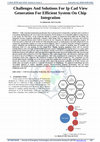
With constantly transforming specifications due to advancements in design flows and faster time t... more With constantly transforming specifications due to advancements in design flows and faster time to market, it is becoming challenging for the Very Large Scale Integration (VLSI) designers to accommodate different components in to the System On Chip (SoC). As the complexity depends on number of components being added into the design, the integration becomes singularly challenging. Computer Aided Design helps in capturing the intricacies and extensive details in an organized format which could be reused by the SoC integrator for efficient and expeditious progress. IP CAD views play a critical role in the System On Chip integration process as multi-purpose and multi voltage devices are coming into consideration together on a same yet minute platform. There is a need for innovative techniques targeted to achieve Simplified and Standardized generation process of CAD Views capable of handling huge IP portfolio and addressing needs of a big spectrum of EDA design flows. Rapidly changing te...
International Journal of Engineering and Advanced Technology, 2019
Nowadays, large volume of data is generated in the form of text, voice, video, images and sound. ... more Nowadays, large volume of data is generated in the form of text, voice, video, images and sound. It is very challenging job to handle and to get process these different types of data. It is very laborious process to analysis big data by using the traditional data processing applications. Due to huge scattered file systems, a big data analysis is a difficult task. So, to analyses the big data, a number of tools and techniques are required. Some of the techniques of data mining are used to analyze the big data such as clustering, prediction, and classification and decision tree etc. Apache Hadoop, Apache spark, Apache Storm, MongoDB, NOSQL, HPCC are the tools used to handle big data. This paper presents a review and comparative study of these tools and techniques which are basically used for Big Data analytics. A brief summary of tools and techniques is represented here.