What is Conversion Rate Optimization? (original) (raw)
Conversion Rate Optimization (CRO) is the practice of optimizing a website or digital experience to get more of your website visitors to take a specific, desired action, like purchasing a product, asking for a quote, or signing up for a service. In short, it’s optimizing your site so more users take the actions most important to your company.
This technique, also referred to as conversion optimization, is more than bringing traffic—it is a critical component of a high-performing sales funnel strategy that maximizes the value of the traffic you already have. When CRO is absent, companies tend to pay a lot for advertising or outreach without converting that attention as thoroughly as possible into customers who pay.
Website conversion rates are typically between 2% and 5%, but small increases yield huge returns. For instance, a jump from an average conversion rate of 3% to 4% represents a 33% increase in outcomes without additional marketing expenditure. That is why CRO is vital for sustainable growth.

Why Conversion Rate Optimization is Important
As of 2026, the industry’s average conversion rate remains only 2.35% to 2.9%, while optimized sites achieve 3% or higher. Even a modest lift – like shifting from 2% to 3% – is a 50% increase in conversion without additional traffic.
Channel performance also points to the same message. Direct traffic converts the highest at 3.3%, particularly in healthcare, law, and professional services. Paid search comes in at 3.2% average, varying by industry. These statistics indicate why it is as valuable to focus on converting existing traffic as it is to bring new visitors in.
The value of CRO extends beyond metrics:
- Lower customer acquisition costs.
- Higher ROI and sales without increased ad spend.
- Improved SEO through faster website performance.
- Better user experience that generates qualified leads.
Top-performing sites are distinguished by applying data-driven, personalized CRO tactics. People-centric personalization, optimized user pathways, and ongoing experimentation continually enhance conversions and form long-term trust.
Concisely, CRO fortifies ROI, mitigates dependence on ongoing traffic expansion, and makes sure your site delivers quantifiable value with each visitor.
Understanding the Conversion Rate Optimization Process
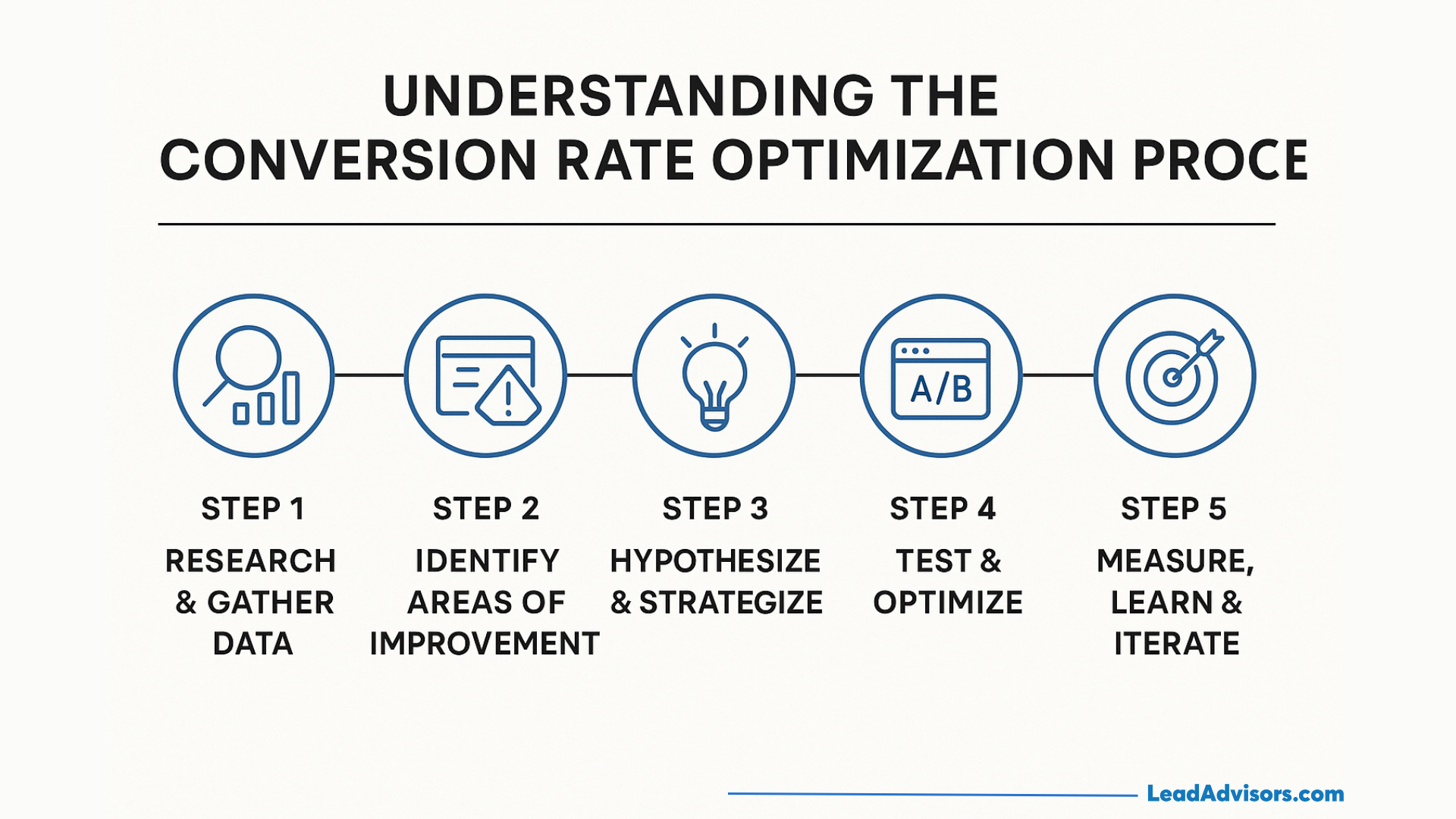
Effective CRO is not guesswork – it is a formal process aimed at turning insights into quantifiable improvements. Here’s how organizations can go about conversion optimization in steps.
Step 1 – Research & Gather Data
Each CRO project starts with data. Quantitative data (analytics, heat maps, click tracking) indicates where users are falling off, whereas qualitative insights (surveys, interviews, user feedback) provide the “why” for the actions. Bringing the two together means you can finally understand what people do and why there are obstacles to conversion.
Step 2 – Identify Areas of Improvement
Second, identify trouble areas in your conversion funnel. Search for drop-off points where customers leave forms, carts, or pages. Assess high-value areas like web pages, product pages, and landing pages to make sure they lead users towards the desired action.
Step 3 – Hypothesize & Strategize
With problems defined, develop testable hypotheses. For instance: “Including clear value propositions and customer testimonials will grow sign-ups.” Associate each concept with primary metrics such as conversion rate or bounce rate. This phase sets the roadmap to CRO success.
Step 4 – Test & Optimize
Execute well-structured experiments through A/B testing, split testing, or multivariate testing. Test a single change at a time to determine what works best. Discipline and consistency avoid false positives and provide consistent results.
Step 5 – Measure, Learn & Iterate
After tests are finished, inspect results in Google Analytics, CRO software, or free software such as Hotjar. Record lessons, then implement them in subsequent changes. CRO is an iterative process – ongoing optimization that aggregates small gains into substantial growth.
Conversion Rate Optimization (CRO) Strategies & Best Practices
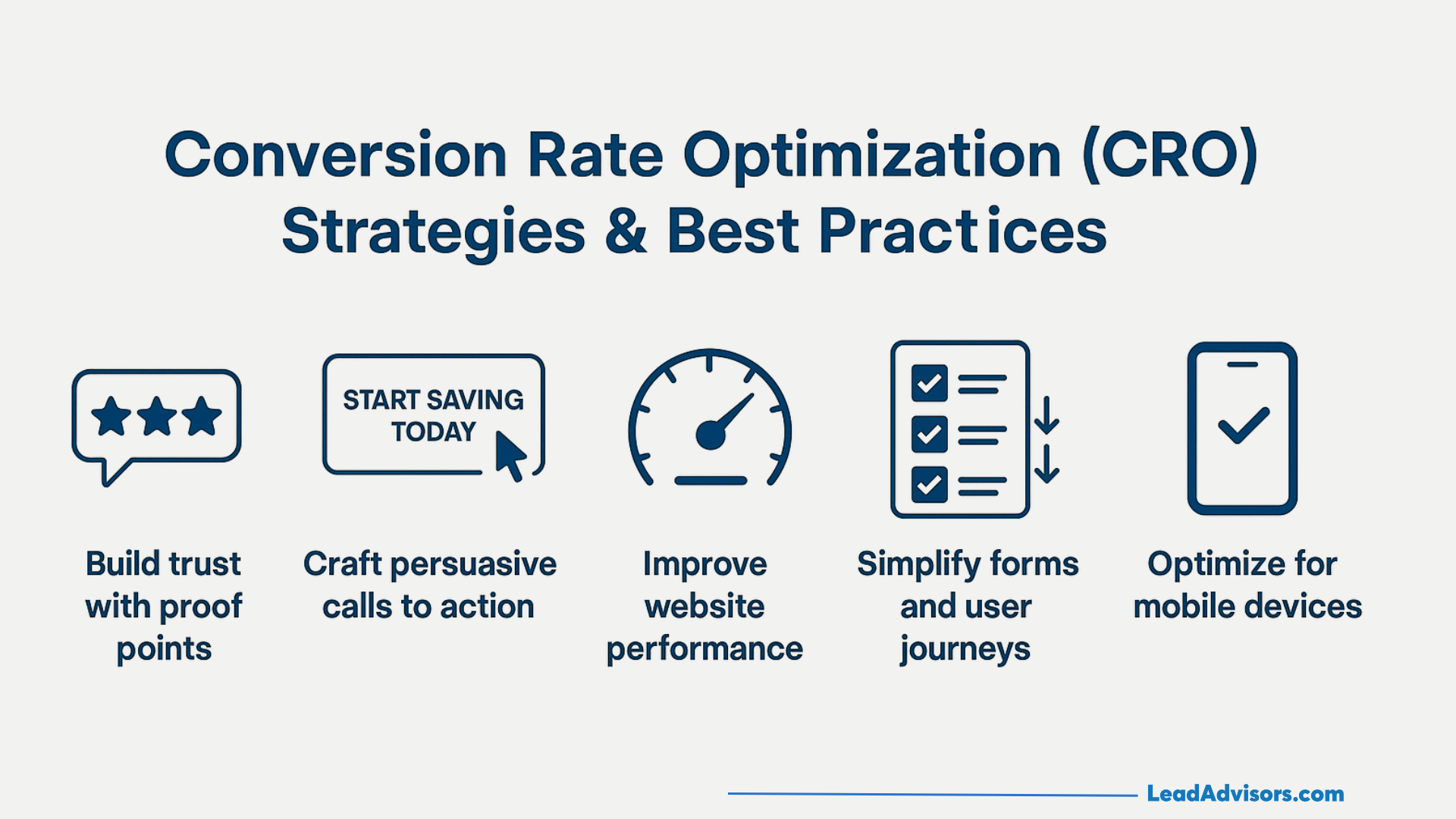
Applying the right tactics is what turns insights into measurable results. Here are some of the most successful CRO strategies businesses use to boost conversions:
- Build trust with proof points: Add customer testimonials, highlight reviews, and incorporate social proof such as user counts or case studies. Placing security badges in checkout flows reduces hesitation and builds credibility.
- Craft persuasive calls to action: Replace vague text like “Submit” with benefit-driven CTAs such as “Get My Free Guide” or “Start Saving Today.” Clear, action-focused wording encourages users to take the desired action.
- Improve website performance: Faster loading speeds and smooth navigation strengthen both trust and usability. Compress images, streamline code, and optimize pages to deliver better website performance.
- Simplify forms and user journeys: Shorten web forms to essential fields, use autofill where possible, and guide users step by step. A seamless user journey minimizes friction and prevents drop-offs.
- Optimize for mobile devices: With most browsing happening on mobile devices, adopt a user-centric approach. Ensure responsive design, fast load times, and easy-to-tap buttons for a smoother experience.
These optimization efforts don’t just enhance user experience – they also create a reliable foundation for long-term growth in conversions.
CRO for Ecommerce & Websites
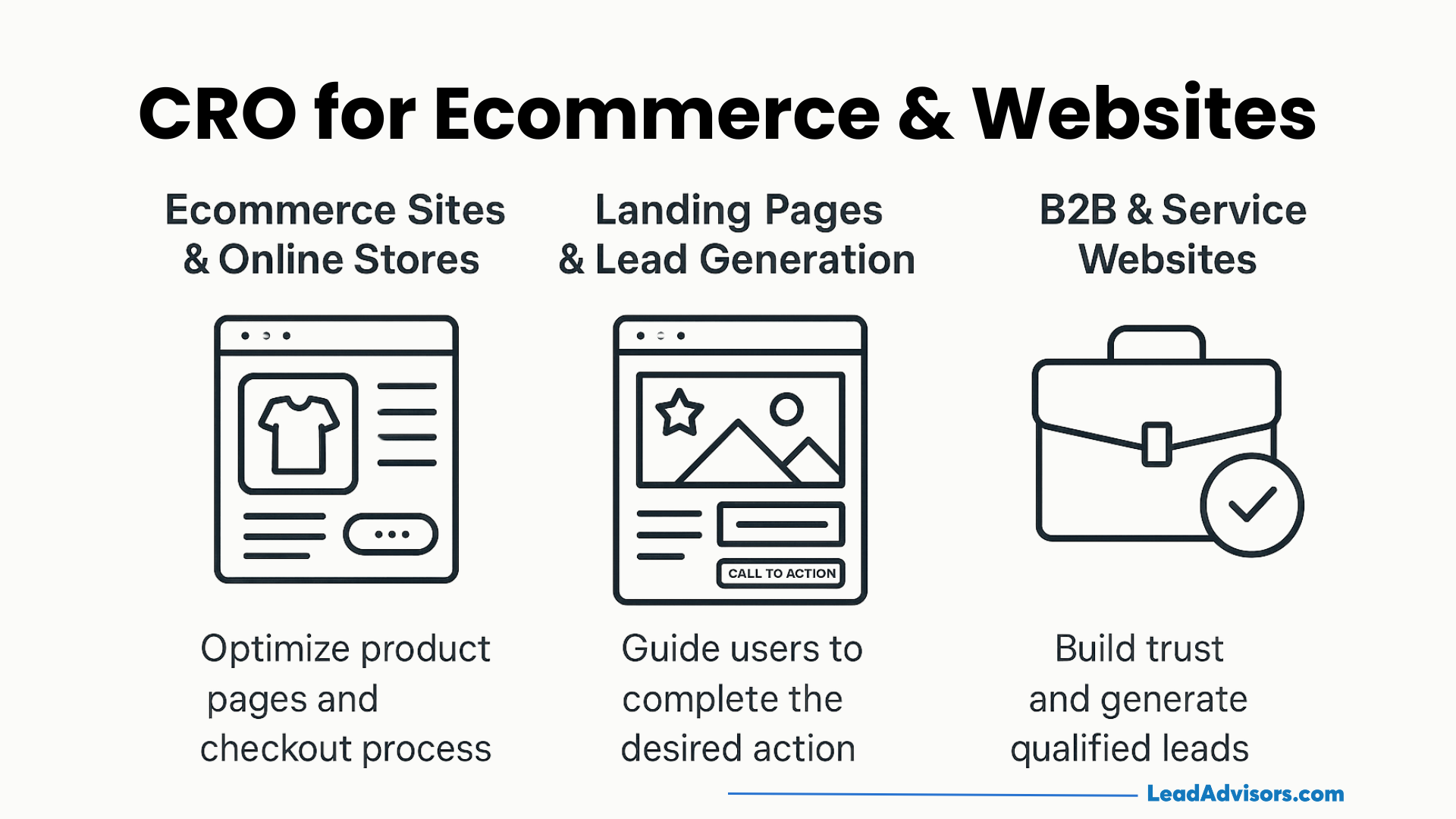
Different types of websites have unique challenges, but the principles of conversion rate optimization apply across the board. Tailoring strategies to your business model ensures you’re meeting user expectations and guiding them toward the right actions.
Ecommerce Sites & Online Stores
For ecommerce websites, optimization begins with the shopping experience. Great-performing product pages feature clear photos, open pricing, and rich product descriptions that address customer questions before they become questions, including urgency features like low-stock notifications, which also force quicker decisions.
The checkout funnel is another key area. Streamlining steps, providing guest checkout, and exposing trust indicators like security badges minimize cart abandonment and get more website traffic to make the final purchase. The focus is on optimizing product pages and the entire buying process to turn browsers into buyers.
Landing Pages & Lead Generation
Dedicated landing pages usually outperform directing traffic to an average homepage. A well-designed landing page eliminates distractions and directs users to one call to action. Top-converting pages have compelling headlines, interest-rousing visuals, and forms that gather only the necessary information.
Great CTAs such as “Schedule My Demo” or “Download Free Guide” emphasize benefits, not actions. Uncluttered designs and simple layouts enhance clarity, allowing visitors to feel assured of filling in the form.
B2B & Service Websites
For professional services and B2B businesses, CRO is about converting prospective buyers into leads created. Trust is at the center – featuring case studies, client logos, and industry certifications establishes authority.
Forms used for lead generation should be easy to use, frequently requesting only name, email address, and company in order to minimize friction. Mapping content offers, including whitepapers or consultations, onto the buyer journey nurtures website visitors into qualified leads.
CRO Tools & Technology Stack
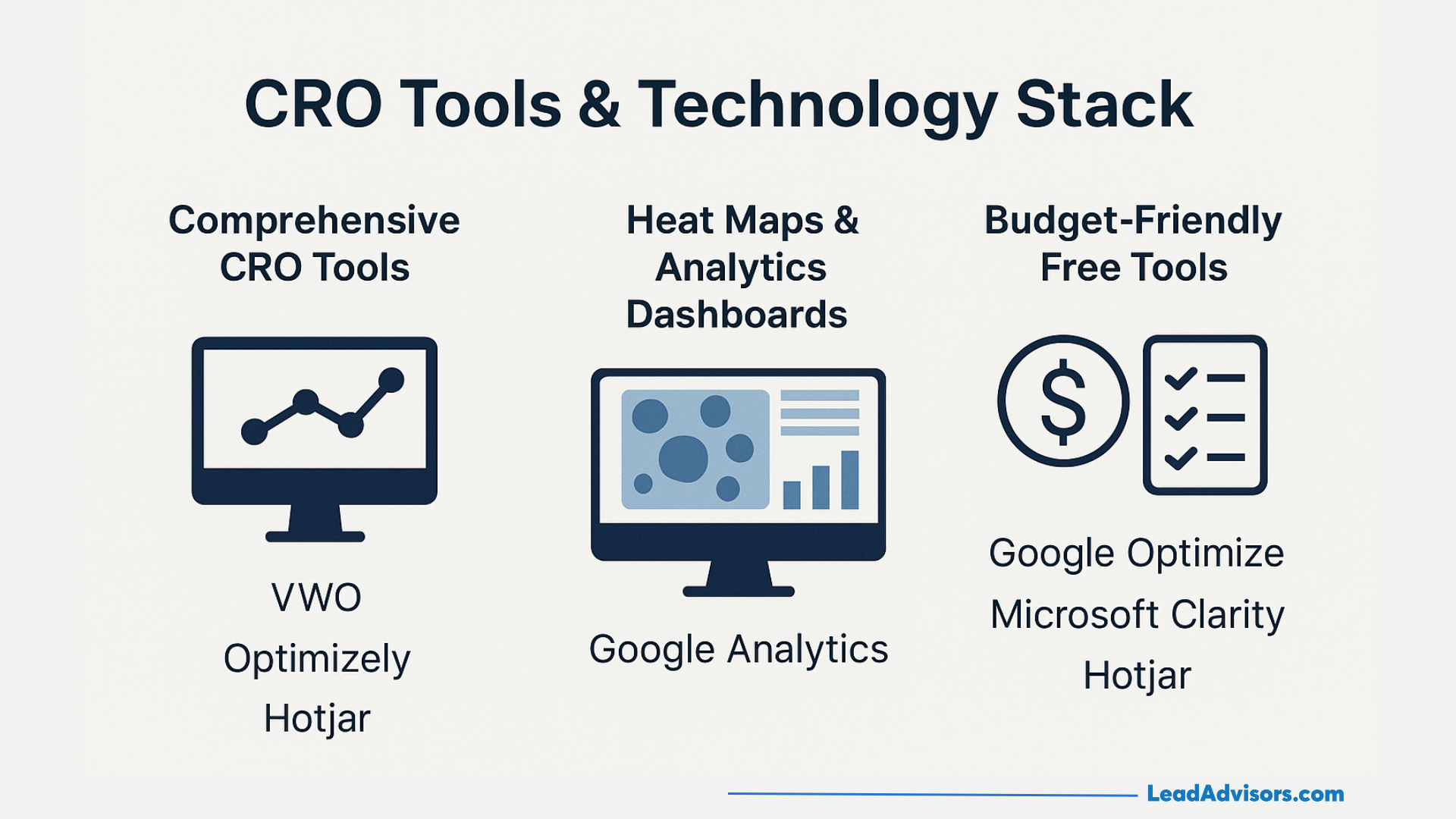
Operating a successful CRO program means having the right tools. These tools supply the high-quality data necessary to analyze performance, understand barriers, and test new strategies with confidence.
- Comprehensive CRO Tools: VWO, Optimizely, Hotjar – provide the full spectrum, from running A/B tests to visitor interaction tracking. Teams can work through managed experiments, audience segmentation, and hypothesis validation in an orderly manner.
- Heat Maps & Analytics Dashboards: Heat maps, scroll maps, and session recordings show users how visitors engage with website pages. Combined with Google Analytics, these insights point out where they click, scroll how far, and where they bail. This combined ability provides businesses with actionable insights on how to optimize funnels and page designs.
- Budget-Friendly Free Tools: Small business owners don’t have to begin with costly platforms. Google Optimize (sunset alternatives), Microsoft Clarity, and Hotjar’s free plan offer affordable entry points. Such free tools offer sufficient data to recognize patterns and experiment with improvements before expanding to sophisticated solutions.
Through the integration of strong CRO tools with regular examination, companies can discover trends in user actions, optimize designs, and implement evidence-based changes that incrementally boost conversions.
CRO & SEO: How They Work Together
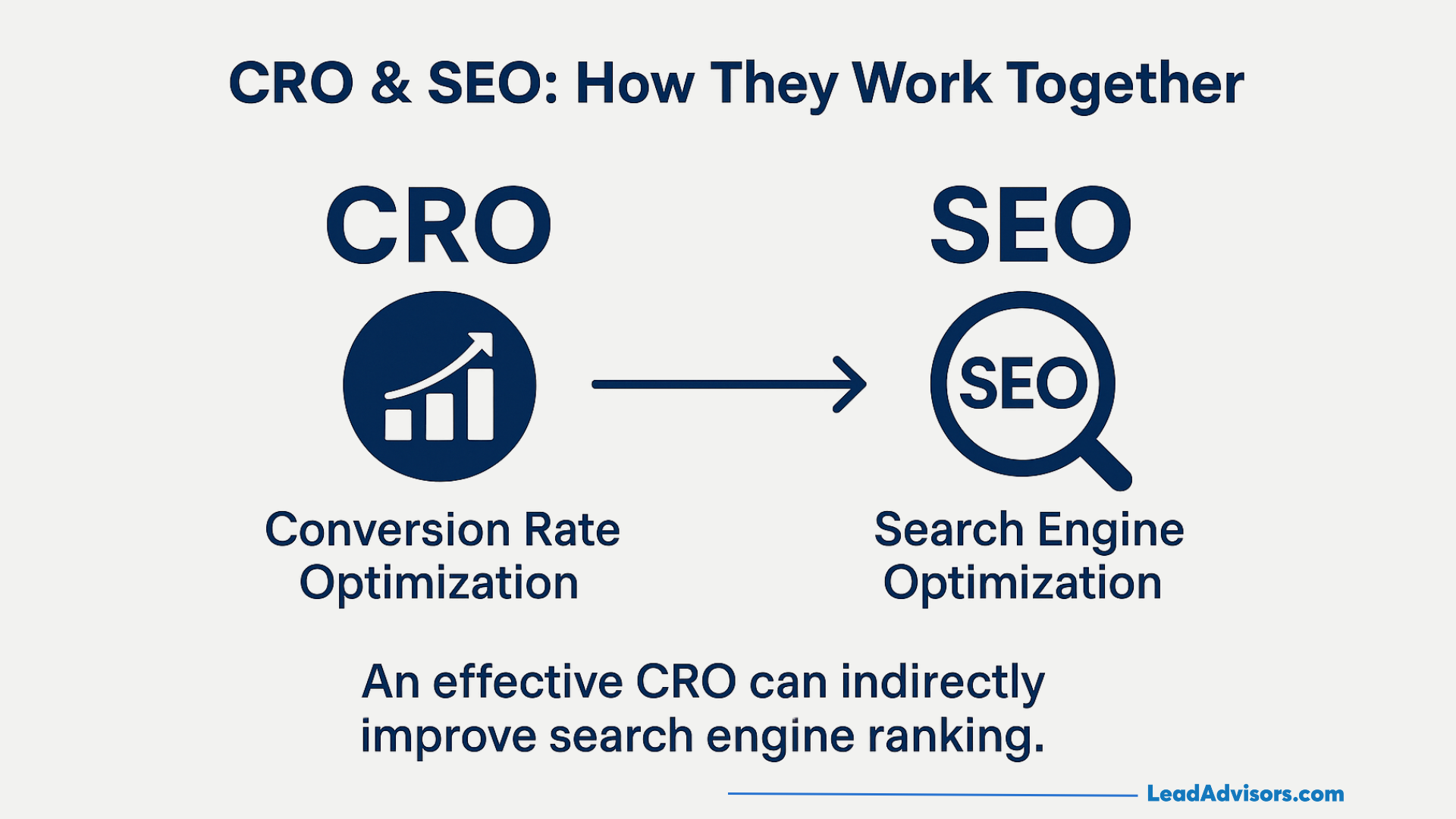
Search engines reward those sites that deliver value, and that’s where SEO CRO and CRO converge. While search engine optimization targets driving qualified traffic, conversion optimization guarantees that traffic behaves meaningfully upon landing on-site. Converging, they form a cycle that drives sustainable growth.
A good CRO has a positive indirect effect on search engine ranking. Users bounce less and engage more when pages are fast to load, navigation is easy, and what they seek is easily found. Such positive signals boost a site’s credibility and enhance overall website visibility in search results.
CRO also optimizes the return on organic traffic. Without optimization, even the most effective SEO campaigns can underperform, as website visitors won’t necessarily convert into leads or customers. Bringing conversions SEO efforts in line with CRO – like optimizing landing pages for keywords and user experience – means that every visitor is more likely to take a desired action.
For companies in digital marketing, integration is particularly important. SEO fuels discovery, CRO fuels results, and combined, they make sure your marketing investment provides visibility and revenue.
CRO Careers & Agencies
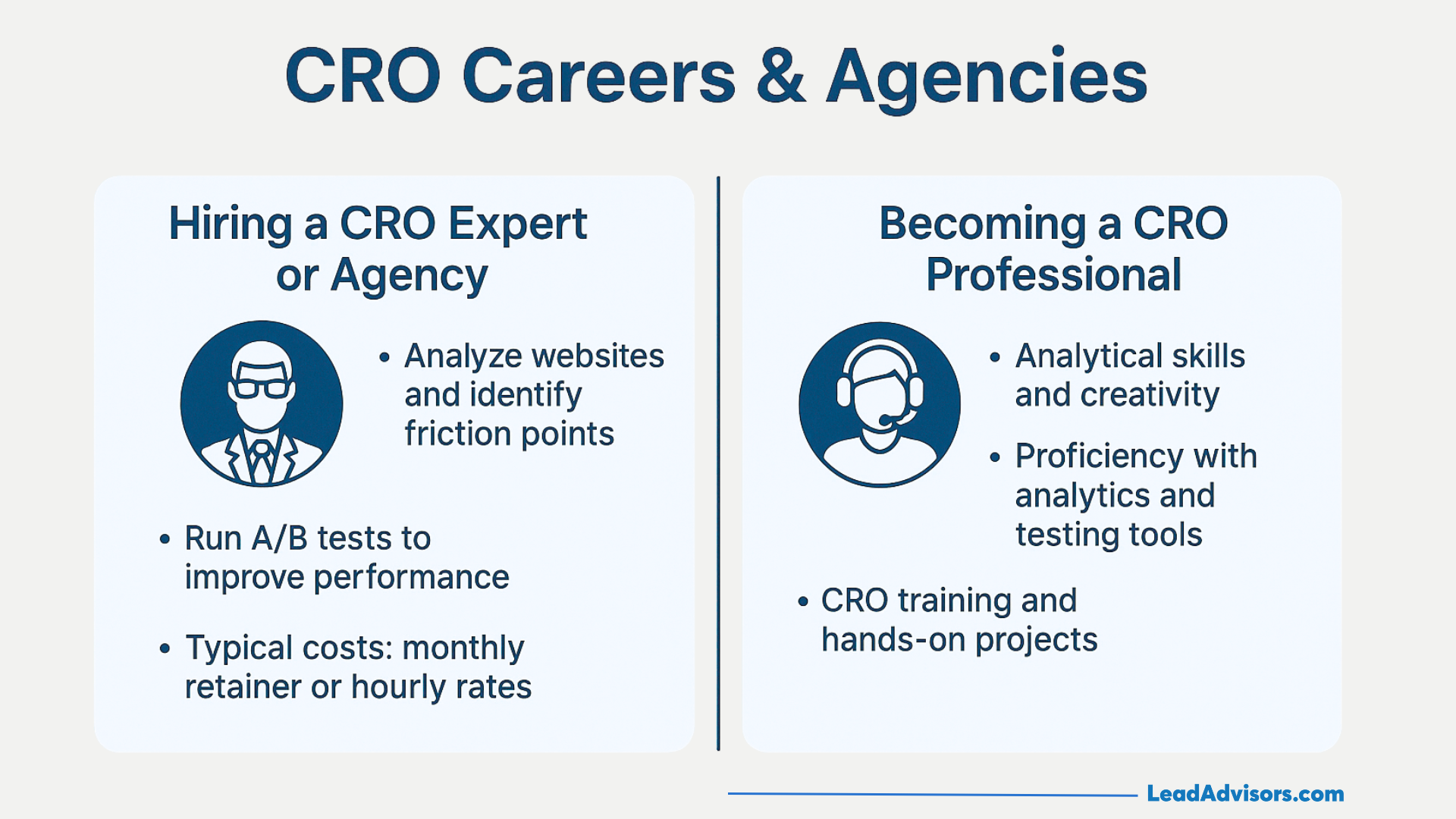
The more significant CRO becomes, the more businesses are looking to hire professional assistance, and the more professionals are looking to build careers there. Whether hiring in or working there yourself, knowing both sides of the equation is important.
Hiring a CRO Expert or Agency
A CRO expert or agency concentrates on auditing websites, finding points of friction, and executing well-planned tests to enhance performance. They blend data analysis, design wisdom, and marketing strategy to maximize performance.
In recruitment, companies usually seek established experience in A/B testing, analytics, and UX design. Fees are project-dependent, but CRO agencies normally invoice monthly retainers between a few thousand dollars and more than 10,000forfull−scaleprojects.FreelanceCROspecialistssometimesinvoiceanhourlyrate,typicallybetween10,000 for full-scale projects. Freelance CRO specialists sometimes invoice an hourly rate, typically between 10,000forfull−scaleprojects.FreelanceCROspecialistssometimesinvoiceanhourlyrate,typicallybetween75 and $200, depending on level of experience.
Partnering with the correct partner ensures your conversion rate optimization is data-driven, measurable, and business goal-aligned.
Becoming a CRO Professional
The process of becoming a conversion optimization professional combines analytical abilities with creative skills. Expertise in Google Analytics, user research, and testing tools is obligatory. A strong UX foundation, copywriting expertise, and behavioral psychology contribute to a competitive edge.
Future professionals can establish credibility through CRO training courses, certification, and project work. Others begin in adjacent professions such as digital marketing, SEO, or graphic design before specializing. Over time, it is best to demonstrate expertise by showcasing a portfolio of successful experiments.
Online courses, workshops, and mentorship courses give one an easy point of entry into a profession that is not only needed but fulfilling.
Advanced CRO Concepts
As online competition intensifies, companies are breaking past the level of form adjustments and A/B testing. New conversion rate optimization employs sophisticated strategies to provide customized, scalable outcomes.
- Personalization & AI-Driven CRO: With machine learning technology now available, websites can customize experiences based on individual website visitors. AI can suggest products, alter layouts, or provide messaging based on current behavior, enhancing engagement and increasing conversions.
- Dynamic Content Testing: Rather than fixed landing pages, companies are trying out dynamic components that modify depending on user segments. For instance, an online store might display a discount promotion, whereas repeat customers notice loyalty rewards.
- CRO for Mobile Apps & Emerging Tech: With mobile consumption taking center stage in online activity, mobile app optimization is key. Simplified onboarding, seamless payment methods, and easy navigation reflect CRO best practices from web to mobile. New platforms such as voice search and AR shopping also require specific testing and conversion rate optimization strategies.
- Case Studies in Action: SaaS businesses typically experiment with various value propositions on pricing pages, whereas ecommerce businesses experiment with variations of product pages and checkout flows. These real-case scenarios demonstrate that incremental gains can result in quantifiable lifts in sign-ups, purchases, and customer retention.
If companies adopt cutting-edge CRO strategies, they remain one step ahead of evolving user needs and create scalable models for sustainable growth.
How to Measure CRO Success
Having a sense of whether your optimization work is paying off depends on monitoring the correct key elements and key metrics. Conversion rate optimization success isn’t about making arbitrary changes – it’s about measuring effects and employing evidence to inform the next move.
- Defining Key Metrics: The key indicators are the conversion rate of the website, the bounce rate, the average order value, and the lead quality. Keeping an eye on these, in conjunction with revenue, assists in attributing a tangible number to your optimization efforts.
- How to Calculate Conversion Rate: The formula is simple:

It is easy to calculate:
For instance, if 200 sales result from 10,000 visits, the site’s conversion rate is 2%. By monitoring this benchmark, you can observe new test effects. - Benchmarking Performance: As of 2026, the industry average conversion rate is 2.35% to 2.9%. Benchmarking your performance against these averages indicates whether your website is under or above par.
- Beyond the Numbers: CRO also relies on qualitative indicators. Watching how users behave, noting where users drop out of the funnel, and ongoing optimization guarantee your changes stick.
Through ongoing measurement of results and iteration, companies can make strategic improvements and create a repeatable process for expansion.