Efficacy of the lithotripsy in treating lower pole renal stones (original) (raw)
Abstract
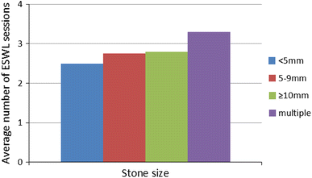
Use of extracorporeal lithotripsy is declining in North America and many European countries despite international guidelines advocating it as a first-line therapy. Traditionally, lithotripsy is thought to have poor efficacy at treating lower pole renal stones. We evaluated the success rates of lithotripsy for lower pole renal stones in our unit. 50 patients with lower pole kidney stones ≤15 mm treated between 3/5/11 and 19/4/12 were included in the study. Patients received lithotripsy on a fixed-site Storz Modulith SLX F2 lithotripter according to a standard protocol. Clinical success was defined as stone-free status or asymptomatic clinically insignificant residual fragments (CIRFs) ≤3 mm at radiological follow-up. The mean stone size was 7.8 mm. The majority of stones (66 %) were between 5 and 10 mm. 28 % of stones were between 10 and 15 mm. For solitary lower pole stones complete stone clearance was achieved in 63 %. Total stone clearance including those with CIRFs was achieved in 81 % of patients. As expected, for those with multiple lower pole stones the success rates were lower: complete clearance was observed in 39 % and combined clearance including those with CIRFs was 56 %. Overall, complete stone clearance was observed in 54 % of patients and clearance with CIRFs was achieved in 72 % of patients. Success rate could not be attributed to age, stone size or gender. Our outcome data for the treatment of lower pole renal stones (≤15 mm) compare favourably with the literature. With this level of stone clearance, a non-invasive, outpatient-based treatment like lithotripsy should remain the first-line treatment option for lower pole stones. Ureteroscopy must prove that it is significantly better either in terms of clinical outcome or patient satisfaction to justify replacing lithotripsy.
Access this article
Subscribe and save
- Starting from 10 chapters or articles per month
- Access and download chapters and articles from more than 300k books and 2,500 journals
- Cancel anytime View plans
Buy Now
Price excludes VAT (USA)
Tax calculation will be finalised during checkout.
Instant access to the full article PDF.
Fig. 1
The alternative text for this image may have been generated using AI.
References
- Cortes JA, Motamedinia P, Gupta M (2011) Update on technological and selection factors influencing shockwave lithotripsy of renal stones in adults and children. Curr Opin Urol 21(2):134–140. doi:10.1097/MOU.0b013e3283435c1f
Article PubMed Google Scholar - Lin CC, Hsu YS, Chen KK (2008) Predictive factors of lower calyceal stone clearance after extracorporeal shockwave lithotripsy (ESWL): the impact of radiological anatomy. J Chin Med Assoc 71(10):496–501. doi:10.1016/S1726-4901(08)70157-6
Article PubMed Google Scholar - Talas H, Kilic O, Tangal S, Safak M (2007) Does lower-pole caliceal anatomy predict stone clearance after shock wave lithotripsy for primary lower-pole nephrolithiasis? Urol Int 79(2):129–132. doi:10.1159/000106325
Article PubMed Google Scholar - Albala D, Assimos D, Clayman R, Denstedt J, Grasso M, Gutierrez-Aceves J et al (2001) Lower pole I: a prospective randomized trial of extracorporeal shock wave lithotripsy and percutaneous nephrostolithotomy for lower pole nephrolithiasis-initial results. J Urol 166(6):2072–2080. doi:10.1097/00005392-200112000-00014
Article PubMed CAS Google Scholar - Pearle MS, Lingeman JE, Leveillee R, Kuo R, Preminger GM, Nadler RB et al (2005) Prospective randomized trial comparing shock wave lithotripsy and ureteroscopy for lower pole caliceal calculi 1 cm or less. J Urol 173(6):2005–2009. doi:10.1097/01.ju.0000158458.51706.56
Article PubMed Google Scholar - Sumino Y, Mimata H, Tasaki Y, Ohno H, Hoshino T, Nomura T et al (2002) Predictors of lower pole renal stone clearance after extracorporeal shock wave lithotripsy. J Urol 168(4):1344–1347. doi:10.1097/00005392-200210010-00009
Article PubMed Google Scholar - Chiong E, Hwee ST, Kay LM, Liang S, Kamaraj R, Esuvaranathan K (2005) Randomized controlled study of mechanical percussion, diuresis, and inversion therapy to assist passage of lower pole renal calculi after shock wave lithotripsy. Urology 65(6):1070–1074. doi:10.1016/j.urology.2004.12.045
Article PubMed Google Scholar - Turk C, Knoll T, Petrik A, Sarica K, Straub M, Seitz C, eds (2012) Guidelines on urolithiasis. 27th Annual EAU Congress, Paris
- Preminger G (2006) Management of lower pole renal calculi: shock wave lithotripsy versus percutaneous nephrolithotomy versus flexible ureteroscopy. Urol Res 34(2):108–111. doi:10.1007/s00240-005-0020-6
Article PubMed Google Scholar - Havel D, Saussine C, Fath C, Lang H, Faure F, Jacqmin D (1998) Single stones of the lower pole of the kidney. Eur Urol 33(4):396–400. doi:10.1159/000019623
Article PubMed CAS Google Scholar - Drăguţescu M, Mulţescu R, Geavlete B, Mihai B, Ceban E, Geavlete P (2012) Impact of obesity on retrograde ureteroscopic approach. J Med Life 5(2):222–225
PubMed Google Scholar - Handa RK, McAteer JA, Connors BA, Liu Z, Lingeman JE, Evan AP (2012) Optimising an escalating shockwave amplitude treatment strategy to protect the kidney from injury during shockwave lithotripsy. BJU Int 110:E1041–E1047. doi:10.1111/j.1464-410X.2012.11207.x
Article PubMed Google Scholar - Marsdin E, Noble JG, Reynard JM, Turney BW (2012) Audiovisual distraction reduces pain perception during shockwave lithotripsy. J Endourol 26(5):531–534. doi:10.1089/end.2011.0430
Article PubMed Google Scholar - Chaussy C, Schmiedt E, Jocham D, Schüller J, Liedl B (1984) Extracorporeal shock-wave lithotripsy (ESWL) for treatment of urolithiasis. Urology 23(5, Suppl):59–66. doi:10.1016/0090-4295(84)90243-7
Article PubMed CAS Google Scholar - Preminger G, Tiselius H, Assimos D, Alken P, Buck C, Gallucci M et al (2007) 2007 Guideline for the management of ureteral calculi. J Urol 178(6):2418–2434. doi:10.1016/j.juro.2007.09.107
Article PubMed Google Scholar - Turney BW, Reynard JM, Noble JG, Keoghane SR (2011) Trends in urological stone disease. BJU Int 109(7):1082–1087. doi:10.1111/j.1464-410X.2011.10495.x
Article PubMed Google Scholar - Pearle M, Lingeman J, Leveillee R, Kuo R, Preminger G, Nadler R et al (2005) Prospective, randomized trial comparing shock wave lithotripsy and ureteroscopy for lower pole caliceal calculi 1 cm or less. J Urol 173(6):2005–2009. doi:10.1097/01.ju.0000158458.51706.56
Article PubMed Google Scholar - El-Nahas AR, Ibrahim HM, Youssef RF, Sheir KZ (2012) Flexible ureterorenoscopy versus extracorporeal shock wave lithotripsy for treatment of lower pole stones of 10–20 mm. BJU Int 110(6):898–902. doi:10.1111/j.1464-410X.2012.10961.x
Article PubMed Google Scholar - Matlaga BR, Jansen JP, Meckley LM, Byrne TW, Lingeman JE (2012) Economic outcomes of treatment for ureteral and renal stones: a systematic literature review. J Urol 188(2):449–454. doi:10.1016/j.juro.2012.04.008
Article PubMed Google Scholar - Koo V, Young M, Thompson T, Duggan B (2011) Cost-effectiveness and efficiency of shockwave lithotripsy vs flexible ureteroscopic holmium:yttrium-aluminium-garnet laser lithotripsy in the treatment of lower pole renal calculi. BJU Int 108(11):1913–1916. doi:10.1111/j.1464-410X.2011.10172.x
Article PubMed Google Scholar - Khaitan A, Gupta NP, Hemal AK, Dogra PN, Seth A, Aron M (2002) Post-ESWL, clinically insignificant residual stones: reality or myth? Urology 59(1):20–24. doi:10.1016/S0090-4295(01)01494-7
Article PubMed Google Scholar - Delvecchio FC, Preminger GM (2000) Management of residual stones. Urol Clin North Am 27(2):347–354. doi:10.1016/S0094-0143(05)70263-9
Article PubMed CAS Google Scholar - Alanee S, Ugarte R, Monga M (2010) The effectiveness of shock wave lithotripters: a case matched comparison. J Urol 184(6):2364–2367. doi:10.1016/j.juro.2010.08.023
Article PubMed Google Scholar
Acknowledgments
We would like to thank Jackie Redgwell, Fiona Barber, Mandy Spencer and Paul Martin for help with collection of data for this study and delivering the lithotripsy service.
Conflict of interest
The authors declare that they have no conflict of interest.
Author information
Authors and Affiliations
- The Oxford Stone Group, The Churchill Hospital, Oxford, OX3 7LF, UK
Helen Cui, Eeke Thomee, Jeremy G. Noble, John M. Reynard & Benjamin W. Turney - Department of Urology, Nuffield Department of Surgical Sciences, University of Oxford, Churchill Hospital, Oxford, OX3 7LJ, UK
Helen Cui
Authors
- Helen Cui
- Eeke Thomee
- Jeremy G. Noble
- John M. Reynard
- Benjamin W. Turney
Corresponding author
Correspondence toHelen Cui.
Rights and permissions
About this article
Cite this article
Cui, H., Thomee, E., Noble, J.G. et al. Efficacy of the lithotripsy in treating lower pole renal stones.Urolithiasis 41, 231–234 (2013). https://doi.org/10.1007/s00240-013-0549-8
- Received: 23 October 2012
- Accepted: 16 February 2013
- Published: 03 March 2013
- Issue date: June 2013
- DOI: https://doi.org/10.1007/s00240-013-0549-8