Hexavalent chromium reduction in Desulfovibrio vulgaris Hildenborough causes transitory inhibition of sulfate reduction and cell growth (original) (raw)
Abstract
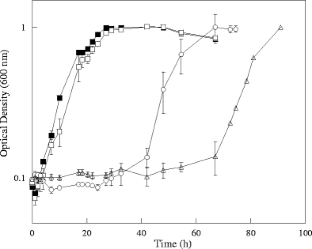
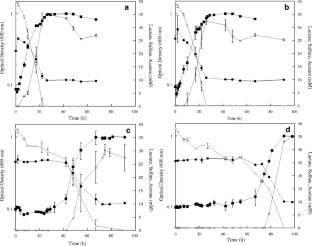
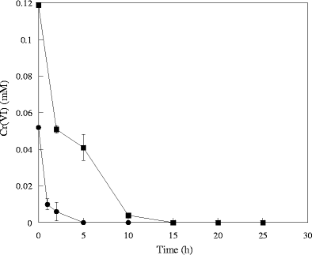
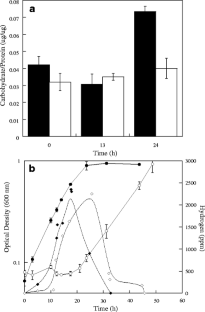
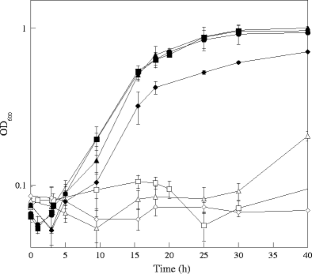
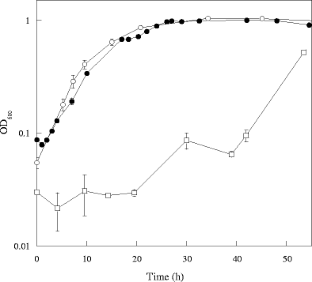
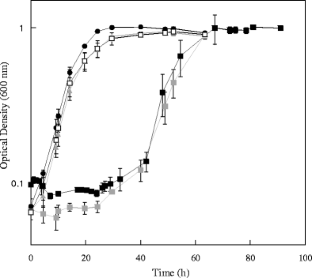
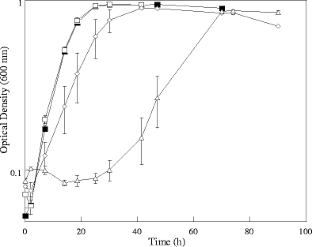
Desulfovibrio vulgaris Hildenborough is a well-studied sulfate reducer that can reduce heavy metals and radionuclides [e.g., Cr(VI) and U(VI)]. Cultures grown in a defined medium had a lag period of approximately 30 h when exposed to 0.05 mM Cr(VI). Substrate analyses revealed that although Cr(VI) was reduced within the first 5 h, growth was not observed for an additional 20 h. The growth lag could be explained by a decline in cell viability; however, during this time small amounts of lactate were still utilized without sulfate reduction or acetate formation. Approximately 40 h after Cr exposure (0.05 mM), sulfate reduction occurred concurrently with the accumulation of acetate. Similar amounts of hydrogen were produced by Cr-exposed cells compared to control cells, and lactate was not converted to glycogen during non-growth conditions. D. vulgaris cells treated with a reducing agent and then exposed to Cr(VI) still experienced a growth lag, but the addition of ascorbate at the time of Cr(VI) addition prevented the lag period. In addition, cells grown on pyruvate displayed more tolerance to Cr(VI) compared to lactate-grown cells. These results indicated that D. vulgaris utilized lactate during Cr(VI) exposure without the reduction of sulfate or production of acetate, and that ascorbate and pyruvate could protect D. vulgaris cells from Cr(VI)/Cr(III) toxicity.
Access this article
Subscribe and save
- Starting from 10 chapters or articles per month
- Access and download chapters and articles from more than 300k books and 2,500 journals
- Cancel anytime View plans
Buy Now
Price excludes VAT (USA)
Tax calculation will be finalised during checkout.
Instant access to the full article PDF.
Fig. 1
The alternative text for this image may have been generated using AI.
Fig. 2
The alternative text for this image may have been generated using AI.
Fig. 3
The alternative text for this image may have been generated using AI.
Fig. 4
The alternative text for this image may have been generated using AI.
Fig. 5
The alternative text for this image may have been generated using AI.
Fig. 6
The alternative text for this image may have been generated using AI.
Fig. 7
The alternative text for this image may have been generated using AI.
Fig. 8
The alternative text for this image may have been generated using AI.
References
- ATSDR (2004) Toxicological Profile for Chromium; Agency for Toxic Substances and Disease Registry: Atlanta, GA
- Bencheike-Latmani R, Obraztsova A, Mackey MR, Ellisman MH, Tebo BM (2007) Toxicity of Cr(III) to Shewanella sp. strain MR-4 during Cr(VI) reduction. Environ Sci Technol 41:214–220
Article Google Scholar - Chang IS, Groh JL, Ramsey MM, Ballard JD, Krumholz LR (2004) Differential expression of Desulfovibrio vulgaris genes in response to Cu(II) and Hg(II) toxicity. Appl Environ Microbiol 70:1847–1851
Article CAS Google Scholar - Chaplin MF (1986) Monosaccharides. In: Chaplin MF, Kennedy JF (eds) Carbohydrate analysis. IRL, Oxford, pp 1–2
Google Scholar - Chardin B, Dolla A, Chaspoul F, Fardeau ML, Gallice P, Bruschi M (2002) Bioremediation of chromate: thermodynamic analysis of the effects of Cr(VI) on sulfate-reducing bacteria. Appl Microbiol Biotechnol 60:352–360
Article CAS Google Scholar - Chardin B, Giudici-Orticoni MT, De Luca G, Guigliarelli B, Bruschi M (2003) Hydrogenases in sulfate-reducing bacteria function as chromium reductase. Appl Microbiol Biotechnol 63:315–321
Article CAS Google Scholar - Cheung KH, Gu JD (2007) Mechanism of hexavalent chromium detoxification by microorganisms and bioremediation application potential: a review. Int Biodeterior Biodegrad 59:8–15
Article CAS Google Scholar - Clark ME, He Q, He Z, Alm EJ, Huang KH, Hazen TC, Arkin AP, Wall JD, Zhou J, Fields MW (2006) Temporal transcriptomic analyses of Desulfovibrio vulgaris Hildenborough during electron donor depletion. Appl Environ Microbiol 72:5578–5588
Article CAS Google Scholar - Elias DA, Suflita JM, McInerney MJ, Krumholz LR (2004) Periplasmic cytochrome c3 of Desulfovibrio vulgaris is directly involved in H2-mediated metal but not sulfate reduction. Appl Environ Microbiol 70:413–420
Article CAS Google Scholar - Goulhen F, Gloter A, Guyot F, Bruschi M (2006) Cr(VI) detoxification by Desulfovibrio vulgaris strain Hildenborough: microbe–metal interaction studies. Appl Microbiol Biotechnol 71:892–897
Article CAS Google Scholar - He Q, Huang KH, He Z, Alm EJ, Fields MW, Hazen TC, Arkin AK, Wall JD, Zhou J (2006) Energetic consequences of nitrite stress in Desulfovibrio vulgaris Hildenborough inferred from global transcriptional analysis. Appl Environ Microbiol 72:4370–4438
Article Google Scholar - Heidelberg JF, Seshadri R, Haveman SA, Hemme CL, Paulsen IT et al (2004) The genome sequence of the anaerobic, sulfate-reducing bacterium Desulfovibrio vulgaris Hildenborough. Nat Biotechnol 22:554–559
Article CAS Google Scholar - Iwamoto T, Nasu M (2001) Current bioremediation practice and perspective. J Biosci Bioeng 92:1–8
Article CAS Google Scholar - Lovley DR, Phillips EJ (1994) Reduction of chromate by Desulfovibrio vulgaris and its c(3) cytochrome. Appl Environ Microbiol 60:726–728
Article CAS Google Scholar - Mabbett AN, Lloyd JR, Macaskie LE (2002) Effects of complexing agents on the reduction of Cr(VI) by Desulfovibrio vulgaris ATCC 29579. Biotechnol Bioeng 79:389–397
Article CAS Google Scholar - Postgate J (1984) The sulfate-reducing bacteria, 2nd edn. Cambridge University Press, Cambridge
Google Scholar - Pourbaix M (1966) Atlas of electrochemical equilibria in aqueous solutions. Pergamon, Oxford, UK
Google Scholar - Puzon GJ, Petersen JN, Roberts AG, Kramer DM, Xun L (2002) A bacterial flavin reductase system reduces chromate to a soluble chromium(III)–NAD+ complex. Biochem Biophys Res Comm 294:76–81
Article CAS Google Scholar - Puzon GJ, Roberts AG, Kramer DM, Xun L (2005) Formation of soluble organo-chromium(III) complexes after chromate reduction in the presence of cellular organics. Environ Sci Technol 39:2811–2817
Article CAS Google Scholar - Riley RG and Zachara JM (1992) Chemical contaminants on DOE lands and selection of contaminant mixtures for subsurface science research. DOE/ER-0547T, DE92 014826; http://www.lbl.gov/ERSP/generalinfo/primers_guides/Riley-Zachara1992.pdf
- Santos H, Fareleira P, Xavier AV, Chen L, Liu MY, LeGall J (1993) Aerobic metabolism of carbon reserves by the obligate anaerobe Desulfovibrio gigas. Biochem Biophys Res Comm 195:551–557
Article CAS Google Scholar - Stearns DM, Kennedy LJ, Courtney KD, Giangrande PH, Phieffer LS, Wetterhahn KE (1995) Reduction of chromium(V1) by ascorbate leads to chromium–DNA binding and DNA strand breaks in vitro. Biochem 34:910–919
Article CAS Google Scholar - Sugden KD (2000) Formation of modified cleavage termini from the reaction of chromium(V) with DNA. J Inorg Biochem 77:177–183
Article Google Scholar - Traore AS, Hatchikian CE, Belaich JP, LeGall J (1981) Microcalorimetric studies of the growth of sulfate-reducing bacteria: energetics of Desulfovibrio vulgaris growth. J Bacteriol 145:191–199
Article CAS Google Scholar - Vasant C, Balamurugan K, Rajaram R, Ramasami T (2001) Apoptosis of lymphocytes in the presence of Cr(V) complexes: role in Cr(VI)-induced toxicity. Biochem Biophys Res Commun 285:1354–1360
Article CAS Google Scholar - Viamajala S, Peyton BM, Apel WA, Petersen JN (2002) Chromate/nitrite interactions in Shewanella oneidensis MR-1: evidence for multiple hexavalent chromium [Cr(VI)] reduction mechanisms dependent on physiological growth conditions. Biotechnol Bioeng 78:770–778
Article CAS Google Scholar
Acknowledgments
The research was supported by the United States Department of Energy, Office of Science under the Environmental Remediation Science Program (DOE-ER64125) and the Genomics Program: GTL through contract DE-AC02-05CH11231 between Lawrence Berkeley National Laboratory and the U. S. Department of Energy. In addition, BJG and JDW were supported through the DOE Office of Basic Energy Sciences grant DE-FG02-87ER13713.
Author information
Author notes
- A. Klonowska
Present address: Laboratoire des Symbioses Tropicales et Méditerranéennes, Institut de Recherche pour le Développement, UMR 113, Montpellier, France
Authors and Affiliations
- Department of Microbiology, Miami University, Oxford, OH, USA
A. Klonowska, M. E. Clark & S. B. Thieman - Center for Biofilm Engineering, Montana State University, 366 EPS Bldg, Bozeman, MT, 59717, USA
M. E. Clark & M. W. Fields - Department of Biochemistry, University of Missouri, Columbia, MO, USA
B. J. Giles & J. D. Wall - Department of Molecular Microbiology & Immunology, University of Missouri, Columbia, MO, USA
J. D. Wall - Department of Microbiology, Montana State University, Bozeman, MT, USA
M. W. Fields
Authors
- A. Klonowska
- M. E. Clark
- S. B. Thieman
- B. J. Giles
- J. D. Wall
- M. W. Fields
Corresponding author
Correspondence toM. W. Fields.
Additional information
J.D. Wall and M.W. Fields are both affiliated to the Virtual Institute of Microbial Stress and Survival (http://vimss.lbl.gov/).
M.E. Clark and S.B. Thieman contributed equally to this work.
Rights and permissions
About this article
Cite this article
Klonowska, A., Clark, M.E., Thieman, S.B. et al. Hexavalent chromium reduction in Desulfovibrio vulgaris Hildenborough causes transitory inhibition of sulfate reduction and cell growth.Appl Microbiol Biotechnol 78, 1007–1016 (2008). https://doi.org/10.1007/s00253-008-1381-x
- Received: 14 November 2007
- Revised: 07 January 2008
- Accepted: 18 January 2008
- Published: 01 April 2008
- Issue date: April 2008
- DOI: https://doi.org/10.1007/s00253-008-1381-x