Shifts in caterpillar biomass phenology due to climate change and its impact on the breeding biology of an insectivorous bird (original) (raw)
Abstract
Timing of reproduction has major fitness consequences, which can only be understood when the phenology of the food for the offspring is quantified. For insectivorous birds, like great tits (Parus major), synchronisation of their offspring needs and abundance of caterpillars is the main selection pressure. We measured caterpillar biomass over a 20-year period and showed that the annual peak date is correlated with temperatures from 8 March to 17 May. Laying dates also correlate with temperatures, but over an earlier period (16 March – 20 April). However, as we would predict from a reliable cue used by birds to time their reproduction, also the food peak correlates with these temperatures. Moreover, the slopes of the phenology of the birds and caterpillar biomass, when regressed against the temperatures in this earlier period, do not differ. The major difference is that due to climate change, the relationship between the timing of the food peak and the temperatures over the 16 March – 20 April period is changing, while this is not so for great tit laying dates. As a consequence, the synchrony between offspring needs and the caterpillar biomass has been disrupted in the recent warm decades. This may have severe consequences as we show that both the number of fledglings as well as their fledging weight is affected by this synchrony. We use the descriptive models for both the caterpillar biomass peak as for the great tit laying dates to predict shifts in caterpillar and bird phenology 2005–2100, using an IPCC climate scenario. The birds will start breeding earlier and this advancement is predicted to be at the same rate as the advancement of the food peak, and hence they will not reduce the amount of the current mistiming of about 10 days.
Access this article
We’re sorry, something doesn't seem to be working properly.
Please try refreshing the page. If that doesn't work, please contact support so we can address the problem.
Fig. 1
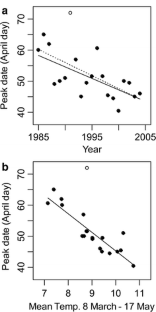
The alternative text for this image may have been generated using AI.
Fig. 2

The alternative text for this image may have been generated using AI.
Fig. 3

The alternative text for this image may have been generated using AI.
Fig. 4

The alternative text for this image may have been generated using AI.
References
- Beebee TJC (1995) Amphibian breeding and climate. Nature 374:219–220
Article CAS Google Scholar - Both C, Visser ME (2005) The effect of climate change on the correlation between avian life-history traits. Global Change Biol 11:1606–1613
Article Google Scholar - Brown JL, Li SH, Bhagabati N (1999) Long-term trend toward earlier breeding in an American bird: A response to global warming? Proc Natl Acad Sci USA 96:5565–5569
Article PubMed CAS Google Scholar - Crick HQP, Dudley C, Glue DE, Thomson DL (1997) UK birds are laying eggs earlier. Nature 388:526–526
Article CAS Google Scholar - Daan S, Dijkstra C, Tinbergen JM (1990) Family planning in the kestrel (Falco tinnunculus) – the ultimate control of covariation of laying date and clutch size. Behaviour 114:83–116
Google Scholar - Dias PC, Blondel J (1996) Breeding time, food supply and fitness components of Blue Tits Parus caeruleus in Mediterranean habitats. Ibis 138:644–649
Google Scholar - Durant JM, Anker-Nilssen T, Stenseth NC (2003) Trophic interactions under climate fluctuations: the Atlantic puffin as an example. Proc R Soc Lond Ser B Biol Sci 270:1461–1466
Article Google Scholar - Esch M (2005) ECHAM4_OPYC_SRES_B2: 110 years coupled B2 run 6H values. DOI: 10.1594/WDCC/EH4_OPYC_SRES_B2
- Fischbacher M, Naef-Daenzer B, Naef-Daenzer L (1998) Estimating caterpillar density on trees by collection of frass droppings. Ardea 86:121–129
Google Scholar - Gebhardt-Henrich SG (1990) Temporal and spatial variation in food availability and its effect on fledgling size in the great tit. In: Blondel J, Gosler A, Lebreton J-D, McCleery R (eds) Population biology of passerine birds, 2.0 edn. Springer, Berlin Heidelberg New york, pp 175–186
Google Scholar - Gienapp P, Hemerik L, Visser ME (2005) A new statistical tool to predict phenology under climate change scenarios. Global Change Biol 11:600–606
Article Google Scholar - Grieco F, van Noordwijk AJ, Visser ME (2002) Evidence for the effect of learning on timing of reproduction in blue tits. Science 296:136–138
Article PubMed CAS Google Scholar - Keller LF, van Noordwijk AJ (1994) Effects of local environmental conditions on nestling growth in the great tit (Parus major L.). Ardea 82:349–362
Google Scholar - Klomp H (1970) Determination of clutch-size in birds — a review. Ardea 58:124
Google Scholar - Lack D (1950) The breeding seasons of European birds. Ibis 92:288–316
Google Scholar - Liebhold AM, Elkinton JS (1988a) Estimating the density of larval gypsy-moth, Lymantria dispar (Lepidoptera, Lymantriidae), populations using frass drop and frass production measurements — sources of variation and sample size. Environ Entomol 17:385–390
Google Scholar - Liebhold AM, Elkinton JS (1988b) Techniques for estimating the density of late-instar gypsy-moth, Lymantria dispar (Lepidoptera, Lymantriidae), populations using frass drop and frass production measurements. Environ Entomol 17:381–384
Google Scholar - Martin TE (1987) Food as a limit on breeding birds — a life-history perspective. Ann Rev Ecol Syst 18:453–487
Article Google Scholar - Naef-Daenzer L, Naef-Daenzer B, Nager RG (2000) Prey selection and foraging performance of breeding Great Tits Parus major in relation to food availability. J Avian Biol 31:206–214
Article Google Scholar - Nussey DH, Postma E, Gienapp P, Visser ME (2005) Selection on heritable phenotypic plasticity in a wild bird population. Science 310:304–306
Article PubMed CAS Google Scholar - Parmesan C, et al (1999) Poleward shifts in geographical ranges of butterfly species associated with regional warming. Nature 399:579–583
Article CAS Google Scholar - Parmesan C, Yohe G (2003) A globally coherent fingerprint of climate change impacts across natural systems. Nature 421:37–42
Article PubMed CAS Google Scholar - Pearce-Higgins JW, Yalden DW (2004) Habitat selection, diet, arthropod availability and growth of a moorland wader: the ecology of European Golden Plover Pluvialis apricaria chicks. Ibis 146:335–346
Article Google Scholar - Penuelas J, Filella I, Comas P (2002) Changed plant and animal life cycles from 1952 to 2000 in the Mediterranean region. Global Change Biol 8:531–544
Article Google Scholar - Perrins CM (1970) The timing of bird’s breeding seasons. Ibis 112:242–255
Google Scholar - Perrins CM (1991) Tits and their caterpillar food supply. Ibis 133(suppl):49–54
Google Scholar - Thomas DW, Blondel J, Perret P, Lambrechts MM, Speakman JR (2001) Energetic and fitness costs of mismatching resource supply and demand in seasonally breeding birds. Science 291:2598–2600
Article PubMed CAS Google Scholar - Tinbergen JM, Dietz MW (1994) Parental energy-expenditure during brood rearing in the great tit (Parus major) in relation to body-mass, temperature, food availability and clutch size. Funct Ecol 8:563–572
Article Google Scholar - van Balen JH (1973) A comparative study of the breeding ecology of the Great Tit (Parus major) in different habitats. Ardea 61:1–93
Google Scholar - van Noordwijk AJ, McCleery R, Perrins C (1995) Selection for the timing of great tit breeding in relation to caterpillar growth and temperature. J Anim Ecol 64:451–458
Article Google Scholar - Verboven N, Tinbergen JM, Verhulst S (2001) Food, reproductive success and multiple breeding in the great tit Parus major. Ardea 89:387–406
Google Scholar - Verboven N, Visser ME (1998) Seasonal variation in local recruitment of great tits: the importance of being early. Oikos 81:511–524
Article Google Scholar - Verhulst S, van Balen JH, Tinbergen JM (1995) Seasonal decline in reproductive success of the great tit – variation in time or quality. Ecology 76:2392–2403
Article Google Scholar - Visser ME, et al (2003) Variable responses to large-scale climate change in European Parus populations. Proc R Soc Lond Ser B Biol Sci 270:367–372
Article Google Scholar - Visser ME, Both C (2005) Shifts in phenology due to global climate change: the need for a yardstick. Proc R Soc Lond Ser B Biol Sci DOI:10.1098/rspb.2005.3356
- Visser ME, Both C, Lambrechts MM (2004) Global climate change leads to mistimed avian reproduction. Adv Ecol Res 35:89–110
Article Google Scholar - Visser ME, Holleman LJM (2001) Warmer springs disrupt the synchrony of oak and winter moth phenology. Proc R Soc Lond Ser B Biol Sci 268:289–294
Article CAS Google Scholar - Visser ME, van Noordwijk AJ, Tinbergen JM, Lessells CM (1998) Warmer springs lead to mistimed reproduction in great tits (Parus major). Proc R Soc Lond Ser B Biol Sci 265:1867–1870
Article Google Scholar - Zandt HS (1994) A comparison of 3 sampling techniques to estimate the population-size of caterpillars in trees. Oecologia 97:399–406
Google Scholar
Acknowledgements
We thank Jan Visser for maintaining the great tit database, Ruben Smit for the measurements of the trees, Arie van Noordwijk and many students for their help with the branch sampling and Will Cresswell for his comments on the manuscript. We are grateful to the board of the National Park de Hoge Veluwe, to Barones van Boetzelaer van Oosterhout and the State Forestry Service in Vlieland for the permission to work in their woodlands.
Author information
Authors and Affiliations
- Netherlands Institute of Ecology (NIOO-KNAW), P.O. Box 40, 6666 ZG, Heteren, The Netherlands
Marcel E. Visser, Leonard J. M. Holleman & Phillip Gienapp
Authors
- Marcel E. Visser
- Leonard J. M. Holleman
- Phillip Gienapp
Corresponding author
Correspondence toMarcel E. Visser.
Additional information
Communicated by Bernhard Stadler
Rights and permissions
About this article
Cite this article
Visser, M.E., Holleman, L.J.M. & Gienapp, P. Shifts in caterpillar biomass phenology due to climate change and its impact on the breeding biology of an insectivorous bird.Oecologia 147, 164–172 (2006). https://doi.org/10.1007/s00442-005-0299-6
- Received: 06 June 2005
- Accepted: 02 November 2005
- Published: 03 December 2005
- Issue date: February 2006
- DOI: https://doi.org/10.1007/s00442-005-0299-6