Quaternary Aquifer of the North China Plain—assessing and achieving groundwater resource sustainability (original) (raw)
Abstract
The Quaternary Aquifer of the North China Plain is one of the world’s largest aquifer systems and supports an enormous exploitation of groundwater, which has reaped large socio-economic benefits in terms of grain production, farming employment and rural poverty alleviation, together with urban and industrial water-supply provision. Both population and economic activity have grown markedly in the past 25 years. Much of this has been heavily dependent upon groundwater resource development, which has encountered increasing difficulties in recent years primarily as a result of aquifer depletion and related phenomena. This paper focuses upon the hydrogeologic and socio-economic diagnosis of these groundwater resource issues, and identifies strategies to improve groundwater resource sustainability.
Résumé
L’aquifère Quaternaire de la Plaine du Nord de la Chine est l’un des plus grands systèmes aquifères du monde; il permet une exploitation énorme d’eau souterraine, qui a permis des très importants bénéfices socio-économiques en terme de production de céréales, d’emplois ruraux et de réduction de la pauvreté rurale, en même temps que l’approvisionnement en eau potable et pour l’industrie. La population comme l’activité économique ont remarquablement augmenté au cours de ces 25 dernières années. Elles ont été sous la forte dépendance du développement de la ressource en eau souterraine, qui a rencontré des difficultés croissantes ces dernières années, du fait du rabattement de l’aquifère et des phénomènes associés. Cet article est consacré aux diagnostiques hydrogéologique et socio-économique des retombées de cette ressource en eau souterraine; il identifie les stratégies pour améliorer la pérennité des ressources en eau souterraine.
Resumen
El acuífero cuaternario de la Llanura Septentrional de China es uno de los mayores sistemas acuíferos del mundo y soporta una enorme explotación de su agua subterránea, las cuales han originado grandes beneficios socioeconómicos en términos de producción de grano, empleo en agricultura y mitigación de la pobreza rural, además de proveer agua para abastecimiento urbano e industria. Tanto la población como la actividad económica han crecido mucho en los últimos 25 años con una gran dependencia de las aguas subterráneas, que ha encontrado dificultades recientes por la explotación intensiva del acuífero y fenómenos relacionados. Este artículo se centra en la diagnosis hidrogeológica y socioeconómica de los problemas relacionados con las aguas subterráneas e identifica estrategias para mejorar la sustentabilidad de este recurco.
Access this article
Subscribe and save
- Starting from 10 chapters or articles per month
- Access and download chapters and articles from more than 300k books and 2,500 journals
- Cancel anytime View plans
Buy Now
Price excludes VAT (USA)
Tax calculation will be finalised during checkout.
Instant access to the full article PDF.
Fig. 1

The alternative text for this image may have been generated using AI.
Fig. 2

The alternative text for this image may have been generated using AI.
Fig. 3
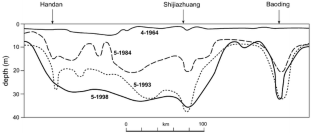
The alternative text for this image may have been generated using AI.
Fig. 4
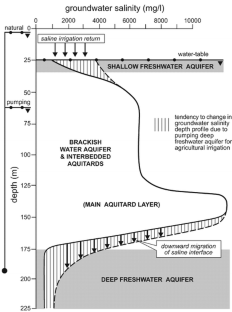
The alternative text for this image may have been generated using AI.
Fig. 5

The alternative text for this image may have been generated using AI.
Fig. 6

The alternative text for this image may have been generated using AI.
Introduction
Chapter © 2022
References
- China Institute of Geosciences (2000) Assessment of present groundwater resources in the Hai River Basin and analysis of environmental and geological effects in a typical area. Hai River Basin Resources Commission Report
- Crook FW (1999) China’s quest for food-grain security. Washington J Mod China 5(2):13–14
Google Scholar - Evans R, Han Z (1999) Groundwater: Hai, Huai and Huang River basins. World Bank China Water Sector Action Plan Program Study
- Foster SSD, Lawrence AR (1995) Groundwater quality in Asia: an overview of trends and concerns. UN-ESCAP Water Resources J Series C 184:97–110
- Foster SSD, Gale IN, Hespanhol I (1994) Impacts of wastewater use and disposal on groundwater. BGS Tech Rep WD/94/55 (in association with WHO)
- Foster SSD, Lawrence AR, Morris BL (1997) Groundwater in urban development: assessing management needs and formulating policy strategies. Washington, DC, World Bank Tech Paper 390
Google Scholar - Foster SSD, Chilton PJ, Moench M, Cardy WF, Schiffler M (2000) Groundwater in rural development: facing the challenges of supply and resource sustainability. Washington, DC, World Bank Tech Paper 463
Google Scholar - Garduno H (2001) Water rights administration: experience, issues and guidelines. UN-FAO Legislative Study 70
Google Scholar - Hai River Basin Resources Commission (1997) Water supply and demand planning for the middle and long term in the Hai River basin—2000 and 2010. Hai River Basin Resources Commission Report
- Han Z (1997) Groundwater for urban water supply in northern China. In: Proc IAH 37th Congr Groundwater in the Urban Environment, September 1997, Nottingham, vol 1, pp 331–334
- Institute of Hydrogeology & Engineering Geology (1979) The hydrogeological atlas of the People’s Republic of China. Atlas Publishing House, Beijing, China
- Institute of Hydrogeology & Engineering Geology (1995) The study of rational utilisation of groundwater resources and techniques for interception of floodwater for artificial recharge of groundwater in the Yellow River basin. Ministry of Geology and Minerals Report
- Lin X, Shu L (1992) Aquifer overexploitation and environmental effects. In: Proc Int Conf Groundwater and Environment, August 1992, Beijing. Seismological Press, Beijing, pp 6–9
- Liu P, Liu Z, Duan Z (1994) A case study on artificial recharge of groundwater in the coastal aquifer of Longkou, China. In: Proc ASCE 2nd Int Symp Artificial Recharge of Groundwater, pp 464–470
- MWR (1992) Water resources assessment for China. Ministry of Water Resources, Water & Power Press, Beijing, China
- Shen Z, Wang L (1999) Study of real agricultural water saving. Beijing, World Bank/China Institute of Water Resources & Hydropower Res Report
- Tian Y, Zhang Y, Sun X (1990) Artificial recharge of groundwater in the Huang-Huai-Hai Plain. Water Resources & Power Press, Beijing, China
- Xue Y, Wu J, Ye S, Zhang Y (2000) Hydrogeological and hydrogeochemical studies of salt-water intrusion on the south coast of Laizhou Bay, China. Ground Water 38:38–45
CAS Google Scholar - Yellow River Water Resources Commission (1997) Water supply and demand planning for the middle and long term in the Yellow River basin—2000 and 2010. Yellow River Water Resources Commission Report
- Zhang Z, Payne BR (1997) Environmental isotope study related to groundwater age, flow system and saline water origin in Quaternary aquifers of the North China Plain. In: Proc IAEA Conf Isotope Hydrology for Asia and the Pacific, Beijing, June 1997, Vienna
- Zhou L, Lui C, Jiang S, Gao S (2003) A study of 36Cl age of Quaternary groundwater of the Hebei Plain, China. Sci China (in press)
Acknowledgements
This paper is an initiative of the World Bank–Groundwater Management Advisory Team (GW-MATE) and was produced as a ‘by-product’ of three World Bank missions to China, associated with the major MWR China Water Conservation Project. The authors are most grateful to Mr Liping Jiang (World Bank-China Resident Mission), the World Bank Project Task Manager, for his encouragement of the work in general and for his permission to publish this paper. Such permission does not necessarily imply that the World Bank or its associate organisations endorse the observations and conclusions. The authors are also indebted to numerous staff of certain provincial/municipal WRBs and various county/district WRMBs across the North China Plain, and of the MWR headquarters—especially to Ms Lin Wang and Mr Yuquan Xiao (China Institute of Water Resources & Hydropower), and to Mr Houbin Liu and Ms Qinfang Sun of the MWR Project Office for open and constructive exchange of experiences on putting groundwater management into practice.
Author information
Author notes
- Stephen Foster
Present address: c/o HR-Wallingford, Howbery Park, Wallingford, Oxford, OX10-8BA, UK
Authors and Affiliations
- World Bank-Groundwater Management Advisory Team (GW-MATE) Director, Oxford, UK
Stephen Foster - Member World Bank–GW-MATE, Water Resources Planning & Institutions Consultant, Mexico DF, Mexico
Hector Garduno - Member World Bank–GW-MATE, Sinclair Knight Merz Pty Ltd, Armadale, Victoria, Australia
Richard Evans - World Bank–East Asia & Pacific Region, Washington, DC, USA
Doug Olson - North China College of Hydraulics & Hydropower, Harbin, China
Yuan Tian - Wuhan University of Hydraulic Engineering, Wuhan, China
Weizhen Zhang - China Geological Survey, Beijing, China
Zaisheng Han
Authors
- Stephen Foster
- Hector Garduno
- Richard Evans
- Doug Olson
- Yuan Tian
- Weizhen Zhang
- Zaisheng Han
Rights and permissions
About this article
Cite this article
Foster, S., Garduno, H., Evans, R. et al. Quaternary Aquifer of the North China Plain—assessing and achieving groundwater resource sustainability.Hydrogeology Journal 12, 81–93 (2004). https://doi.org/10.1007/s10040-003-0300-6
- Received: 01 October 2003
- Accepted: 15 October 2003
- Published: 12 December 2003
- Issue date: February 2004
- DOI: https://doi.org/10.1007/s10040-003-0300-6