Effect of partial replacement of sugar with stevia on the quality of kulfi (original) (raw)
Abstract
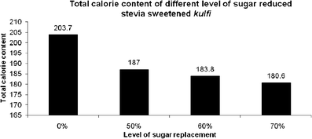
Stevia is a natural sweetener obtained from the leaf of Stevia rebaudiana plant. Its refined extract powder is 130–300 times sweeter than sucrose. Besides, it prevents diabetes, decreases weight, prevents tooth decay, increases digestion etc. Dietetic kulfi was produced, in which 50, 60 and 70% sugar was replaced with 0.05, 0.06 and 0.07% refined stevia extract powder respectively. At higher levels of sugar replacement there was a significant decrease in specific gravity, melting rate, carbohydrate percentage and total calorie content and a significant increase in freezing point, hardness and fat, protein, ash and moisture percentage. Kulfi prepared by replacing half the sugar content with stevia was adjudged on par with the control in sensory characteristics. Above 50% sugar replacement resulted in bitterness, lack of brownish appearance and presence of icy texture.
Access this article
Subscribe and save
- Starting from 10 chapters or articles per month
- Access and download chapters and articles from more than 300k books and 2,500 journals
- Cancel anytime View plans
Buy Now
Price excludes VAT (USA)
Tax calculation will be finalised during checkout.
Instant access to the full article PDF.
Fig. 1
References
- Arbuckle WS (1986) Ice cream, 4th edn. AVI Pub Co Inc, New York, pp 10–11
Book Google Scholar - Geuns JMC (2003) Molecules of interest: stevioside. Phytochemistry 64:913–921
Article CAS Google Scholar - IS: 10083 (1982) Method of test for determination of SNF in milk by the use of lactometer. Indian Standards Institution, New Delhi
Google Scholar - IS: 5194 (1969) Method of determination of nitrogen by Kjeldahl method. Indian Standards Institution, New Delhi
Google Scholar - IS: 6273 (1971) Part I, Guide for sensory evaluation of foods - optimum requirements. Indian Standards Institution, New Delhi
Google Scholar - IS: Part XI (1981) Indian standards institute handbook of food analysis. Indian Standards Institution, New Delhi
Google Scholar - Kolb N, Herrera JL, Ferreyrra DJ, Uliane RF (2001) Analysis of sweet deterpene glycosides from Stevia rebaudiana: Improved HPLC method. J Agric Food Chain 49:4538–4551
Article CAS Google Scholar - Rao HGR, Giri A (2009) Stevia - natural sweetener for dairy products. Indian Dairyman 61(11):68–73
Google Scholar - Rao HGR, Shiv Prakash A (2004) Development of pro-biotic kulfi (Indian ice cream). Indian Dairyman 56(6):57–64
Google Scholar - Salama FMM (2004) The use of some natural sweeteners in ice cream manufacture. Egypt J Dairy Sci 322:355–366
Google Scholar - Salem AS, Massoud MI (2003) Effect of using Stevia rebaudiana (Bertoni) leaves powder as natural non caloric sweetener on the physico-chemical properties of fibre fortified frozen yoghurt. Egypt J Dairy Sci 311:61–70
Google Scholar - Salooja MK, Balachandran R (1982) Studies on the production of kulfi part - I. The acceptable level of total milk solids. J Food Sci Technol 19:116–118
Google Scholar - Savita SM, Sheela K, Sharan S (2004) Stevia rebaudiana - a potential component for food industry. Trends Carbo Chem 9:9–14
Google Scholar - Sundararaj N, Nagaraju S, Venkataramu MN, Jagannath MK (1972) Design and analysis of field experiments. Directorate of Research. University of Agricultural Sciences, Bangalore, India
Author information
Authors and Affiliations
- Department of Dairy Technology, Dairy Science College, Karnataka Veterinary, Animal and Fishery Sciences University, Bangalore, 560024, Karnataka, India
Apurba Giri, H. G. Ramachandra Rao & Ramesh V.
Authors
- Apurba Giri
- H. G. Ramachandra Rao
- Ramesh V.
Corresponding author
Correspondence toApurba Giri.
Rights and permissions
About this article
Cite this article
Giri, A., Rao, H.G.R. & V., R. Effect of partial replacement of sugar with stevia on the quality of kulfi .J Food Sci Technol 51, 1612–1616 (2014). https://doi.org/10.1007/s13197-012-0655-6
- Revised: 22 November 2011
- Accepted: 06 February 2012
- Published: 25 February 2012
- Issue date: August 2014
- DOI: https://doi.org/10.1007/s13197-012-0655-6