How I Built a 6-Figure Coaching Business in 4 Months (on the side) (original) (raw)
This is the complete step-by-step case study that shows you exactly how to replace your salary with coaching — even if you’re starting from zero.
Because maybe you recognize this feeling: You’re spending your days in a cubicle, making good money at what everyone thinks is your “dream job.”
But there’s this nagging voice in your head asking, “Is this really it? Am I going to spend the next 30 years building someone else’s dream?”
In 2014, I found myself exactly in that position. I was working as a manager at a hot New York tech startup, managing millions in projects. On paper, I’d achieved everything my Asian immigrant parents had hoped for.
At the same time, something was missing — I was still trading my time and life to build someone else’s empire.
Despite telling my mom every week that I’d quit my job, I never took action on my dreams.
Then life delivered a brutal wake-up call.
Within a single year, my dad collapsed from heart failure, my mom was diagnosed with cancer, and my baby sister was almost blinded. Since I had already used up all my vacation days, I couldn’t be there for them when they needed me most.
That’s when I finally got serious about building my own business — not someday, but now.
The result? I built my first online coaching business to $106,000 in just four months, all while working a demanding full-time job. I had zero audience, no business idea, and only evenings and weekends to work with.
Here’s the exact step-by-step strategy I used to build my six-figure coaching business — and the three critical mistakes you must avoid if you want to do the same.

👋 Who am I? I’m Luisa Zhou — Princeton graduate, business coach, entrepreneur, and investor who’s helped 4,000+ coaches start and scale their businesses. This guide is based on my decade of hard-earned experience (including plenty of mistakes you won’t have to make).
Quick summary:
In this case study, you’ll discover exactly how I:
- Found a profitable coaching niche (even after two failed attempts)
- Created and priced my first offer — and landed my first client
- Got clients daily using free social platforms (no ads, no website)
- Built trust through real relationships instead of flashy marketing
- Scaled from 1:1 to group coaching and broke six figures in four months
Whether you’re just starting or want to grow faster, this guide gives you the blueprint to start strong, grow with confidence, and finally replace your 9–5 income with a business you love.
PS: Want to get started even faster? I’ve condensed the most important steps into a 10-minute video that shares the exact steps I took to get to six figures:
Why I chose coaching as a business (and you should too)
When I decided to finally build my business, I already had experience with other types of businesses, including a payments startup and a tutoring business.
Based on these experiences, I knew my next business would be an online business that had to meet some non-negotiable criteria:
- Scalable without consuming all my time
- Low cost to start and run
- Highly profitable from day one
- Built on my existing skills
- Flexible around my schedule
- Meaningful and impactful
An online coaching business checked every single box.
Unlike other business models, coaching (or consulting) doesn’t require:
- A huge social media following or email list
- Complex technical skills
- Tons of startup capital
- 60-hour workweeks
- Being a “natural-born entrepreneur”
As an introvert with zero entrepreneurial role models growing up, I used to doubt I had what it took. But coaching let me monetize what I already knew while helping people get real results.
Why people actually pay for coaching (even now)
While many people think it’s harder now to get into coaching than it was before, it’s simply not true.
The demand for coaching doesn’t come from trends or social media. People pay for coaching because certain problems are expensive to solve alone.
They don’t buy coaching because they don’t have access to free information — they do.
They buy because the cost is high: wasted time, wrong decisions, slow progress, and expensive mistakes.
That’s why buyers don’t pay for “general advice.” They pay for someone who’s already solved a specific problem in a specific context, because it lowers risk and saves time.
And for people with money but limited time, speed matters.
Coaching compresses the time it takes to see results — which is why people keep paying for it, even when information is free and they could use AI.
Why this still works
This story happened years ago. The platforms were different, and the internet was a different place. That part has changed.
What hasn’t changed is why people pay for coaching at all. Buyers don’t pay because information is scarce. They pay because making the wrong decision is costly—lost time, slow progress, and expensive mistakes.
When the cost of figuring something out alone is high, paying for clarity makes economic sense.
My business didn’t work because of early timing, visibility, or personality. No, it worked because it focused on a specific problem people were already trying to solve and priced help around reducing uncertainty in that situation.
Markets that feel “crowded” tend to contain many vague offers. Demand concentrates around clearly defined outcomes because specificity lowers perceived risk for the buyer. That pattern hasn’t changed.
For professionals, this model doesn’t rely on audience size or branding. It relies on judgment—being able to understand a situation, explain trade-offs, and help someone decide what to do next. Those are standard professional skills applied in a different context.
That context matters for what follows.
Why professional skills matter more than personality
There’s one more assumption we should clear up.
I didn’t succeed thanks to any natural charisma or confidence. (I’m an introvert who used to be incredibly afraid of being in front of a camera… I almost deleted my first video the moment I posted it because I was so scared.)
Like most professionals, I knew how to listen carefully, identify what was actually wrong, explain trade-offs clearly, and help someone decide what to do next. Those skills transfer directly to coaching because that’s what clients are paying for: clarity.
People don’t hire coaches because they want inspiration. They hire them because they feel stuck, uncertain, or overwhelmed by options — and they want someone who can quickly understand their situation and reduce the risk of making the wrong decision.
When someone feels understood, sees their problem framed accurately, and leaves a conversation knowing what their next step should be, that’s when they trust you. That trust doesn’t come from a personal brand or an audience. It comes from demonstrated experience.
If you already diagnose problems, communicate complex ideas, and guide decisions in your job, you’re not starting from zero. You’re applying existing skills in a different context — one where clarity is the product.
With that context, here’s how I applied those basics when I was starting – beginning with how I chose my niche.
Step 1: How I found my profitable niche (without overthinking it)
Let me be honest — finding my niche wasn’t some lightning bolt moment. It took three attempts before I got it right.
Attempt #1: The “easy” business that wasn’t
My first idea was teaching Microsoft Excel. I saw other six and seven-figure businesses doing it, and I thought, “I do this every day at work. If they can do it, so can I.”
Big mistake.
Because I was so focused on quitting my job as fast as possible instead of building a business that solved a problem, I set myself up for failure.
I skipped researching my market entirely and had no plan and no clear audience. Not only that — I spent my entire workday in Excel and had zero interest in thinking about it after hours.
Without realizing it, I had set myself up to spend all my time thinking about the most boring part of my day job.
And after a month of forcing myself to work on the business, I realized it wasn’t going to work and started searching for my next business idea.

I tried to market my business, here with a guest post pitch. But, unsurprisingly, I never got a reply.
While I had learned my lesson and actually researched my market this time around, my next attempt was also doomed to fail…
Attempt #2: Good idea, wrong passion
Next, I tried career coaching. People always asked me about switching industries and negotiating six-figure salaries, so it seemed natural.
This time I was smarter. I did market research and spoke to potential clients to understand their challenges and goals.
At the end of each conversation, I asked a simple question: “Would you be willing to pay for help to get a better job or salary?”
Two people said yes, so I offered coaching for $300/month. (I seriously undercharged, but at least I was officially in business!)

I successfully started marketing my business with guest posts like this one.
But here’s what I discovered: I absolutely hated giving career advice. I couldn’t help but think, “Forget the corporate ladder—build your own business instead!”
And while your business idea doesn’t have to be your life’s biggest passion, it should be something you enjoy doing.
So I began looking for one more idea…
Attempt #3: The breakthrough idea
After these two attempts, I started to feel discouraged, wondering if I had other sellable skills and if I would ever find another business idea that would work for me.
Fortunately, I did.
And my third attempt came from a chance conversation with a copywriter I’d hired for my career coaching business. When I asked where she found clients, she said, “Facebook groups.”
Curious, I joined the groups she recommended. That’s when I noticed something: people in those groups were really interested in paid advertising.
💡Lightbulb moment. My day job was in digital advertising and I spent my days managing and analyzing ad campaigns.
I actually enjoyed this work and could help people get real results.
That’s how my digital advertising consulting business was born.
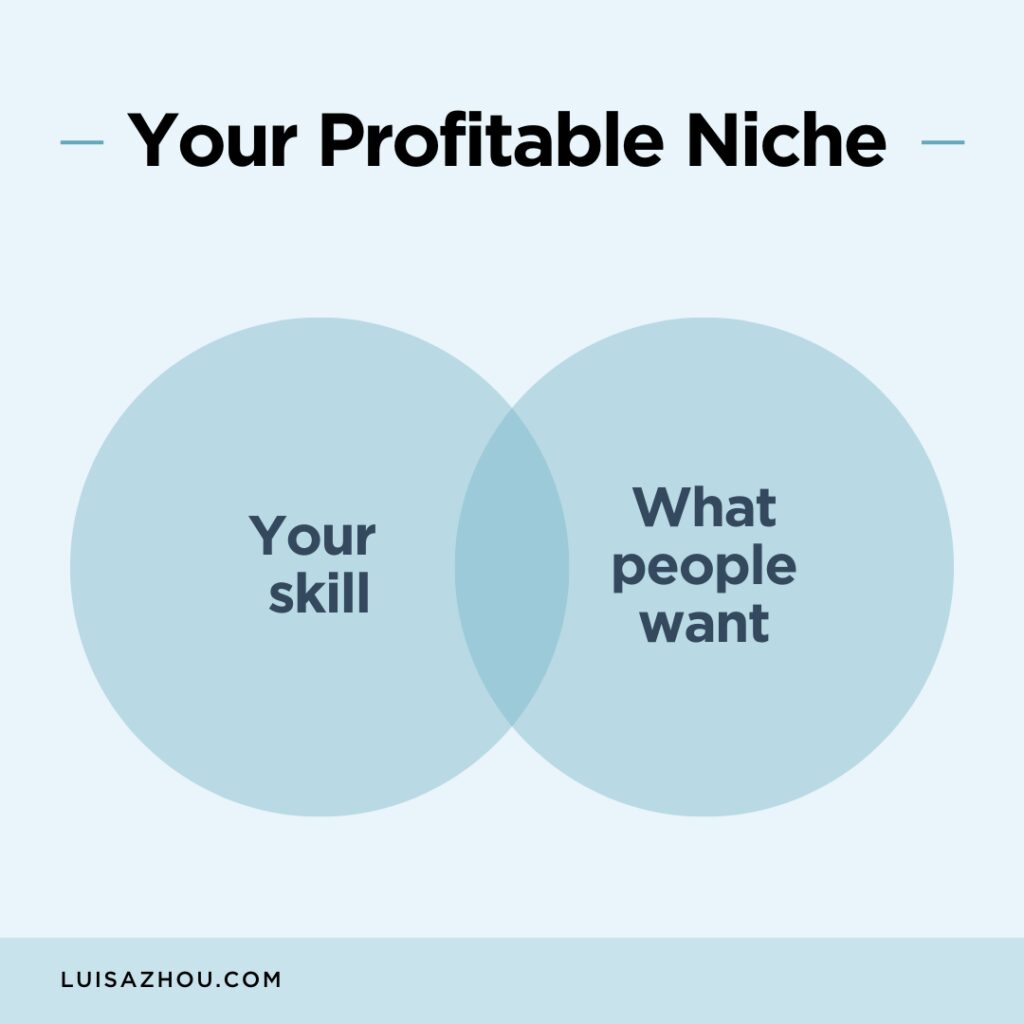
Key takeaway: Your perfect niche is often hiding in plain sight. Look for the intersection of:
- What you’re already good at
- What you enjoy doing
- What people need help with
- What people will pay to solve
And quick note: While Facebook groups were trendy back then, this strategy works even better today.
Whether your audience is on Instagram, LinkedIn, Reddit, YouTube, or TikTok, there is a place for your offer. You can even apply the same strategies outside of social media – in WhatsApp groups, Discord, niche online groups, or local events.

For example, online communities like Reddit are full of potential clients. Here’s someone looking for career advice.
Step 2: My simple first offer (and why I charged premium prices)
Once I found my niche, I kept my first offer dead simple: 6-month advertising coaching packages.
And having figured out where my audience hung out, I started showing up in those Facebook groups I had found, sharing valuable information and answering as many questions as I could about advertising. I wasn’t really looking to sell, but to get to know my audience.
But here’s where I got a lucky chance — and made a mistake that taught me everything about pricing.
The $5,000 lucky break
For my pricing, I calculated my hourly salary and multiplied it by the estimated hours I’d work with each coaching client over six months. The number came out to $5,000.
When I pitched this to my first potential client, a woman I’d been helping for free in Facebook groups, she didn’t even hesitate.
“I figured the price would be about that,” she said. “I was ready to say yes before we even hopped on this call. With all the help you’ve already given me, I know the value I’ll get working with you will be so much more.”
First sale: $5,000.

My first payment!
The reality check: 30 rejections in a row
Encouraged by this success, I started pitching my $5,000 offer more frequently.
The response? “You’re too expensive.”
I got rejected by 30 people in a row – and one even said she couldn’t buy from me because I “looked like a 12 year old.”
I realized why my first client was different. I’d spent weeks helping her for free before mentioning my price. She already understood the value.
But when I pitched without offering value first, people couldn’t see past the price tag.
The strategic price drop that changed everything
Feeling dejected but determined not to give up, I asked myself: “What’s the lowest price I’d be willing to charge without resenting my clients?”
The answer: $1,500 for a 3-month package.
And within weeks, I landed two new coaching clients.
Once I had the testimonials and confidence I needed, I was able to raise my price back up to $5,000 and never had to drop it again.
The lesson: Sometimes you have to slow down to speed up. That “lower” price point became my sweet spot — high enough to attract serious clients, but not so high it became a bottleneck for sales.
Pro tip: For new coaches, $1,500 for a 3-month package is often the perfect starting price. It’s high enough to attract committed clients but accessible enough to start building your track record.

Step 3: How I got clients without ads (my “Sales Activities” framework)
With limited time (remember, I was working full-time), I had to be laser-focused on activities that actually led to sales. I call these “sales activities.”
The thing is: For service-based businesses, it’s not about having a fancy website or perfect social media. It’s about one thing — building trust through relationships.
By now, I knew my clients would be in Facebook groups, so I had to be in those groups to start building connections.
Quick note: A mistake new coaches make is to be on many different social media platforms at once. Choose one and stick to it until you’ve mastered it – then move on to the next platform.
The four core sales activities I focused on:
- Finding people to talk to (prospecting)
- Talking to them (relationship building)
- Following up with potential clients (nurturing)
- Having sales conversations (closing)
That’s it. If an activity didn’t fall into one of these categories, I didn’t do it.

My daily routine: 15 minutes that changed everything
Every single day — no matter how busy work was — I committed to doing at least one sales activity. Most importantly: I committed to showing up in Facebook groups daily and helping people with their advertising questions for the next four weeks.

Most of my early posts tanked. But after a few months, I started getting serious engagement, as my skills improved and my audience got to know me better.
During weekdays, I marked my calendar with three 15-minute time slots and during weekends, I worked on my business for a few hours.
The key: I treated this like brushing my teeth – my sales activities were non-negotiable.
What I didn’t waste time on (this is crucial)
While building my business, I deliberately avoided:
- Building a website (I didn’t have one until I’d made over $20,000)
- Email marketing (my writing skills weren’t strong enough yet)
- Extensive social media presence (to this day, people ask how I have an eight-figure business without a massive social following)
- Perfect branding or design
Why this worked: With limited time, I focused only on activities that directly led to sales conversations.
Get the Ultimate Guide
for building a
6-Figure Coaching Business so you can achieve more freedom!
Step 4: Building a repeatable sales process
After landing my first few clients, I needed a consistent way to turn conversations into sales. That’s when I developed my “free taster session” strategy.
The 30-minute free session framework
Instead of waiting for people to respond to my posts, I got proactive. When I saw someone asking advertising questions, I’d message them directly: “I’d love to help if you’d answer some market research questions in return.”
And here’s exactly how I structured these coaching calls:
Opening: “On this call, we’re going to make sure you walk away with [specific valuable takeaway]. At the end, if you found it helpful, I’d love to share how I can help you further through my consulting. Does that sound good?”
During the session: I’d laser-focus on solving one specific problem or answering their biggest question about advertising.
Closing: “Do you feel you got a lot of value from this call? What stood out to you? I know your goal is [their specific goal], and considering how much we accomplished in just 30 minutes, I’d love to help you even more. Would you like to hear about how we could work together?”
The results: This approach felt natural, provided genuine value, and made the transition to discussing my coaching services feel organic rather than pushy.
Step 5: Scaling with group programs
After working with several one-on-one clients, I hit a wall. I was fully booked and couldn’t take on more clients, but I wasn’t ready to quit my job yet.
The solution? Leveraging my time with a group coaching program.
Creating my first group program
I took the first few weeks of what I was doing with private clients and packaged it into a short group program priced at just over $400.
My promotion strategy:
- Daily live streams in my Facebook group
- Shared the program benefits every day
- Talked to everyone who showed even remote interest
The scary part: I didn’t make a single sale until the last three or four days of enrollment. I was terrified I’d look stupid with zero sales, but fortunately I didn’t give up.
My commitment: I kept repeating one of my favorite mantras — “It’s not over until it’s over.” I refused to give up until I’d exhausted every option.

And the result? 18 sales in those final days.
Here’s a month-by-month breakdown of my growth:
Month 1: First $5,000 client
Month 2: Price adjustment and new clients at 1,500each=1,500 each = 1,500each=11,000
Month 3: Group program (18 sales) + private clients = $41,000
Month 4: Over-delivered on group program, leading to upsells and referrals = $49,000
Total: $106,000 in four months
…Or a 6-figure coaching business!

The secret sauce: Why most people fail (and what actually works)
Hopefully, you’re seeing how much work and persistence this really takes to gain any momentum.
Looking back, my breakthrough came down to three key mindset changes that anyone can make:
1. I was “impatiently patient”
My mom (bless her practical Asian heart) kept telling me not to quit my job prematurely. While this frustrated my impatient side, it forced me to build real momentum before making the leap.
The benefit: When you can’t rely on quitting your job as an escape, you have to get creative and strategic with your limited time.
2. I focused on one thing at a time
While others were trying to build audiences, create funnels, and launch multiple products, I obsessively focused on one goal: getting my next paying client.
The power of one:
- One niche
- One offer
- One traffic source (Facebook groups)
- One sales method (free sessions)
And this focus built momentum – fast. By showing up every day, people started seeing me and hearing of my free sessions. And once I had a few clients and testimonials, they started recommending me to others.
3. I turned off the negative voice
Every entrepreneur has that voice saying, “Is this really possible? Are you wasting your time?” I had friends and family saying the same thing.
My solution? I flipped a mental switch and refused to entertain those thoughts.
I coached myself: “How would they know if I can do this? No one around me has ever built the business I want, so why would I listen to someone who hasn’t done what I want to do?”

But while I had certain advantages at this time, like having no kids and thus more time to spend on my business, it’s not just me.
Since starting this business, I’ve helped 3,500+ new coaches get started. Here are a few of their stories:
Real client success stories: How these coaches built successful businesses fast
The strategies I used have worked for thousands of my clients across different industries:
Emily: Career coach
Emily leveraged her experience as a headhunter for Fortune 500 companies. Having read thousands of resumes and rejected 99% of candidates, she had insider knowledge of what actually gets people hired.
She turned this into her business, a career coaching business for people who want to land their dream jobs. After posting a short message on LinkedIn, sharing her new business, she quickly got a few clients and grew her business from there.
Result: A multi-six-figure coaching business that made it possible for her to quit her day job.
Ruby: Relationship coach
Ruby combined her matchmaker experience at eHarmony with a specific underserved audience: genuine, good-hearted men who always got friend-zoned.
And by getting ultra-specific about who she served, she attracted her perfect clients. Her first client came from Reddit, where she had asked people for a short market research call in exchange for a free coaching call.
Result: Within 7 months, Ruby quit her day job and built a six-figure relationship coaching business.
Rose: Recovery coach
Rose used her earlier life experiences to launch a recovery coaching business to help others in recovery.
Instead of focusing on sales, she focused on getting to know people, sharing her experiences, asking “how can I help?” and leveraging her existing network for sales.
Result: While recovery coaching traditionally isn’t associated with premium prices, Rose sold her first ever addiction coaching package for five figures.
These are just three examples from thousands of similar transformations.

Want to see more detailed case studies and learn the exact step-by-step processes these coaches used? Take a look here!
Your turn: The next 24 hours
Here’s what you can do in the next 24 hours to start your own six-figure coaching journey:
- Identify your niche using the intersection of your skills, interests, and market demand
- Create your first offer — a simple 3-month coaching package
- Reach out to one person in your network who might need your help
- Join relevant online communities where your ideal clients spend time
- Offer to help someone for free to start building trust and testimonials

Remember: I wasn’t an overnight success. It was the result of years of learning, failing, and refining my approach. It took me 2 years to get ready to build a successful coaching business – and even before then, I had dabbled in entrepreneurship for several years.
But once I found the right formula, growth happened quickly and I was able to go from a stable corporate career to a growing coaching business. And if there are four strategies that helped me build that momentum, they are:
1. Start with what you know
I see this all the time – entrepreneurs trying to build businesses around their “passions” when they don’t know the first thing about the industry.
Now, don’t get me wrong, doing what you love is great. And as I learned the hard way, you shouldn’t despise the business you’re working on.
But success often starts with leveraging what you already know.
Take it from me: I was able to deliver fast results for my clients and their Facebook ad campaigns because I had developed that ability in my job experience.
While I enjoyed that business, it wasn’t my ultimate end goal. Today, I’m a business coach and work on other businesses on the side.
But it all started with using my existing skills at the time instead of learning new ones.
If you want coaching niche ideas and validate them, use the 25-point coaching niche viability score to figure out if it’s a high-profit niche by answering five questions.
And notice how your coaching credentials don’t come from having a coaching certification (except in niches where it’s required, like some areas of health coaching).
I didn’t have one – but my skills meant I could teach others to set up successful ad campaigns.
Similarly, your skills and experiences qualify you to help others while getting paid for it.
You’ll refine your coaching skills as you go — and that’s okay. A big reason for offering that initial lower-priced coaching program is so that you can earn your stripes before plunging into higher-paid coaching.
2. Be consistent
As you know by now, I didn’t start my business by showing up once and hoping for the best. Instead, I was in Facebook groups multiple times a day, answering questions, sharing insights, and (when it made sense), offering my paid services.

I scheduled everything to hold myself accountable – if I hadn’t, I would’ve likely spent my evenings watching Netflix.
That consistency quickly built momentum because I was constantly top of mind for potential clients. When they booked their free coaching calls, they’d often say: “I’ve seen your posts and can tell you really know your stuff.”
PS: Feel like the biggest roadblock to taking these steps is time? Then, I have the perfect video for you:
3. Build relationships
If you’re afraid of coming off as “pushy” when selling your coaching, I have great news for you.
Sales don’t happen because of the things you say on a sales call. They happen because of the trust and relationships you’ve built before you ever hop on that call.
Thanks to the free content I shared (my social media posts, livestreams, and free offers), I created genuine connections with my audience.
In other words: The platform I used or the skill I sold weren’t the reasons people bought.
This relationship-first approach helped me overcome factors that would otherwise have tanked my business:
- No brand recognition
- No social proof
- Average sales and marketing skills
By prioritizing connection over flashy tactics, I was able to build trust and grow my business, even from scratch.
4. Adapt to market demand
When I kept hearing, “You’re too expensive,” I realized I had two choices:
1. I could stick to my guns, offer coaching at $5,000/package, and wait for the right client to say “yes”
2. Or, I could lower my rates and meet the market where it was at
Now, lowering my rates wasn’t an easy decision. At $1,500/package, I was earning less than in my 9-5.
But I saw the bigger picture:
Offering a reduced price would help me land more clients faster and build my credibility through social proof and testimonials.
So, even though people say you shouldn’t lower your price, I chose to do so over short-term profit.
But what about the biggest mistakes I made early on? Here they are:
🚀 PS: Want to learn how I grew my business to $1 million within a year? Read the full case study here!
FAQ: Building a six-figure coaching business
Can you really make six figures as a coach?
Absolutely. Coaching is one of the highest-leverage business models because you’re selling your expertise and results, not your time. With the right niche and pricing, six figures is very achievable.
What’s the fastest way to get coaching clients?
Focus on relationship building through value-first approaches. Offer free sessions, help people in online communities, and ask for referrals from your network. Skip the “fancy marketing” until you have consistent clients.
Do you need a big audience to make money coaching?
Not at all. I made my first $20,000 online without a single “follower.” Focus on deep relationships with a small number of people rather than shallow connections with thousands.
How much can beginner coaches earn?
New coaches start anywhere from 1,500−1,500-1,500−2,000 per client for 3-month packages. As you gain experience and testimonials, you can raise your prices to 3,000−3,000-3,000−10,000+ per client.
Get the Ultimate Guide
for building a
6-Figure Coaching Business so you can achieve more freedom!
Ready to build your six-figure coaching business?
That’s it! An ultimate coaching business case study that shows you exactly how I grew my own business to six figures.
Still, I get it – getting started is extremely overwhelming.
But here’s the good news:
If you’re dreaming of replacing your salary with a profitable coaching business, you don’t have to figure it out alone.
I’ve helped over 3,500 people build their own successful coaching businesses using these exact strategies.
And the blueprint works whether you’re in health, business, relationships, career, or any other niche.
Want the complete step-by-step system?
I’ve created a FREE PDF that shows you exactly how to start and scale a six-figure coaching business — even if you’re starting from zero.
Warmly,
Luisa Zhou
👉Read more:
- How to Build a Six-Figure Business
- How to Become a Great Coach
- 24 Great Ways to Market Your Coaching Business
- What are the Legal Requirements for Coaches?
