Vitamin A for measles | Cochrane Equity (original) (raw)
Vitamin A reduces the risk of death from measles by 87% for children younger than 2 years.
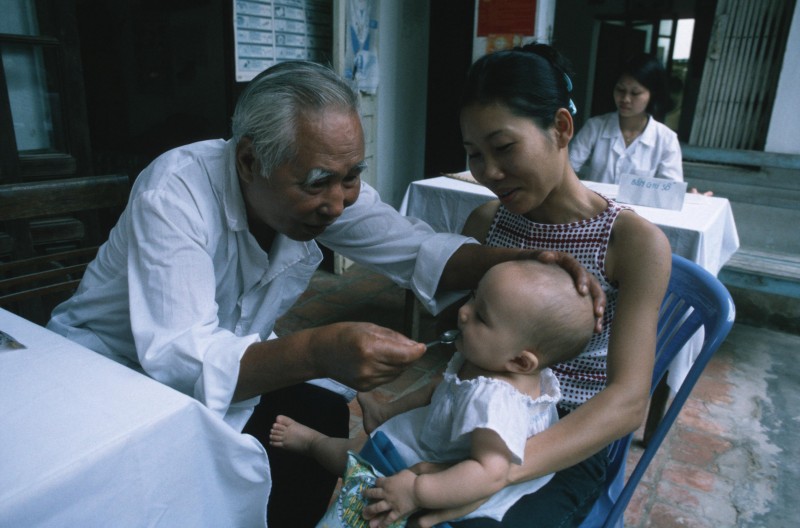
Photo Credits: Tran Thi Hoa


Why is vitamin A important for treating measles?
Measles kills up to 10% of people it infects and, while cases are more common in low- and middle-income countries, measles outbreaks happen in all countries. Vitamin A deficiency is common in the world, especially in low- and middle-income countries and is a risk factor for severe measles. Since 1997, the World Health Organization (WHO) and the United Nations Children’s Fund (UNICEF) have recommended that 200,000 International Units (IUs) of vitamin A be given twice to all children older than 1 year diagnosed with measles and living in an area where vitamin A deficiency is common.
Does vitamin A for measles work?
- Vitamin A did not have a clear effect on overall mortality rates. However, it reduced the risk of death from measles by 87% for children younger than two years old. In addition, for all children, it reduced the length of time the child suffers from diarrhea by 2 days and shortens the duration of fever by 1 day.
Equity: does it work in the disadvantaged?
- Vitamin A deficiency is more common in low- and middle-income countries putting children with measles in these countries at greater risk of severe infection. Providing children with measles in these countries with vitamin A can prevent measles-related deaths and complications.
Intervention Delivery
- The studies delivered oral vitamin A supplements, either water- or oil-based, to children in hospital or community settings.
- Vitamin A was given orally in 1-2 doses of 100,000 IU-200,000 IU.
Population and Setting
- 6 of the included studies were conducted in Africa (in Ghana, Kenya, South Africa, Tanzania, and Zambia), one in England and one in Japan.
- 2 of the studies were conducted in the community setting and the rest were hospital-based.
Summary of Findings [SOF] Table: Vitamin A compared to placebo or no vitamin A for treating measles in children
Patient or population: children with measles
Settings: in hospital or in the community
Intervention: Vitamin A
Comparison: placebo or no vitamin A
| Outcomes | Anticipated absolute effects per year | Relative effect (95% CI) | No of Participants (studies) | Quality of the evidence (GRADE) | |
|---|---|---|---|---|---|
| Risk without vitamin A (Control) | Risk with vitamin A (95% CI) | ||||
| Mortality (all patients) | 10.27 per 100 | 1.12 fewer per 100 (from 3.25 fewer to 1.72 more) | OR 0.88 (0.66-1.19) | 1974 (7) | Moderate1 |
| Mortality (patients under 2 years old) | 10.76 per 100 | 8.75 fewer per 100 (from 4.12 to 10.28 fewer) | OR 0.17 (0.04-0.59) | 309 (3) | Moderate2 |
| Mortality (water based vitamin A) | 8.59 per 100 | 6.93 fewer per 100 (from 1.44 to 8.22 fewer) | OR 0.18 (0.04-0.82) | 249 (2) | Moderate2 |
| Mortality (areas with case fatality >10%) | 10.45 per 100 | 6.63 fewer per 100 (from 2.11 to 8.73 fewer) | OR 0.34 (0.15-0.78) | 429 (3) | Moderate2 |
| Duration of diarrhea | The intervention group had diarrhea lasting for a mean difference of 1.92 fewer days (from 0.44 to 3.40 fewer days) | MD -1.92 (-3.40, -0.44) | 249 (2) | Moderate3 | |
| Duration of fever | The intervention group had fever for a mean difference of 1.01 fewer days (from 0.13 to 1.89 fewer days) | MD -1.01 (-1.89, -0.13) | 149 (2) | Moderate4 | |
| Adverse Events: None of the studies in the review reported on adverse effects. |
1. Inconsistency in results.
2. Small sample size, rare event, and wide confidence interval.
3. High heterogeneity (79%) and wide confidence interval.
4. High heterogeneity (89%).
| Relevance of the review for disadvantaged communities Vitamin A reduces the risk of death from measles by 87% for children younger than 2 years. Vitamin A deficiency is more common in low- and middle-income countries putting children with measles in these countries at greater risk of severe infection. Providing children with measles in these countries with vitamin A can prevent measles-related deaths and complications. | |
|---|---|
| Findings | Interpretation |
| Equity – Which of the PROGRESS groups examined | |
| Almost all of the included studies were conducted in low-income countries. | It is unclear whether the results of this review are applicable in high-income countries. Vitamin A is effective for preventing mortality due to measles in low-income studies but policymakers in high-income countries or areas with vitamin A deficiency is rare need to ensure careful monitoring of such an intervention to ensure effectiveness. |
| The greatest benefit of vitamin A treatment for measles was in reducing mortality for hospitalized children younger than 2 years of age. | While no adverse events were reported for children older than 2 years, there was no difference in mortality for those treated or not treated with vitamin A. However, there was a significant reduction in mortality for children younger than 2 years. Vitamin A should be included in low-income countries for children hospitalized due to measles. In children older than 2, vitamin A was effective in reducing the duration of diarrhea and fever. |
| The review does not report on differences in outcomes based on child sex or gender, or socioeconomic status. | There is no indication that vitamin A is less effective for boys or girls. Vitamin A may be more effective among lower income children who may be at greater risk of vitamin A deficiency and therefore benefit more from vitamin A for measles treatment. |
| Equity Applicability | |
| Two of the studies examined the effectiveness of vitamin A among children in the community while the rest included hospitalized children. The protective effect of vitamin A was only seen among hospitalized children. This could be due to hospitalized children having more severe illness. | Vitamin A may be best used for treating measles in hospitalized patients. Community-based children did not experience the same benefit from vitamin A. Policymakers who want to implement a vitamin A program to prevent measles mortality should focus on hospitalized cases. Vitamin A should be given in addition to standard treatment. |
| Cost-equity | |
| Vitamin A is cost-saving because it reduces the length of hospitalization while costing only about $0.02 per dose. | Vitamin A is a cost-effective treatment for treating measles among hospitalized children. |
| Vitamin A was effective for measles treatment but only among more severe, hospitalized children. | Since the children who are most likely to be hospitalized due to measles are often deficient in vitamin A and vitamin A deficiency is more common in disadvantaged children, providing children with vitamin A to treat their measles can help the most disadvantaged children. |
| Monitoring & Evaluation for PROGRESS Groups | |
| Two doses of vitamin A are effective in preventing measles-related mortality in children under 2 years living in areas with high case-fatality from measles. | None of the included studies measured the longer term impact of vitamin A for treating measles. Policymakers adding vitamin A supplementation to measles treatment should consider monitoring longer term outcomes to ensure effectiveness. |
| More research is needed to determine whether vitamin A is effective in measles treatment for children older than 2. | Policymakers should evaluate the effectiveness of vitamin A for treating measles in children older than 2. |
Comments on this summary? Please contact Jennifer Petkovic.