Active Immunity- Definition, Characteristics, Types, Examples (original) (raw)
Active immunity develops due to the production of antibodies in the body. Active immunity is attained by exposure to a pathogen leading to the production of antibodies in the body.
The immunity induced by exposure to a foreign antigen is called active immunity. Active immunity confers a form of resistance against a foreign antigen when encountered by an individual. Therefore active immunity can be gained through:
- clinical or subclinical infection – this is previous exposure to an antigen that might have caused an infection
- immunization with live or killed infectious agents or their antigens via vaccination
- exposure to microbial products, such as toxins and toxoids.
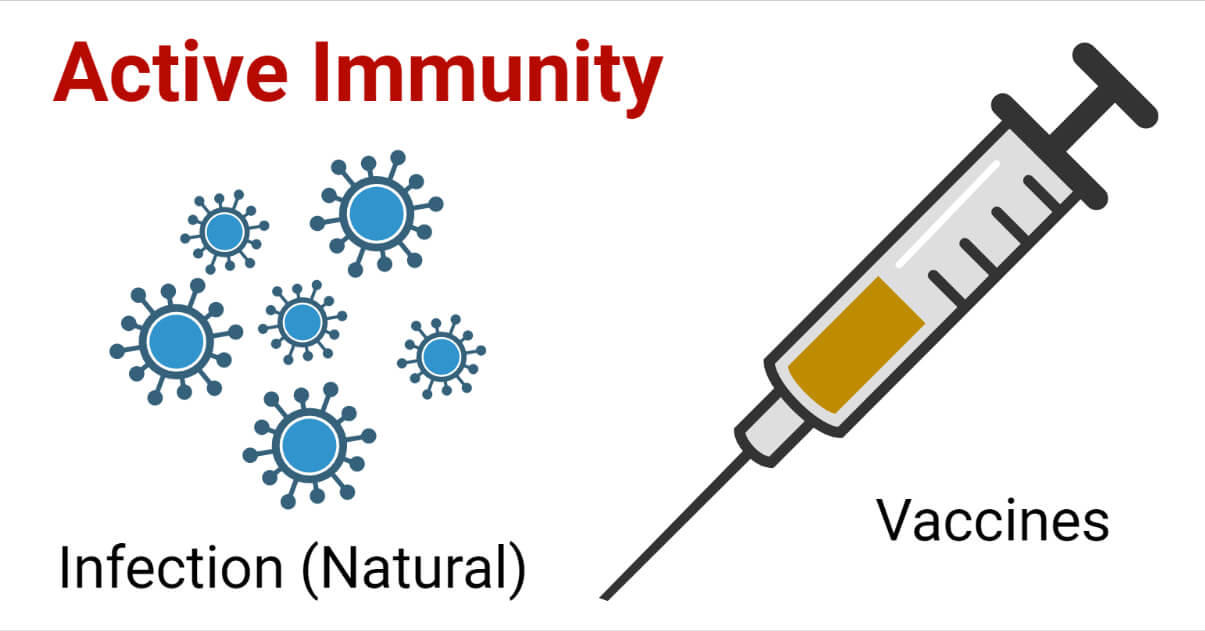
Active Immunity
In these forms of exposure to an antigen, the host immune system stimulates an immune response against the foreign antigens, and these immune responses can be by activation of antibodies by the B-cells and T-cells activation (T-helper and T-cytotoxic/Cytotoxic T-cells).
After the activation of these immune mechanisms and a latent period of infection and body immune responses, then active immunity is developed. The host immunity is then geared up to act against the foreign pathogen/antigen. This means that immune responses are normally slow on the onset (primary response), but once the active immunity is developed, it forms a long-lasting immunity. This is the major advantage of active immunity.
Active immunity requires exposure to a pathogen or to the antigen of a pathogen.
Exposure to the antigen leads to the production of antibodies. These antibodies essentially mark a cell for destruction by lymphocytes.
Cells involved in active immunity are T-cells (cytotoxic T cells, helper T cells, memory T cells, and suppressor T cells), B-cells (memory B cells and plasma cells), and antigen-presenting cells (B cells, dendritic cells, and macrophages).
There is a delay between exposure to the antigen and acquiring immunity. The first exposure leads to a primary response. If exposed to the antigen again later, the response the immune system elicits is much faster and stronger. This is called a secondary response.
Active immunity is a long-term type of immunity that can last a lifetime.
Some of the known side effects of active immunity are resultant autoimmune diseases and allergic responses.
Types of Active Immunity
A. Natural active immunity
- This is the immunity that is acquired when an individual is exposed clinically or subclinically through infection.
- This means that the individual is exposed to the live pathogen, develops the disease, and develops a long-term form of immunity as a result of the primary response.
- When a microbe penetrates the body’s barriers such as the skin, mucous membranes, or other primary defenses, it interacts with the immune system activating the B-cells to produce antibodies that help to fight the invading pathogen.
- The adaptive immune response generated against the pathogen takes days or weeks to develop but may be long-lasting, or even lifelong.
- In cases that involve wild infection, such as hepatitis A virus (HAV) and subsequent recovery, it gives rise to a natural active immune response usually leading to lifelong protection.
B. Artificial active immunity
- Now, in this case, an administration of a vaccine will generate an acquired artificial active immunity.
- For example, administration of the two doses of the hepatitis A vaccine will generate an acquired active immune response which will lead to long-lasting or life-long protection against hepatitis A.
- This type of immunity is acquired through immunization via vaccination. Vaccination is a deliberate induction of an immune response by introducing an antigen (part of a disease-causing pathogen) into the body to activate the body in producing an immune response against the antigen, rendering a long-term memory response in case of another exposure to the antigen.
- Vaccination represents the single most effective manipulation of the immune system that scientists have developed.
- Immunizations are successful because they utilize the immune system’s natural specificity as well as its inducibility. The principle behind immunization is to introduce an antigen, derived from a disease-causing organism, that stimulates the immune system to develop protective immunity against that organism, but which does not itself cause the pathogenic effects of that organism.
- Therefore artificial active immunity is induced in individuals by vaccines.
- There is a wide range of vaccines available against many microbial pathogens. These may be live vaccines, killed vaccines, or vaccines containing bacterial products.
Mediators of active immunity
Active immunity is mediated by humoral immunity and cell-mediated immunity and their components. The principal function of these immune responses is to eliminate or kill different types of pathogens.
Humoral immunity
This immunity offers the mediation of antibody functions, found in blood and the mucosal secretions. These antibodies are secreted by B-cell plasma cells, and they are able to recognize microbial antigens, neutralize their infectivity, and target them for elimination by various effector mechanisms. Humoral immunity is the principal defense mechanism against extracellular microbes.
Cell-mediated immunity
This immunity is mediated by both activated TH cells and CTLs. Cytokines secreted by TH cells activate various phagocytic cells, enabling them to phagocytose and kill microorganisms. This type of cell-mediated immune response is especially important against a host of bacterial and protozoal pathogens. CTLs play an important role in killing virus-infected cells and tumor cells. They act by killing altered self-cells.
Active Immunity vs. Passive Immunity
| S.N. | Active Immunity | Passive Immunity |
|---|---|---|
| 1. | It is produced actively by the host’s immune system | No active host participation; received passively |
| 2. | Antibodies induced by infection or by immunogens | Antibodies transferred directly into the host |
| 3. | Active immunity often involves both the cell-mediated and humoral immunity | Passive immunity is due to readymade antibodies |
| 4. | Types: _Natural_—clinical or inapparent infection; _Artificial_— induced by vaccines | Types: _Natural_—transfer of maternal antibodies through the placenta; _Artificial_—injection of immunoglobulins |
| 5. | Immunity is effective only after a lag period | Immediate immunity; no lag period |
| 6. | Durable; long-term and it is an effective protection | Transient; short-lived and it is less effective |
| 7. | Immunological memory present | No immunological memory |
| 8. | Booster effect on subsequent dose | Subsequent dose less effective due to immune elimination |
| 9. | A negative phase may occur | No negative phase |
| 10. | Not applicable in immunodeficient | Applicable even in immunodeficient |
| 11. | Used for prophylactic treatments | Used as a post-therapeutic remedy |
| 12. | It is a possible cause of autoimmune disorders and allergic reactions | It can cause serum sickness |
References
- Kuby Immunology 7th Edition
- Microbiology and Immunology 2nd Edition by Shubash Chandra Parija
- https://www.thoughtco.com/active-immunity-and-passive-immunity-4134137
- https://en.wikipedia.org/wiki/Immunity\_(medical)
- https://www.technologynetworks.com/immunology/articles/active-vs-passive-immunity-differences-and-definition-335112
- https://www.chop.edu/centers-programs/vaccine-education-center/human-immune-system/types-immunity
- https://www.health.com/condition/infectious-diseases/active-vs-passive-immunity
- https://byjus.com/biology/difference-between-active-and-passive-immunity/
- https://med.libretexts.org/Bookshelves/Anatomy\_and\_Physiology/Book%3A\_Anatomy\_and\_Physiology\_(Boundless)/20%3A\_Immune\_System/20.7%3A\_Cell-Mediated\_Immune\_Response/20.7C%3A\_Active\_and\_Passive\_Humoral\_Immunity
- David Baxter, Active and passive immunity, vaccine types, excipients and licensing, Occupational Medicine, Volume 57, Issue 8, December 2007, Pages 552–556, https://doi.org/10.1093/occmed/kqm110
- https://www.biologyonline.com/dictionary/local-immunity
About Author

Dr. Faith Mokobi is a passionate scientist and completed her Ph.D. in Nanoengineering (Synthetic Biology specialization) from Joint School of Nanoscience and Nanoengineering, North Carolina A and T State University, North Carolina, USA in 2025. She has a background in Immunology and Microbiology (MSc./BSc.). With extensive higher education teaching and research experience in Biomedical studies, metagenomic studies, and drug resistance, Faith is currently integrating her Biomedical experience in nanotechnology and cancer theranostics.