RBC vs WBC- Definition and 19 Major Differences (original) (raw)
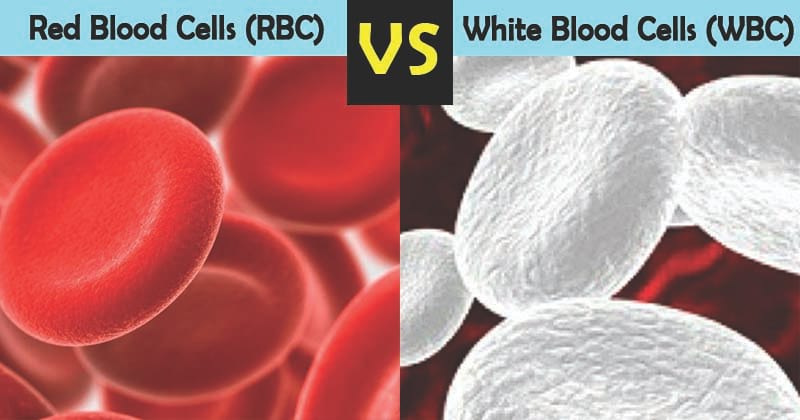
RBC vs WBC (Table form)
| S.N. | Characteristics | Red Blood Cells (RBCs) | White Blood Cells (WBCs) |
|---|---|---|---|
| 1. | Alternative Name | Erythrocytes | Leucocytes |
| 2. | Origin | In the embryonic phase, they are formed in the liver and spleen. However, after birth, they are formed in the red bone marrow. | They are formed in red bone marrow, lymph nodes, spleen, etc |
| 3. | Process of Formation | Formation of RBCs is called “Erythropoiesis” | Formation of WBCs is called “Leucopoiesis” |
| 4. | Abundance | More abundant (4-5 million /mm3) They are the most abundant cell in the blood, accounting for about 40 to 45 percent of its volume. | They are much fewer in number than red blood cells, accounting for about 1 percent of blood (8000 /mm3). |
| 5. | Size | Smaller than WBC ( 0.008 mm diameter ) | Larger than RBC (0.02mm) |
| 6. | Shape | Biconcave disc-shaped | Irregular or round in shape |
| 7. | Colour | Red cells are pinkish‐brown in color. | White cells are colorless. |
| 8. | Hemoglobin | The complex protein, hemoglobin, is the major constituent of RBCs. | Hemoglobin is absent in WBCs. |
| 9. | Nucleus | The nucleus is absent (anucleate). | Present and may be bilobed, irregular or round. |
| 10. | Circulatory system | Belong to the cardiovascular system | Belong to the lymphatic system |
| 11. | Types | Single type. | In healthy people, there are at least five types of white cells in the circulating blood. White cells are divided into granulocytes, monocytes, and lymphocytes. |
| 12. | Number Increment | Number increases during exercise or when at high altitudes. | The infection leads to an increase in the number of WBCs. |
| 13. | Life span | The average life span of 120 days | Life span ranges from 5-21 days. |
| 14. | Motility | Non-motile but can move through circulation and have the ability to squeeze through small capillaries. | Generally motile. |
| 15. | Movement | Movement is Primarily between the cardiovascular system | Between the cardiovascular and lymphatic systems. |
| 16. | Movement type | Do not leave the blood vessel | They can leave blood from capillaries and land in tissues. |
| 17. | Rouleaux formation | Forms stacks or aggregation called Rouleaux | Do not form Rouleaux |
| 18. | Related disorders | Disorders result in anemia, thalassemia, polycythemia vera, etc. | Lymphoma, Leukemia, Myelodysplastic syndrome (MDS) |
| 19. | Function | Carry respiratory gases- oxygen and carbon dioxide. Also, it contributes to blood viscosity. | Phagocytosis and defensive role including antibody production. |
References
- https://www.livestrong.com/article/106131-white-blood-cells-functions/
- https://www.diffen.com/difference/RBC\_vs\_WBC
- https://theydiffer.com/difference-between-red-and-white-blood-cells/
- http://simplebiologyy.blogspot.com/2015/04/table-comparison-between-red-blood-cells-erythrocytes-white-blood-cells-leucocytes-platelets-thrombocytes.html
- http://www.hematology.org/Patients/Basics/
About Author

Sagar Aryal is a microbiologist and a scientific blogger. He completed his Ph.D. degree in Microbiology from the Central Department of Microbiology, Tribhuvan University, Kathmandu, Nepal in 2025. He was awarded the DAAD Research Grant to conduct part of his Ph.D. research work for two years (2019-2021) at Helmholtz-Institute for Pharmaceutical Research Saarland (HIPS), Saarbrucken, Germany. Sagar is interested in research on actinobacteria, myxobacteria, and natural products. He is the Research Head of the Department of Natural Products, Kathmandu Research Institute for Biological Sciences (KRIBS), Lalitpur, Nepal. Sagar has more than 15 years of experience in blogging, content writing, and SEO. Sagar was awarded the SfAM Communications Award 2015: Professional Communicator Category from the Society for Applied Microbiology (Now: Applied Microbiology International), Cambridge, United Kingdom (UK). Sagar is also the ASM Young Ambassador to Nepal for the American Society for Microbiology since 2023 onwards.