Incubator Uncovered: Types, Uses & Precautions (original) (raw)
An incubator, in microbiology, is an insulated and enclosed device that provides an optimal condition of temperature, humidity, and other environmental conditions required for the growth of organisms.
An incubator is a piece of vital laboratory equipment necessary for cultivating microorganisms under artificial conditions.
An incubator can be used to cultivate both unicellular and multicellular organisms.
- Components/Parts of Incubator
- Principle/ Working of Incubator
- Procedure for running an incubator
- Types of incubators
- Uses of Incubator
- Precautions
- References
- Sources
Components/Parts of Incubator
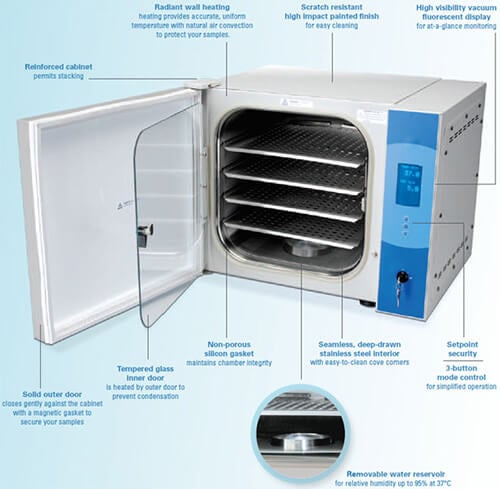
Image Source: McQueen Laboratory.

A microbial incubator is made up of various units, some of which are:
Cabinet
- The cabinet is the main body of the incubator consisting of a double-walled cuboidal enclosure with a capacity ranging from 20 to 800L.
- The outer wall is made up of stainless steel sheets while the inner wall is made up of aluminum.
- The space between the two walls is filled with glass wool to provide insulation to the incubator.
- The insulation prevents heat loss and reduces electric consumption, thereby ensuring the smooth working of the device.
- The inner wall of the incubator is provided with inward projections that support the shelves present inside the incubator.
Door
- A door is present in all incubators to close the insulated cabinet.
- The door also has insulation of its own. It is also provided with a glass that enables the visualization of the interior of the incubator during incubation without disturbing the interior environment.
- A handle is present on the outside of the door to help with the maneuvering of the door.
Control Panel
- On the outer wall of the incubator is a control panel with all the switches and indicators that allows the parameters of the incubator to be controlled.
- The control panel also has a witch to control the thermostat of the device.
Thermostat
- A thermostat is used to set the desired temperature of the incubator.
- After the desired temperature is reached, the thermostat automatically maintains the incubator at that temperature until the temperature is changed again.
Perforated shelves
- Bound to the inner wall are some perforated shelves onto which the plates with the culture media are placed.
- The perforations on the shelves allow the movement of hot air throughout the inside of the incubator.
- In some incubators, the shelves are removable, which allows the shelves to be cleaned properly.
Asbestos door gasket
- The asbestos door gasket provides an almost airtight seal between the door and the cabinet.
- This seal prevents the outside air from entering the cabinet and thus, creating an isolated hot environment inside the cabinet without being interrupted by the external environment.
L-shaped thermometer
- A thermometer is placed on the top part of the outer wall of the incubator.
- One end of the thermometer provided with gradations remains outside of the incubator so that temperature can be read easily.
- The next end with the mercury bulb is protruded slightly into the chamber of the incubator.
HEPA filters
- Some advanced incubators are also provided with HEPA filters to lower the possible contamination created due to airflow.
- AN air-pump with filters creates a closed-loop system so that the air flowing inside the incubator generates less contamination.
Humidity and gas control
- The CO2 incubators are provided with a reservoir underneath the chamber that contains water.
- The water is vapourised to maintain the relative humidity inside the chamber.
- Similarly, these incubators are also provided with gas chambers to give the desired concentration of CO2 inside the incubator.
Principle/ Working of Incubator
- An incubator is based on the principle that microorganisms require a particular set of parameters for their growth and development.
- All incubators are based on the concept that when organisms are provided with the optimal condition of temperature, humidity, oxygen, and carbon dioxide levels, they grow and divide to form more organisms.
- In an incubator, the thermostat maintains a constant temperature that can be read from the outside via the thermometer.
- The temperature is maintained by utilizing the heating and no-heating cycles.
- During the heating cycle, the thermostat heats the incubator, and during the no-heating period, the heating is stopped, and the incubator is cooled by radiating heat to the surrounding.
- Insulation from the outside creates an isolated condition inside the cabinet, which allows the microbes to grow effectively.
- Similarly, other parameters like humidity and airflow are also maintained through different mechanisms that create an environment similar to the natural environment of the organisms.
- Similarly, they are provided with adjustments for maintaining the concentration of CO2 to balance the pH and humidity required for the growth of the organisms.
- Variation of the incubator like a shaking incubator is also available, which allows for the continuous movement of the culture required for cell aeration and solubility studies.
Procedure for running an incubator
Once the cultures of organisms are created, the culture plates are to be placed inside an incubator at the desired temperature and required period of time. In most clinical laboratories, the usual temperature to be maintained is 35–37°C for bacteria.
The following are the steps to be followed while running an incubator:
- Before using the incubator, it should be made sure that no remaining items are present in the incubator from the previous cycles. However, in some cases, if the same incubator is being used for multiple organisms, and they require the same set of parameters, they can be placed together in the same incubator.
- The door of the incubator is then kept closed, and the incubator is switched on. The incubator has to be heated up to the desired temperature of the growth of the particular organism. The thermometer can be used to see if the temperature has reached.
- In the meantime, if the organism requires a particular concentration of CO2 or a specific humidity, those parameters should also be set in the incubator.
- Once all the parameters are met, the petri dish cultures are placed on the perforated shelves upside down, i.e., media uppermost. This is necessary because if the plates are incubated normally, condensation collects on the surface of the medium and prevents the formation of isolated colonies.
- If it is necessary to incubate Petri dish cultures for several days, the plates are sealed with adhesive tapes or are placed in plastic bags or plastic food containers.
- Now, the door is locked, and the plates are kept inside for the required time before taking them out.
Types of incubators
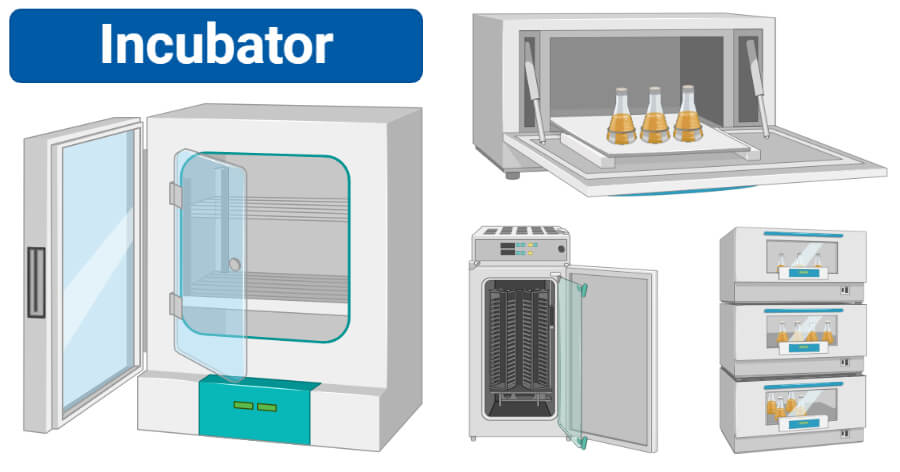
Figure: Some Incubators used in Microbiology Lab. Image created using biorender.com
On the basis of the presence of a particular parameter or the purpose of the incubator, incubators are divided into the following types:
Benchtop incubators
- This is the most common type of incubator used in most of the laboratories.
- These incubators are the basic types of incubators with temperature control and insulation.
CO2 incubators
- CO2 incubators are the special kinds of incubators that are provided with automatic control of CO2 and humidity.
- This type of incubator is used for the growth of the cultivation of different bacteria requiring 5-10% of CO2 concentration.
- For humidity control, water is kept underneath the cabinet of the incubator.
Cooled incubators
- For incubation at temperatures below the ambient, incubators are fitted with modified refrigeration systems with heating and cooling controls.
- This type of incubator is called the cooling incubator.
- In the cooling incubator, the heating and cooling controls should be appropriately balanced.
Shaker incubator
- A thermostatically controlled shaker incubator is another piece of apparatus used to cultivate microorganisms.
- Its advantage is that it provides a rapid and uniform transfer of heat to the culture vessel, and its agitation provides increased aeration, resulting in acceleration of growth.
- This incubator, however, can only be used for broth or liquid culture media.
Portable incubator
- Portable incubators are smaller in size and are used in fieldwork, e.g. environmental microbiology and water examination.
Incubators have a wide range of applications in various areas including cell culture, pharmaceutical studies, hematological studies, and biochemical studies.
Some of the uses of incubators are given below:
- Incubators are used to grow microbial culture or cell cultures.
- Incubators can also be used to maintain the culture of organisms to be used later.
- Some incubators are used to increase the growth rate of organisms, having a prolonged growth rate in the natural environment.
- Specific incubators are used for the reproduction of microbial colonies and subsequent determination of biochemical oxygen demand.
- These are also used for breeding of insects and hatching of eggs in zoology.
- Incubators also provide a controlled condition for sample storage before they can be processed in the laboratories.
Precautions
The following precautions are to be followed while running an incubator:
- As microorganisms are susceptible to temperature change, the fluctuations in temperature of the cabinet by repeatedly opening the door should be avoided.
- The required parameters growth of the organism should be met before the culture plates are placed inside the cabinet.
- The plates should be placed upside down with the lid at the bottom to prevent the condensation of water on to the media.
- The inside of the incubators should be cleaned regularly to prevent the organisms from settling on the shelves or the corners of the incubator.
- While running the incubator for an extended period of time, sterile water should be placed underneath the shelves to prevent the culture media from drying out.
References
- Collins CH, Patricia M, and Lyne JM (1995). Collins and Lynes Microbiological Methods 7th edition. Grange, Butter Worth, Oxford.
- Cappucino JG and Sherman N (1996). Microbiology, A Laboratory Manual 4th edition. Benjamin Cumings Inc. California.
- https://www.atmosafe.net/en/glossary/incubator.html
- https://microbenotes.com/instruments-used-in-microbiology-lab/
- https://www.labmanager.com/product-focus/incubators-20299
Sources
- 1% – https://www.pipette.com/shaking-incubators
- 1% – https://www.cliffsnotes.com/study-guides/biology/microbiology/microbial-cultivation-and-growth/microbial-cultivation
- 1% – https://suyatnorindang.blogspot.com/2019/08/microbiology-l-b-o-r-t-o-r-y-m-n-u-l.html
- 1% – https://energysavingtrust.org.uk/home-insulation/cavity-wall
- 1% – http://www.associatedscientific.com/pdf/Incubator%20Shaker%20%20with%20Humidity.pdf
- 1% – http://tslabor.hu/depo/Inkubator/Brochure\_Slimcell\_Incubators\_and\_Ovens.pdf
- <1% – https://www.researchgate.net/post/What\_is\_the\_statistical\_relationship\_between\_CO2\_concentration\_level\_and\_Global\_change\_in\_Temperature
- <1% – https://www.ecostarinsulation.ca/blog/how-insulation-prevent-heat-loss
- <1% – https://www.dummies.com/education/science/anatomy/body-maintains-constant-temperature-thermoregulation/
- <1% – https://www.britannica.com/technology/incubator
- <1% – https://hvac-talk.com/vbb/showthread.php?1091441-Air-in-a-closed-loop-system
- <1% – http://pharmapathway.com/usage-bod-bacteriological-incubator-differences/
About Author

Anupama Sapkota has a bachelor’s degree (B.Sc.) in Microbiology from St. Xavier's College, Kathmandu, Nepal. She is particularly interested in studies regarding antibiotic resistance with a focus on drug discovery.