Laminar Flow Hood/Cabinet: Parts, Principle, Types, Uses (original) (raw)
A Laminar flow hood/cabinet is an enclosed workstation that is used to create a contamination-free work environment through filters to capture all the particles entering the cabinet.
- These cabinets are designed to protect the work from the environment and are most useful for the aseptic distribution of specific media and plate pouring.
- Laminar flow cabinets are similar to biosafety cabinets with the only difference being that in laminar flow cabinets the effluent air is drawn into the face of the user.
- In a biosafety cabinet, both the sample and user are protected while in the laminar flow cabinet, only the sample is protected and not the user.
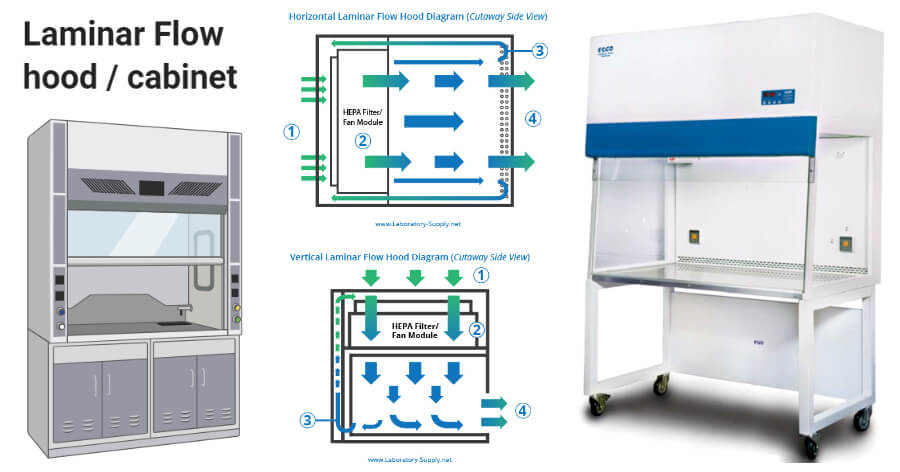
Image Source: Laboratory-supply.net and ProfiLab24. Created with Biorender.com.
- Components/ Parts of Laminar flow hood
- Principle/ Working of Laminar flow hood
- Procedure for running the laminar flow cabinet
- Types of laminar flow cabinet
- Uses of Laminar flow hood
- Precautions
- References and Sources
Components/ Parts of Laminar flow hood
A laminar flow cabinet consists of the following parts:
1. Cabinet
- The cabinet is made up of stainless steel with less or no gaps or joints preventing the collection of spores.
- The cabinet provides insulation to the inner environment created inside the laminar flow and protects it from the outside environment.
- The front of the cabinet is provided with a glass shield which in some laminar cabinets opens entirely or in some has two openings for the user’s hands to enter the cabinet.
2. Working station
- A flat working station is present inside the cabinet for all the processes to be taken place.
- Culture plates, burner and loops are all placed on the working station where the operation takes place.
- The worktop is also made up of stainless steel to prevent rusting.
3. Filter pad/ Pre-filter
- A filter pad is present on the top of the cabinet through which the air passes into the cabinet.
- The filter pad traps dust particles and some microbes from entering the working environment within the cabinet.
4. Fan/ Blower
- A fan is present below the filter pad that sucks in the air and moves it around in the cabinet.
- The fan also allows the movement of air towards the HEPA filter sp that the remaining microbes become trapped while passing through the filter.
5. UV lamp
- Some laminar flow hoods might have a UV germicidal lamp that sterilizes the interior of the cabinet and contents before the operation.
- The UV lamp is to be turned on 15 minutes before the operation to prevent the exposure of UV to the body surface of the user.
6. Fluorescent lamp
- Florescent light is placed inside the cabinet to provide proper light during the operation.
7. HEPA filter
- The High-efficiency particulate air filter is present within the cabinet that makes the environment more sterile for the operation.
- The pre-filtered air passes through the filter which traps fungi, bacteria and other dust particles.
- The filter ensures a sterile condition inside the cabinet, thus reducing the chances of contamination.
Principle/ Working of Laminar flow hood
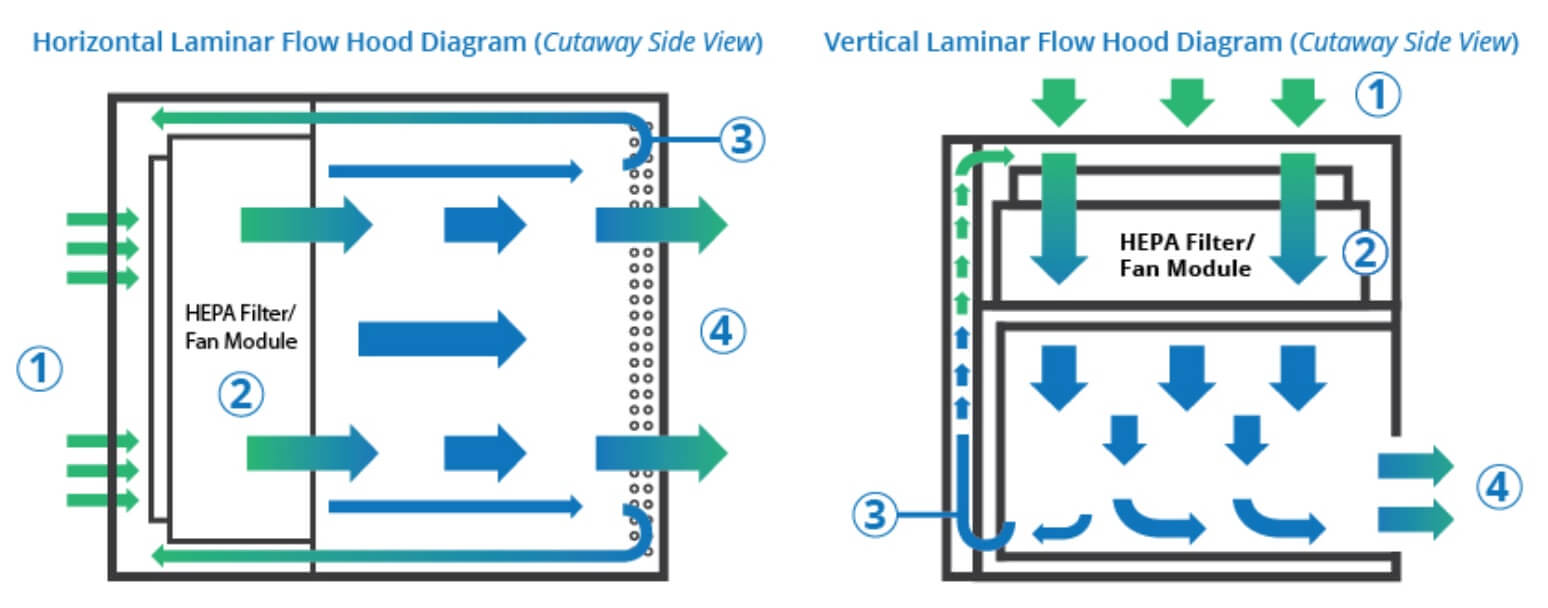
Image Source: Laboratory-supply.net
- The principle of laminar flow cabinet is based on the laminar flow of air through the cabinet.
- The device works by the use of inwards flow of air through one or more HEPA filters to create a particulate-free environment.
- The air is taken through a filtration system and then exhausted across the work surface as a part of the laminar flow of the air.
- The air first passes through the filter pad or pre-filter that allows a streamline flow of air into the cabinet.
- Next, the blower or fan directs the air towards the HEPA filters.
- The HEPA filters then trap the bacteria, fungi and other particulate materials so that the air moving out of it is particulate-free air.
- Some of the effluent air then passes through perforation present at the bottom rear end of the cabinet, but most of it passes over the working bench while coming out of the cabinet towards the face of the operator.
- The laminar flow hood is enclosed on the sides, and constant positive air pressure is maintained to prevent the intrusion of contaminated external air into the cabinet.
Procedure for running the laminar flow cabinet
The procedure to be followed while operating a laminar flow cabinet is given below:
- Before running the laminar flow cabinet, the cabinet should be checked to ensure that nothing susceptible to UV rays is present inside the cabinet.
- The glass shield of the hood is then closed, and the UV light is switched on. The UV light should be kept on for about 15 minutes to ensure the surface sterilization of the working bench.
- The UV light is then switched off, and a time period of around 10 minutes is spared before the airflow is switched on.
- About 5 minutes before the operation begins, the airflow is switched on.
- The glass shield is then opened, and the fluorescent light is also switched on during the operation.
- To ensure more protection, the working bench of the cabinet can be sterilized with other disinfectants like 70% alcohol.
- Once the work is completed, the airflow and florescent lamp both are closed and the glass shield is also closed.
Depending on the direction of movement of air, laminar flow cabinets are divided into two types:
1. Vertical laminar flow cabinet
- In the vertical flow cabinets, the air moves from the top of the cabinet directly towards the bottom of the cabinet.
- A vertical airflow working bench does not require as much depth and floor space as a horizontal airflow hood which makes it more manageable and decreases the chances of airflow obstruction or movement of contaminated air downstream.
- The vertical laminar flow cabinet is also considered safer as it doesn’t blow the air directly towards the person carrying out the experiments.
2. Horizontal laminar flow cabinet
- In the horizontal laminar flow cabinets, the surrounding air comes from behind the working bench, which is then projected by the blower towards the HEPA filters.
- The filtered air is then exhausted in a horizontal direction to the workplace environment.
- One advantage of this cabinet is that airflow parallel to the workplace cleanses the environment with a constant velocity.
- The elluent air directly hits the operator, which might reduce the security level of this type of laminar flow cabinets.
Uses of Laminar flow hood
The following are some common uses of a laminar flow cabinet in the laboratory:
- Laminar flow cabinets are used in laboratories for contamination sensitive processes like plant tissue culture.
- Other laboratories processes like media plate preparation and culture of organisms can be performed inside the cabinet.
- Operations of particle sensitive electronic devices are performed inside the cabinet.
- In the pharmaceutical industries, drug preparation techniques are also performed inside the cabinet to ensure a particulate-free environment during the operations.
- Laminar flow cabinets can be made tailor-made for some specialized works and can also be used for general lab techniques in the microbiological as well as the industrial sectors.
Precautions
While operating the laminar airflow, the following things should be considered:
- The laminar flow cabinet should be sterilized with the UV light before and after the operation.
- The UV light and airflow should not be used at the same time.
- No operations should be carried out when the UV light is switched on.
- The operator should be dressed in lab coats and long gloves.
- The working bench, glass shield, and other components present inside the cabinet should be sterilized before and after the completion of work.
References and Sources
- Collins CH, Patricia M, and Lyne JM (1995). Collins and Lynes Microbiological Methods 7th edition. Grange, Butter Worth, Oxford.
- 5% – https://www.lamsys.com/products/vertical\_laminar\_flow/
- 2% – https://www.laminarflows.co.uk/
- 1% – https://magnaflux.eu/en/Resources/FAQs/FAQs-UV-Lamps
- 1% – https://en.wikipedia.org/wiki/Laminar\_flow\_cabinet
- <1% – https://www.trane.com/residential/en/products/indoor-air-quality/cleaneffects/
- <1% – https://www.sciencedirect.com/topics/immunology-and-microbiology/laminar-flow-cabinet
- <1% – https://www.safety.rochester.edu/ih/uvlight.html
- <1% – https://www.light-sources.com/solutions/germicidal-uvc-lamps/uv-germicidal-lamps/uv-germicidal-bulb/
- <1% – https://www.labogene.com/Biological-Safety-Cabinets
- <1% – https://www.filtermakers.com.au/hepa-filter/
- <1% – https://www.diamed.bg/upl\_doc/Aquaria%20product%20catalog\_Laminarni\_boksove.pdf
- <1% – https://www.chegg.com/homework-help/definitions/the-path-of-airflow-in-humans-14
About Author

Anupama Sapkota has a bachelor’s degree (B.Sc.) in Microbiology from St. Xavier's College, Kathmandu, Nepal. She is particularly interested in studies regarding antibiotic resistance with a focus on drug discovery.