Missense Mutation- Definition, Causes, Mechanism, Types, Examples (original) (raw)
A missense mutation is a type of mutation where the alteration of a nucleotide base in a gene sequence results in the translation of different amino acids in the protein.
- A missense mutation is a type of nonsynonymous substitution in a DNA sequence, indicating that the mutation results in some kind of effect on the resulting sequence.
- The effect caused by missense mutation, however, depends on the location of the mutation and the nucleotide.
- In some cases, the substitution can occur at a position that doesn’t significantly affect the sequence of mRNA or the protein.
- As multiple codons can encode for the same amino acids, there are cases where the changed codon also codes the original amino acid, in which case the mutation is termed silent mutation.
- Nevertheless, there are cases where the mutation can be severe, resulting in the loss of protein function.
- The loss of protein function is responsible for different human diseases like sickle cell anemia, ALS, and Epidermolysis bullosa.
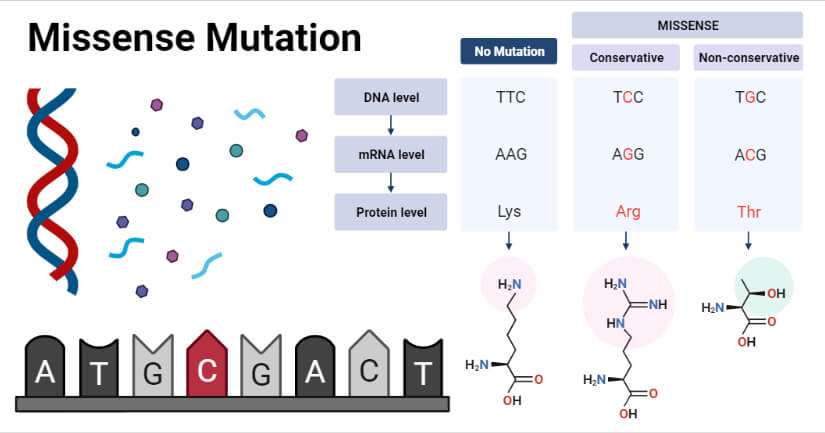
Created with BioRender.com
The missense mutation, like most other mutations, is caused either spontaneously or by the induction by mutagens.
The mutation is often caused during DNA replication, where point mutation occurs at a particular location within the DNA sequence.
The spontaneous mutation is common during processes like DNA replication and processing. The changes occur either at a particular point (point mutation) or over a region of sequence (frameshift mutation).
The induced mutation is commonly caused by different physical agents like X-rays and UV radiation. The radiation can cause ionization of the molecules, which in turn changes the general composition of the DNA molecule.
Besides, chemical species like reactive oxygen species that are produced in the biochemical processes in the body can also act as mutagens in different cases.
The induced mutation affects the double-stranded DNA helix, whereas the spontaneous mutation can occur both on the single strand as well as double-strand.
During DNA replication, some portion of the sequence can also be digested by nucleases which changes the original sequence.
Mechanism of missense mutation
- The mechanism of missense mutation depends on the cause of the mutation. However, some of the common mechanisms include deletion, substitution, insertion, and transformation.
- The most common mechanism of mutation is a tautomeric shift of the nucleotides where the hydrogen atoms of the base move in a way that changes the properties of bonding.
- As all nucleotides exist in two tautomeric forms; keto form and enol form. The keto form in the common form and the enol forms are mostly rare.
- The change in the tautomeric form can affect the complementary base pairing between the nucleotides. This, in turn, affects the mRNA sequence after translation. As a result, the resulting amino acid sequence is also affected.
- Other mechanisms include processes like deletion, where a particular nucleotide is deleted from the sequence.
- Some missense mutations can arise from insertion where the addition of an extra nucleotide changes the codon sequence, which, in turn, changes the amino acid it codes for.
- Missense mutation changes the structure and sequence of nucleotides of the chromosomes, which alters the sequence in mRNA and proteins.
Types of Missense Mutation
Missense mutation can be differentiated into two distinct types depending on the severity of the mutation.
Conservative
- A Conservative missense mutation is the type of missense mutation where the mutation results in an amino acid that is similar in function and properties to the original amino acid.
- A Conservative missense mutation is less severe where the mutation might result in the loss of the function of the protein, but it is only minor.
- In this case, the slowed or slightly changed function of a protein might actually increase the fitness of the organism in the ecosystem.
- Thus, conservative missense mutation can act as a factor of natural selection, enabling the group of organisms to survive through different environmental conditions.
- The change in the function of the protein in conservative missense mutation is less drastic and often beneficial.
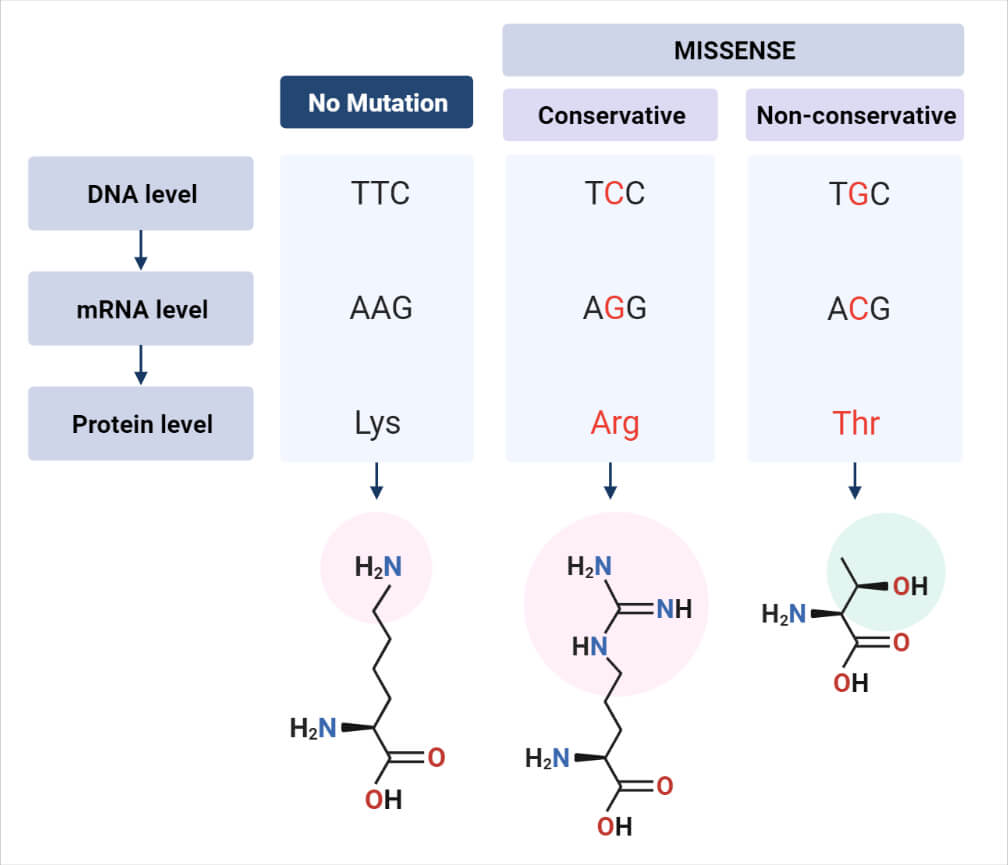
Created with BioRender.com
Non-conservative
- A non-conservative missense mutation is a type of missense mutation where the alteration in nucleotide causes the formation of a completely different kind of amino acid in the chain.
- A common case of non-conservative missense mutation is observed where, in the place of non-polar amino acid, a polar amino acid is added.
- A non-conservative missense mutation is severe, and might brings drastic changes to the amino acid sequence formed from the DNA.
- The change in the amino acid sequence brings changes in the structure of the protein, which in turn affects its function.
- The missense mutation can affect all primary, secondary and tertiary structures of the protein. The change in amino acids often changes the pattern of bonding between them which affects the alpha-helix or beta-sheet structure of the protein.
- In the case of quaternary structure, missense mutation prevents a particle polypeptide from joining a larger protein complex. This can eventually affect the entire biochemical pathways.
Applications of missense mutation
The following are some of the application of missense mutation in living systems;
- Missense mutation can affect genes that are involved in the pathogenesis of various diseases.
- Induced missense mutation can be used as a means of molecular therapy to cure and prevent different genetic disorders.
- Mutagens can be used to target cancer cells so as to induce missense mutation and cause the destruction of proteins of the cell.
- The changes in living beings as a result of missense mutation can be beneficial for the survival of the organisms in an ecosystem.
- Missense mutations in laboratory conditions have been used to generate new and improved crops as a part of mutation breeding.
- Missense mutations can be used as a method to reveal the stability of proteins, their interaction and characteristics of various active sites.
Examples of missense mutation
- Sickle cell anemia is a classic example of missense point mutation, where the mutation results in the production of different amino acids that affects the overall structure of the protein.
- This causes a change in the structure of the red blood cells while changing the ability of the cells to acquire oxygen and cause blood clotting.
- The point mutation, in this case, occurs at the upstream of the gene coding for the amino acids involved in the production of proteins forming the wall of the blood cell.
- The difference in nucleotides results in the production of a different amino acid which brings about the difference in the structure of the blood cell.
References
- Zhou, Xi et al. “Classification of Missense Mutations of Disease Genes.” Journal of the American Statistical Association vol. 100,469 (2005): 51-60. doi:10.1198/016214504000001817
- Hijikata, Atsushi et al. “Decoding disease-causing mechanisms of missense mutations from supramolecular structures.” Scientific Reports vol. 7,1 8541. 17 Aug. 2017, doi:10.1038/s41598-017-08902-1
- Zhang, Zhe et al. “Analyzing effects of naturally occurring missense mutations.” Computational and mathematical methods in medicine vol. 2012 (2012): 805827. doi:10.1155/2012/805827
- https://biologydictionary.net/missense-mutation/
About Author

Anupama Sapkota has a bachelor’s degree (B.Sc.) in Microbiology from St. Xavier's College, Kathmandu, Nepal. She is particularly interested in studies regarding antibiotic resistance with a focus on drug discovery.