Neutrophils: Structure, Count, Range, Functions (original) (raw)
Neutrophils are a type of white blood cell with multi-lobed nuclei and stainable cytoplasmic granules.
- These are the most abundant granulocytes, occupying about 40-60% of the total number of white blood cells in the blood.
- Neutrophils, like all other blood cells, are formed from the stem cells in the bone marrow.
- After differentiation in the bone marrow, neutrophils are released into the peripheral blood and circulate for 7 to 10 hours before migrating into the tissues, where they have a life span of only a few days.
- These are highly motile, allowing them to move in and out of the cells and tissue during infection quickly.
- The neutrophils are divided into two groups; neutrophil-killers and neutrophil-cagers.
- Neutrophils are at the front lines of attack during an immune response and are considered part of the innate immune system.
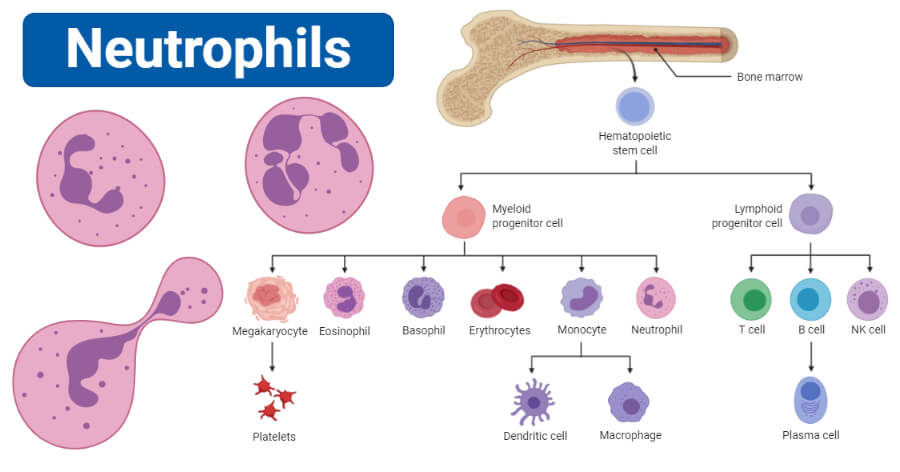
Neutrophils
- Neutrophil Structure
- Neutrophils Test/ Absolute Neutrophil Count
- Neutrophils Normal Range
- Neutrophils Low (with causes)
- Neutrophil Mechanisms Video Lecture (Thomas Underhill)
- Neutrophil High (with causes)
- Neutrophils Functions
- References
Neutrophil Structure
- Neutrophils are mostly circular ranging in size from 12-15 µm (in humans, the average size is 8.85 µm).
- Their shape changes into amoeboid once they are activated so that they can extend their pseudopodia to attack invaders.
- These are the smallest of all granulocytes with a characteristic multi-lobed nucleus with 3-5 lobes joined by a slender strand of genetic material.
- The nucleolus is present in young neutrophils but is lost as the neutrophil matures.
- The cytoplasm of the neutrophils has a large number of purple-colored granules, termed azurophilic or primary granules that have microbicidal activity.
- Additionally, secondary granules are also found int eh cytoplasm that contains lysozyme, collagenase, and other enzymes.
- Other cytoplasmic organelles like mitochondria, Golgi complex appear sparingly, and the endoplasmic reticulum is entirely absent.

Forms of Neutrophil
Neutrophils Test/ Absolute Neutrophil Count
- Absolute Neutrophil Count (ANC) is the test to measure the number of neutrophils and other granulocytes (collectively termed polymorphonuclear cells) present in a blood sample.
- This test usually detects the total number of white blood cells which includes both mature and immature neutrophils.
- The neutrophil blood count breakdown neutrophils into two categories as segmented or mature neutrophils and immature neutrophils or bands.
- The neutrophil count is commonly conducted to detect abnormalities related to the increase or decrease in the number of neutrophils.
- The abnormal count of neutrophils is often associated with various medical conditions, which makes this test an essential part of the laboratory examination of many diseases.
- The formula for calculation of absolute neutrophil count is given below:

Or
ANC= Absolute mature neutrophils + absolute immature neutrophils
- This test is performed to detect the presence of different organisms in the bloodstream and also to detect if the immune system is working correctly.
- ANC is usually performed as a part of the complete blood count to measure the count of different blood cells.
Neutrophils Normal Range
The number of neutrophils in the blood might differ from person to person as it is affected by various factors like age and the environment. However, the following is considered to the normal range of neutrophil count.
In terms of cell count:
The normal range of ANC count in adults: 1500-8000 cells/mm3.
The normal range of mature/ segmented neutrophils: 2500-6000 cells/mm3.
The normal range of immature neutrophils: 0-500 cells/mm3.
In terms of percentage of the WBC:
The normal range of ANC count in adults: 40-45 %
The normal range of mature/ segmented neutrophils: 40-60%
The normal range of immature neutrophils: 0-5%

Targeting Neutrophils in Cancer_ The Pro- and Anti-tumor Activities of Neutrophils
Neutrophils Low (with causes)
When the level of neutrophil is less than 1500 cells/ mm3 of the blood volume, it is considered a low neutrophil level.
This condition is also termed neutropenia. Mild neutropenia is the condition where the levels are between 1000-1500 cells/mm3. When the levels are between 500-100 cells/mm3, it is termed moderate neutropenia. When the levels are below 500 cells/mm3, it is severe neutropenia.
The low neutrophil count is often observed with the ingestion of medication, but it can also be a sign of some other factors or illness.
The causes of the low neutrophil count are:
- The most important cause of low neutrophil count is the intake of medicines, especially those taken during chemotherapy.
- A suppressed immune system caused due to some underlying diseases like AIDS, tuberculosis, and hepatitis also causes low levels of neutrophils.
- Similarly, other conditions like cancer and related bone marrow diseases also result in low neutrophil count.
- Another cause of neutropenia is the deficiency of vitamin B12 and other minerals.
- Autoimmune diseases like Crohn’s disease, lupus, and rheumatoid arthritis also cause a decrease in the count of neutrophils.
Neutrophil Mechanisms Video Lecture (Thomas Underhill)
Neutrophil High (with causes)
When the level of neutrophils is greater than 8000 cells/mm3, it is considered a high neutrophil level.
This condition is termed neutrophilia. Neutrophilia might range from mild, occasional neutrophilia to a more severe condition, often termed neutrophil leukocytosis.
Because neutrophils are a part of the immune system, an increase in the neutrophil count is primarily caused by a bacterial infection, but the increased levels are also caused by other factors.
The causes of the high neutrophil count are:
- The most common cause of neutrophilia is a bacterial infection, especially pyogenic infections resulting in inflammation.
- Besides, increased neutrophil count is also observed during inflammation, usually after heart attacks or burns.
- An increased concentration of cortisol and adrenaline hormones and the ingestion of some drugs like prednisone also cause more neutrophils to enter the bloodstream.
- Neutrophilia is also observed as a result of malignancy like leukemia.
- Surgical procedures, including splenectomy and appendicitis, are also known to increased neutrophil count.
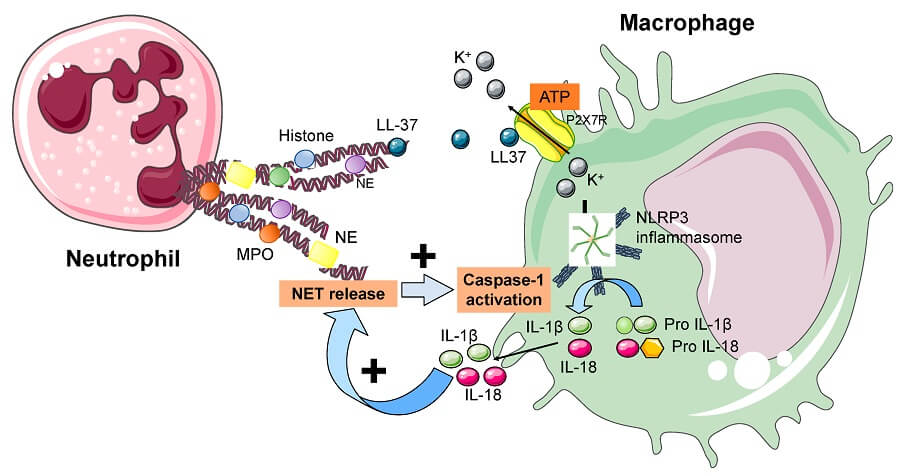
Figure: Interactions between neutrophils and macrophages. Image Source: MDPI (Aldo Bonaventura et al.)
- Neutrophils are the most abundant granulocytes that makeup about 40% of white blood cells and 60% of the immune cells in the blood.
- Neutrophils are the first responders to infection, and they phagocytose bacteria into phagosomes before hydrolyzing and destroying them.
- These cells also secrete a range of proteins that have antimicrobial effects as well as tissue remodeling potential.
- Neutrophils have a short lifespan and thus destroy themselves during the degradation of foreign invaders. New neutrophils are then produced continuously in the bone marrow.
- The neutrophils of another subpopulation, cager neutrophils, perform a transport function of delivering foreign particles to the target site for the action of killer neutrophils.

Neutrophil Recruitment Pathway
References
- Peter J. Delves, Seamus J. Martin, Dennis R. Burton, and Ivan M. Roitt(2017). Roitt’s Essential Immunology, Thirteenth Edition. John Wiley & Sons, Ltd.
- Judith A. Owen, Jenni Punt, Sharon A. Stranford (2013). Kuby Immunology. Seventh Edition. H. Freeman and Company
- Klin Lab Diagn. 2006; (2):34-36.
- http://medcell.med.yale.edu/histology/blood\_bone\_marrow\_lab/neutrophil.php
- https://www.healthline.com/health/neutrophils
- https://training.seer.cancer.gov/abstracting/procedures/clinical/hematologic/blood.html
- https://my.clevelandclinic.org/health/diseases/21058-neutropenia
About Author

Anupama Sapkota has a bachelor’s degree (B.Sc.) in Microbiology from St. Xavier's College, Kathmandu, Nepal. She is particularly interested in studies regarding antibiotic resistance with a focus on drug discovery.