Early Intervention (original) (raw)

Physical therapy focuses on motor development. For example, during the first three to four months of life, an infant is expected to gain head control and the ability to pull to sitting positions (with help) with no head lags and enough strength in the upper torso to maintain an erect posture. Appropriate physical therapy may assist a baby with Down syndrome, who may have low muscle tone, in achieving this milestone.
Before birth and in the first months of life, physical development remains the underlying foundation for all future progress. Babies learn through interaction with their environment. In order to learn, therefore, an infant must have the ability to move freely and purposefully. An infant’s ability to explore his or her surroundings, reach and grasp toys, turn his or her head while watching a moving object, or roll over and crawl are all dependent upon gross as well as fine motor development. These physical, interactive activities foster understanding and mastery of the environment, stimulating cognitive, language, and social development.
Another long-term benefit of physical therapy is that it helps prevent compensatory movement patterns that individuals with Down syndrome are prone to developing. Such patterns can lead to orthopedic and functional problems if not corrected.
Speech and language therapy is a critical component of early intervention. Even though babies with Down syndrome may not say their first words until two or three years of age, there are many pre-speech and pre-language skills that they must acquire before they can learn to form words. These include the ability to imitate and echo sounds; turn-taking skills (learned through games like “peek-a-boo”); visual skills (looking at the speaker and objects); auditory skills (listening to music, speech, or speech sounds for lengthening periods of time); tactile skills (learning about touch, exploring objects in the mouth); oral motor skills (using the tongue, moving the lips); and cognitive skills (understanding object permanence and cause and effect relationships).
A speech and language therapist can help with these and other skills, including breastfeeding. Because breastfeeding employs the same anatomical structures used for speech, it can help strengthen a baby’s jaw and facial muscles and lay the foundation for future communication skills.
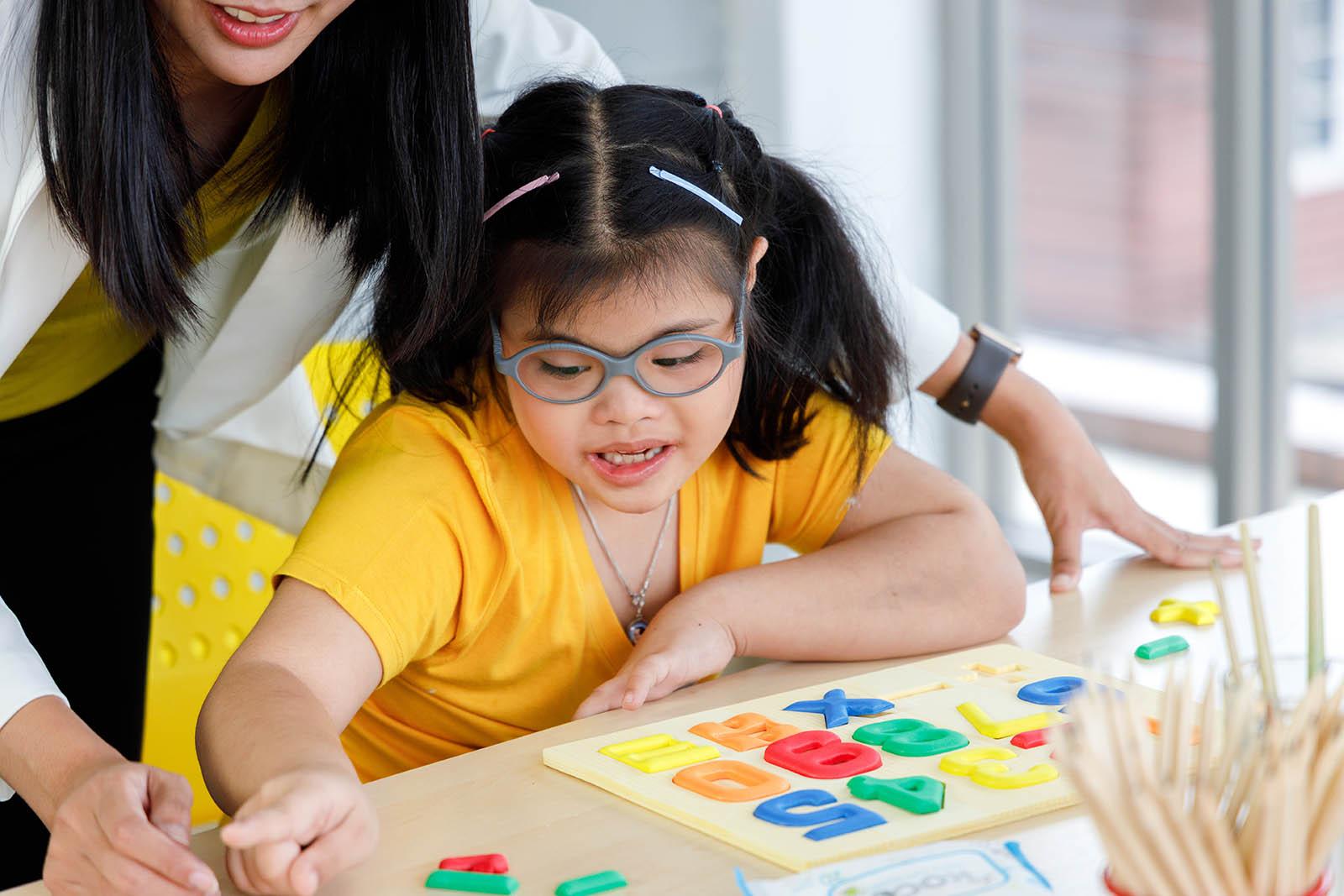
Occupational therapy helps children develop and master skills for independence. Occupational therapy can help with abilities such as opening and closing things, picking up and releasing toys of various sizes and shapes, stacking and building, manipulating knobs and buttons, experimenting with crayons, etc. Therapists also help children learn to feed and dress themselves and teach them skills for playing and interacting with other children.
Early intervention can also prevent a child with Down syndrome from reaching a plateau at some point in development. The overarching goal of early intervention programs is to enhance and accelerate development by building on a child’s strengths and by strengthening those skills that are weaker in all areas of development.
How can parents benefit from early intervention programs?
Programs of early intervention have a great deal to offer to parents in terms of support, encouragement, and information. The programs teach parents how to interact with their infant or toddler, how to meet their child’s specific needs, and how to enhance development.
How do I sign up for early intervention services?
Each state has its own set of laws governing early intervention services. Information on the process for each state can be found here. Early intervention services are individualized to meet the specific needs of each individual baby based on assessments. The caseworker, therapists, and family will determine areas of focus and set goals based on developmental milestones. These will be recorded in a document called the Individualized Family Service Plan (IFSP).
Who pays for early intervention?
The evaluation to determine whether your child is eligible for early intervention is free of charge if performed by a state-authorized entity. No child deemed eligible can be denied services based on ability to pay, but insurance companies may be billed and/or a sliding scale payment may be required, depending on the state. Parents should check with their state’s early intervention center for information about authorized service providers and financial obligations. Frequently, there is little or no cost to parents for these services.
Individualized Family Service Plan (IFSP)
An Individualized Family Service Plan (IFSP) is a written document that outlines the early intervention services that a child will receive when found eligible for early childhood special education services. IFSPs are for children ages birth until three. All children receiving early intervention services under IDEA- Part C must have an IFSP, but specific guidelines for the IFSP vary from state to state.
What happens after age 3?
The Individuals with Disabilities Education Act (IDEA), which regulates early intervention, also mandates that local school districts provide a free, appropriate, public education for preschool-age children with disabilities starting at the age of three, unless doing so would be inconsistent with state law or practice or the order of any court respecting the provision of public education to children between the ages of three and five.