TAPE TRANSFER (original) (raw)
TAPE TRANSFER Recover and upscale legacy video
TAPE TRANSFERsamlivingstone2020-02-12T12:47:37+00:00
Formats We Transfer
Unsure what format you have? Click on the formats below to open an identification guide
VHS (Video Home System)
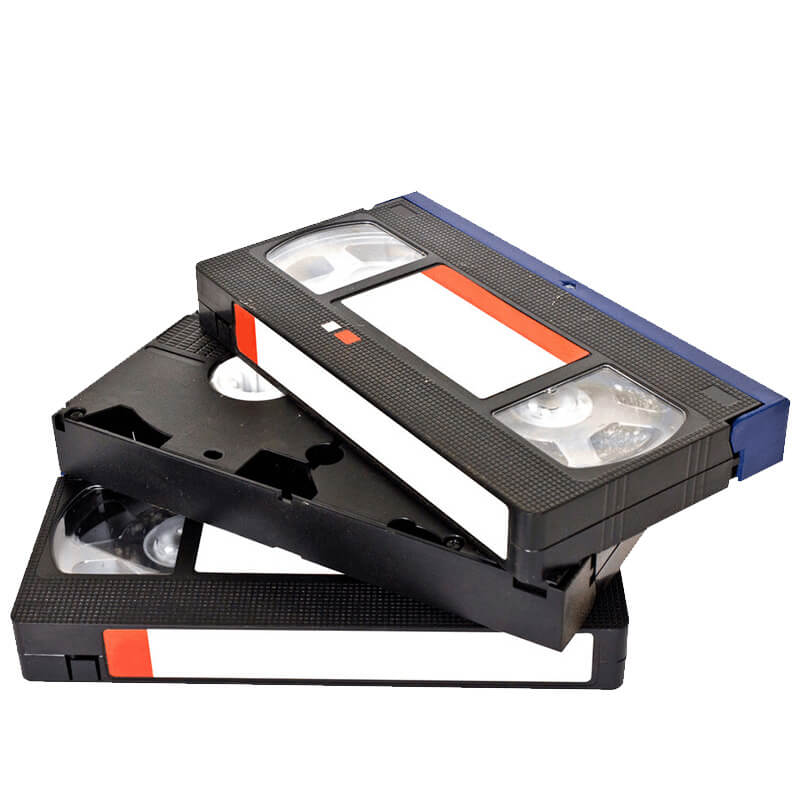
Analogue or Digital: Analogue
Dates in Use: 1977 – late 2000s
Dimensions: 3.5 x 11.9 x 2.5 cm
Description: Cassettes are typically made from black plastic, with white hubs, and clear windows that show both reels. A VHS logo is usually imprinted on the cassette in the upper right-hand corner, while manufacturer name is imprinted in the upper left.
Sources: Museum of Obsolete Media, PSAP
S-VHS
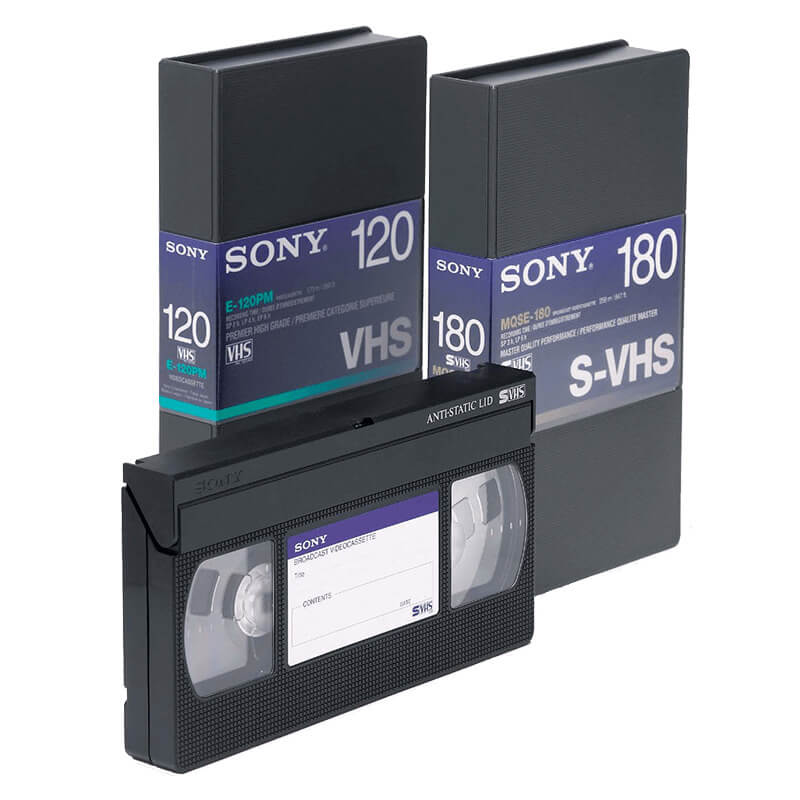
Analogue or Digital: Analogue
Dates in Use: 1987 – late 2000s
Dimensions: 3.5 x 11.9 x 2.5 cm
Description: Cassettes are typically made from black plastic, with white hubs, and clear windows that show both reels. A S- VHS logo is usually imprinted on the cassette in the upper right-hand corner, while manufacturer name is imprinted in the upper left. S-VHS tapes can be distinguished from VHS by an additional hole on the back of the cassette.
Sources: Museum of Obsolete Media, PSAP
VHS-C (Compact VHS)
Analogue or Digital: Analogue
Dates in Use: 1982 – early 2000s
Dimensions: 5.8 x 9.2 x 2 cm
Description: VHS-C is a smaller version of VHS, and was introduced by JVC for use in analogue camcorders. Because it uses the same tape as VHS, VHS-C cassettes can be played back in a VHS machine by use of an adaptor. Come in run times of 30 minutes at SP and 60 for longer-running modes. JVC did market 45-minute and 60-minute SP Mode tapes with the Extra High Grade formulation (135 minutes and 180 minutes in EP/SLP Mode) for a time.
Sources: Museum of Obsolete Media, PSAP
Video 8 (aka 8mm)
Analogue or Digital: Analogue
Dates in Use: 1984 – late 2000s
Dimensions: 9.5 × 6.25 × 1.5 cm
Description: Tape cassettes are usually labeled in the bottom middle of the cassette (between the two reels) Video 8 or 8mm. 8mm-wide magnetic tape is wound between two spools and contained within a hard-shell cassette. Most common tape containers are heavy-duty clear plastic hinged boxes or heavy-duty plastic snap-closure boxes. Some tapes (i.e. Fuji) are in a plastic sleeve. Run times include 60, 90 and 135 minutes at PAL and up to 120 minutes for NTSC.
Sources: Museum of Obsolete Media, PSAP
Hi8 (aka 8mm)
Analogue or Digital: Analogue
Dates in Use: 1989 – late 2000s
Dimensions: 9.5 × 6.25 × 1.5 cm
Description: Tape cassettes are usually labeled in the bottom middle of the cassette (between the two reels) Hi8 or 8mm. 8mm-wide magnetic tape is wound between two spools and contained within a hard-shell cassette. Most common tape containers are heavy-duty clear plastic hinged boxes or heavy-duty plastic snap-closure boxes. Some tapes (i.e. Fuji) are in a plastic sleeve. Run times include 60, 90 and 135 minutes at PAL and up to 120 minutes for NTSC.
Sources: Museum of Obsolete Media, PSAP
Betamax (aka Beta)

Analogue or Digital: Analogue
Dates in Use: 1975 – late 1980s
Dimensions: 15.6 × 9.6 × 2.5 cm
Description: Cassettes are typically made from gray or black plastic, with white hubs, and a clear window that shows only the left-hand reel. The Greek symbol for Beta can be found imprinted in the upper right corner of cassette (Sony) or on the left side of the cassette spine (Scotch).
Sources: Museum of Obsolete Media, PSAP
Video2000 (aka V2000)
Analogue or Digital: Analogue
Dates in Use: 1979 – 1988
Dimensions: 18.3 x 2.5 x 11 cm
Description: The tapes are roughly the same size as VHS, and use ¾ inch chromium dioxide tape. There is a switch on the tape edge which can be turned to red/orange for write protection, and holes along the tape edge were used to indicate the tape length to the player.
Sources: Museum of Obsolete Media, PSAP
VCR (Video Cassette Recording)
Analogue or Digital: Analogue
Dates in Use: 1972 – 1979
Description: VCR was developed by Philips in a variety of models (eg, N1500, N1700). They consist of large square cassettes with 2 co-axial reels, one on top of the other, containing half inch (12.7 mm) wide chrome dioxide magnetic tape. Three playing times were available: 30, 45 and 60 minutes.
Sources: Museum of Obsolete Media, PSAP
U-matic
Analogue or Digital: Analogue
Dates in Use: 1973 – 1990s (U-matic), 1974 – 1990s (U-matic S), 1986 – late 1990s (U-matic SP)
Dimensions: 21.9 x 13.7 x 3 cm (U-matic & U-matic SP), 18.4 x 11.7 x 3 cm (U-matic S)
Description: U-matic cassettes are typically made from grey, black or tan plastic. Hubs can be any number of colours (blue, tan, red), and cassettes have a clear (or slightly blue) window that shows both reels. A small red plastic dot (which must be in place to record on the tape) may be found on the back of cassette. 3/4″ U-matic SP cassettes are dark brown/maroon and have SP and the length written on the spine (3M brand).
Sources: Museum of Obsolete Media, PSAP
Panasonic MII
Analogue or Digital: Analogue
Dates in Use: 1986 – early 1990s
Description: Two sizes of MII cassette were available. The larger one was similar to a VHS cassette in size and had either a 60 or 90 minute recording time, and the smaller version provided 20 minutes. MII tapes use ½ inch wide metal-formulated tape and component video recording.
Sources: Museum of Obsolete Media, PSAP
Digital Betacam (aka Digibeta)
Analogue or Digital: Digital
Dates in Use: 1993 – 2016
Dimensions: 15.6 x 9.5 x 2.5 cm (small), 23.7 x 14.4 x 2.5 cm (large)
Description: Tape cassettes are light gray blue (Sony and Maxell) and are generally labeled as Digital Betacam in the upper right-hand corner, and ‘for Digital’ in the upper left corner. Tape length is often written on the anti-static cover (door) that retracts to reveal the tape.
Sources: Museum of Obsolete Media, PSAP
Half Inch EIAJ Reels (aka EIAJ-1)
Analogue or Digital: Analogue
Dates in Use: 1969 – early 1980s
Dimensions: 12.7 cm diameter (small reels), 18.4 cm (large reels)
Description: There are two common 1/2″ tape versions – CV and AV (EIAJ Type 1) – they look the same, but will playback on different decks. The tape reels are typically made from translucent plastic. The Sony tape containers are typically black and will say “for helical scan video recorders.”
Sources: Museum of Obsolete Media, PSAP
Half Inch EIAJ Cartridges (aka EIAJ-2)
Analogue or Digital: Analogue
Dates in Use: 1972 – late 1970s
Description: The cartridge format was a development of the open reel EIAJ-1 standard and used the same ½-inch tape and recording specifications. The tape was enclosed in a cartridge to do away with the need for manually threading it. EIAJ-2 offered colour recording on 30 and 60 minute cartridges.
Sources: Museum of Obsolete Media, PSAP
1 Inch Type A Reels
Analogue or Digital: Analogue
Dates in Use: 1965 – early 1980s
Dimensions: 29.7 cm diameter
Description: There are numerous forms of 1″ tape that did not succeed in the marketplace, and some are indistinguishable except on playback. 1-inch Type A was a reel-to-reel helical scan analog recording videotape format developed by Ampex in 1965, that was one of the first standardized reel-to-reel magnetic tape formats in the 1 inch (25 mm) width; most others of that size at that time were proprietary. It was capable of 350 line resolution.
Sources: Wikipedia, Little Archives
1 Inch Type B Reels
Analogue or Digital: Analogue
Dates in Use: 1975 – 1980s
Dimensions: 30.3 cm diameter
Description: There are numerous forms of 1″ tape that did not succeed in the marketplace, and some are indistinguishable except on playback. 1-inch Type B was an open reel magnetic tape format for professional analogue video recording. Type B had a standard capacity of 96 minutes on a reel, although later this was increased to 120 minutes. Long play versions eventually became available that could fit up to 6 hours on one reel. Common containers are made from plastic and are rectangular, or have one curved side with a handle. 1″ can also be found in cardboard containers.
Sources: Museum of Obsolete Media, PSAP
1 Inch Type C Reels
Analogue or Digital: Analogue
Dates in Use: 1976 – mid-1990s
Dimensions: 30.3 cm diameter
Description: There are numerous forms of 1″ tape that did not succeed in the marketplace, and some are indistinguishable except on playback. 1-inch Type C was an open reel magnetic tape format for professional analogue video recording. Common containers are made from plastic and are rectangular, or have one curved side with a handle. 1″ can also be found in cardboard containers.
Sources: Museum of Obsolete Media, PSAP
2 Inch Quad Tape (aka 2 Inch Quadruplex)
Analogue or Digital: Analogue
Dates in Use: 1956 – early 1980s
Dimensions: 30.5 cm diameter
Description: Quad tape is substantially larger and heavier than any of the other video formats. Shipping cases for 2″ Quad are a 4″ deep, 15″ square and can weigh 20-30 lbs. You may also find these tapes in cardboard boxes.
Sources: Museum of Obsolete Media, PSAP
miniDV
Analogue or Digital: Digital
Dates in Use: 1995 – late 2000s
Dimensions: 6.5 x 4.8 x 1.1 cm
Description: Tape cassettes are generally labeled in the lower left hand (Sony) or on a sticker on the right side (Panasonic). Note that all MiniDV designations for Panasonic tapes are on stickers or the packaging, and may be covered with labels that list title or production information.
Sources: Museum of Obsolete Media, PSAP
Digital 8 (aka D8)

Analogue or Digital: Digital
Dates in Use: 1999 – 2007
Dimensions: 9.4 x 6 x 1.3 cm
Description: Digital 8 tapes used the same body design and size as a HI8 or 8mm camcorder tapes and provided for playback compatibility with older 8mm and Hi8 tapes. The cassettes are generally labeled in the bottom middle of the cassette (between the two reels) as Digital 8
Sources: Museum of Obsolete Media, PSAP
DVCAM
Analogue or Digital: Digital
Dates in Use: 1996 – present
Dimensions: 6.5 x 4.8 x 1.4 cm (small), 12.4 x 7.6 x 1.4 cm (large)
Description: DVCAM tapes come in two different sizes. The smaller size uses the same form-factor as MiniDV and can hold up to 40 minutes, which the larger size (which is actually the medium size DV tape) can hold up to 184 minutes. Tapes are generally bluish gray and are labeled as DVCAM in the upper right- hand corner. Large cassettes generally have a black anti-static cover, whereas small cassettes generally have a light blue anti-static cover.
TBC
Sources: Museum of Obsolete Media, PSAP
DVCPRO (aka D7)
Analogue or Digital: Digital
Dates in Use: 1995 – early 2010s
Dimensions: 9.7 x 6.4 x 1.4 cm (medium), 12.4 x 7.6 x 1.4 cm (large)
Description: Large cassettes are used in editing decks and will record up to 126 minutes in length. Medium cassettes and are used in cameras to record up to 66 minutes in length. Cassettes are generally dark gray with a yellow anti-static cover (Panasonic) or black with a yellow anti-static cover (Maxell) or black with a red anti-static cover (Fuji). DVCPro logo is in the upper right-hand corner, and tape length is generally listed on left. Panasonic cassettes also designate large cassettes with the letter ‘L’ after tape length (i.e. 126L).
Sources: Museum of Obsolete Media, PSAP
Betacam SX
Analogue or Digital: Digital
Dates in Use: 1996 – 2007
Dimensions: 15.6 x 9.5 x 2.5 cm (small), 23.7 x 14.4 x 2.5 cm (large)
Description: Like other Betacam formats, tape width was ½ inch and cassettes were available in small or large form factors, with the S size holding up to 62 minutes of video, and the L size up to 194 minutes. Betacam SX tape shells were bright yellow.
Sources: Museum of Obsolete Media, PSAP
Betacam IMX (aka D10, MPEG IMX)
Analogue or Digital: Digital
Dates in Use: 2001 – 2016
Dimensions: 15.6 x 9.5 x 2.5 cm (small), 23.7 x 14.4 x 2.5 cm (large)
Description: Like other Betacam formats, tape width was ½ inch and cassettes were available in small or large form factors, with the S size holding up to 60 minutes of video, and the L size up to 184 minutes. To distinguish MPEG IMX tapes from other Betacam formats, the shells were coloured green.
Sources: Museum of Obsolete Media, PSAP
HDCAM
Analogue or Digital: Digital
Dates in Use: 1997 – 2016
Dimensions: 15.6 x 9.5 x 2.5 cm (small), 23.7 x 14.4 x 2.5 cm (large)
Description: Like other Betacam-related formats, HDCAM cassettes were available in large and small sizes with the same tape lengths as Digital Betacam (up to 40 minutes for S and 124 minutes for L tapes). Sony HDCAM tapes were black with an orange lid.
Sources: Museum of Obsolete Media, PSAP
HDCAM SR
Analogue or Digital: Digital
Dates in Use: 2003 – 2016
Dimensions: 15.6 x 9.5 x 2.5 cm (small), 23.7 x 14.4 x 2.5 cm (large)
Description: Like other Betacam-related formats, HDCAM SR cassettes were available in large and small sizes, and had the same tape lengths as Digital Betacam (up to 40 minutes for S and 124 minutes for L tapes). Sony HDCAM SR tapes were black with a blue lid.
Sources: Museum of Obsolete Media, PSAP
D1
Analogue or Digital: Digital
Dates in Use: 1987 – 1990s
Description: D1 was the first SMPTE digital recording video format to be released. Tape cassettes are typically gray and are generally labeled with the name in the upper right-hand corner.
Sources: Museum of Obsolete Media, PSAP
D2
Analogue or Digital: Digital
Dates in Use: 1988 – 2000s
Dimensions: 17.1 x 10.8 x 3.3 cm (small), 25.4 x 14.9 x 3.3 cm (medium)
Description: D2 uses ¾-inch tape in one of three different size cassettes (with maximum playing times of 32, 94, and 208 minutes). The cassettes are very similar to D1, but are not interchangeable and D2 uses metal particle tape. Tape cassettes are typically gray and are generally labeled with the name in the upper right-hand corner.
Sources: Museum of Obsolete Media, PSAP
D3
Analogue or Digital: Digital
Dates in Use: 1990 – present
Dimensions: 21 x 12.4 x 2.3 cm
Description: Tape cassettes are typically gray and are generally labeled with the name in the upper right-hand corner.
Sources: Museum of Obsolete Media, PSAP
D5
Analogue or Digital: Digital
Dates in Use: 1994 – late 2000s
Dimensions: 21 x 12.4 x 2.3 cm
Description: D3 used the same ½-inch tapes as Panasonic’s digital composite D3 video. Tape cassettes are typically gray and are generally labeled with the name in the upper right-hand corner.
Sources: Museum of Obsolete Media, PSAP
D5 HD

Analogue or Digital: Digital
Dates in Use: 1994 – late 2000s
Description: D5 tapes were available in three sizes, S, M and L. S tapes provided up to 23 minutes in D5/D5 HD mode, M tapes provided up to 63 minutes, and L tapes provided up to 94 minutes.
Sources: Museum of Obsolete Media, PSAP
Digital S (aka D9)
Analogue or Digital: Digital
Dates in Use: 1995 – early 2000s
Description: The tape cassette is very similar in size and form factor to VHS.
Sources: Museum of Obsolete Media, PSAP