It’s Still Possible to Be Excited About the 2026 World Cup (original) (raw)

By ,a contributing editor covering sports and film at New York since 2008 and the author of six books, including the novels 'How Lucky' and 'The Time Has Come.'
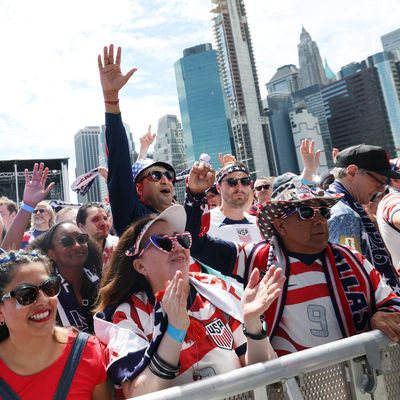
Photo: Vincent Carchietta/USSF/Getty Images
I have been writing about my optimism and excitement over the future of the United States Men’s Soccer Team (USMNT) for so long that there are pieces than ran in this publication (“Leitch: Is 2014 the Year Soccer in America (Truly) Goes Mainstream?”) almost as old as players on the current team. I’ve long adored the USMNT because of its specific place in the American sporting landscape: It’s the only real national team we have that can be legitimately considered an upstart underdog.
In every other major sport (including, most obviously, women’s soccer), the Americans are the favorites or at least established powers: We’re the empire. But Americans — and this has always struck me as a flaw in the national character — never think of themselves as the empire. We always think we’re the rebels, the scrappy overachievers no one believed in, the classic “born on third base and thought they hit a triple” nation.
But the USMNT actually are underdogs, an up-and-coming soccer nation that fans could get on the ground floor of and cheer along as it rose, all the while embracing what I’ve called “hipster patriotism.” This was a team that allowed the flawed image of ourselves to be true, that made it possible to cheer for America without necessarily, you know, cheering for America. And the idea was always that it would culminate in America’s opportunity to strut its stuff on the grandest possible stage: By hosting (well, _co-_hosting) the 2026 World Cup. What better time to show off how far we have come, how clearly we belong among the world’s soccer powers?
It turned out, uh … maybe the summer of 2026 was not, in fact, the best possible time for the entire world to be focusing on the United States — either on a soccer level or an everything else level.
Beyond the obvious unsuitability of this moment from a political perspective, the USMNT has not really lived up to the expectations we had for them four years ago, when they were the youngest in the whole tournament in Qatar (though they did look much better in their friendlies against Senegal last weekend and Germany this weekend). There’s a difference between being an underdog and being cast out of the conversation altogether.
It also doesn’t help that this World Cup, the one we’re hosting, the one that was supposed to be our moment, has so far been such a mess, from the absurd ticket prices to the fact that Iran stilldoesn’t know if it’s going to get visas for its team to enter the United States to worries about ICE staking out venues. For months, everything has felt just off.
So how do longtime USMNT boosters — who have been waiting their whole lives for the United States to host a World cup again — square this particular circle? Can we be that excited for a Donald Trump–ified tournament, and our country’s team, while our country is like this?
I decided to ask three people who know United States soccer as well as anyone and have been following and covering this longer, and far more closely, than I have.
• Roger Bennett, the longtime host of Men in Blazers and the author of We Are the World (Cup), a rollicking and personal history of Bennett’s history intertwined with the USMNT itself. Bennett and his Men in Blazers crew are doing a John Madden–style monthlong bus trip that will follow the tournament to all venues, culminating with the title match in East Rutherford in mid-July.
• Leander Schaerlaeckens, longtime team reporter and author of The Long Game: U.S. Men’s Soccer and Its Savage, Four-Decade Journey to the Top, or Thereabouts, a thorough recent history of the USMNT.
• David Hirshey, who has been on the soccer beat for nearly 50 years, initially covering Pelé and the New York Cosmos for the Daily News and ultimately working as a columnist for the New York Times, ESPN, and Deadspin. Hirshey has written and edited several books including the recent Pride of a Nation: A Celebration of the U.S. Women’s National Soccer Team.
Here’s what they told me:
Bennett: 2014was a more naïve time, football-wise. I’m an American who loves America like Kenny Powers loves America, but that was a different thing in 2014 than now. Not only have the politics changed, but so has the appetite of the football fan base. The USMNT doesn’t actually have to do well for the World Cup to do really well; Americans are much more into international soccer now, and this team is not the default setting like it was for young Will Leitch or young Roger Bennett. If you were a football fan in this country in 2010, 2014, you supported the U.S., but now you support Real Madrid or Liverpool. There’s probably 20 times more Americans excited to watch Arsenal in the Champions League than give a crap about the U.S. men’s national team. That actually makes us a normal footballing nation now. That’s progress.
The World Cup is a mirror that reflects the society that’s around it, the societies that surround it: the politics, the culture, the history. When two teams take the field in World Cup play, a snapshot of their current present reality and their mutual histories take the field alongside them. There’s nothing like France playing Germany in American sports. It’s not the A’s playing the Twins. This is entire historic civilizations colliding. The players feel it, and politics is a part of that.
Football cultures in many Western European countries tend toward the progressive, and then there’s places, like in Eastern Europe, where football culture is a reflection of the far right. The American football fan base has largely tended toward the Western European model. It has largely been progressive, forward-thinking, an eclectic, diverse, welcoming culture around football fandom. The women’s-football fandom is one of the most joyous parts of our footballing identity. But global politicians are drawn to the World Cup for reasons that transcend the sport, and the president, from the very beginning, has realized its power and basked in its spotlight. He understands the power of football as a communicative device and has been so close to this World Cup at every single stage. He will be unmissable at this tournament.
The good news is: The second a ball is kicked, the second Messi takes the field, the second Brazil is in those golden jerseys, the second England shows up with their signature mix of profound insecurity and arrogance … the cognitive dissonance kicks in, and the rational drumbeat just evaporates because we’re all caught in the thrall of the emotional. The world is caught in a global eclipse that sweeps the entire planet. The whole world is watching 22 human beings on that field, and our attention is focused on that and only that. Part of me hopes that will be the scenario that happenshere, that joy, a sense of shared unity that the world cries out for, is created, however fleeting.
But there’s also a dark scenario, man, in which the forces of global geopolitics, our world in chaos, actually seep into the football in ways that are impossible to ignore. And we won’t know until it kicks off. We really won’t.
Schaerlaeckens: In a bit of irony, the 2026 World Cup will be hampered by the fact that the American people know all about it and its attendant issues. Because about a month before the 1994 World Cup, a poll found that something like 80 percent of the country had no idea what the World Cup was or that it was about to be played here. And then the thing washed over the nation like a fluke tsunami of joy that turned a generation of people on to the sport and caused all kinds of other good things to happen for soccer.
This time around, the World Cup comes equipped with terrible energy, owing to the ticket prices, the internal and external politics, all the assorted FIFA fuckery. In a lot of ways, this tournament is supposed to be the culmination of this long march men’s soccer has been on in this country, and it could very well get derailed by forces outside of its control. If 1994 was the pleasant surprise, this one might be the unexpected debacle. And the USMNT might be the victims of that. For years, there was excitement that the USMNT had developed a breakthrough generation at such an auspicious time. But it might have finally built a fun and competitive team at the exact wrong time.
Hirshey: The last four countries to stage the World Cup are South Africa, Brazil, Russia, and Qatar. And now, FIFA, hewing to its exacting standard that a host nation demonstrate the least possible respect for human dignity, has anointed the U.S.
It’s a good fit. The two paragons of integrity — Donald Trump and Gianni Infantino — who are most responsible for the geopolitical griftfest kicking off next month are two peas in the same avaricious pod. Count me among the thousands of suckers who’ve been fleeced by FIFA through ticket prices so extortionate that after glancing at my Visa bill, I required electric paddles to jump-start my heart. So it goes without saying I’ll be there. But don’t expect me to paint my face red, white, and blue.
So that’s where we are. I have long argued that it is impossible to be an ethical sports fan. In the past, that has meant making one’s peace with cheering for players (or owners) with legal issues or putting aside a player’s (or owner’s) personal politics to cheer for them on the field while ignoring what they say, think, or do off the field. Now I have to make this deal with myself — we all do — with the actual national team of the country we live in. Perhaps the best we can do is cheer for the America we want to cheer for, and the players who best represent that, and simply for a month try to pretend the other America doesn’t exist … or exists only outside the field itself. I am sure this is impossible. I — and the rest of us — will nevertheless try.
It’s Still Possible to Be Excited About the World Cup Your product is saved! You’ll receive emails when your saved products go on sale. Manage preferences.